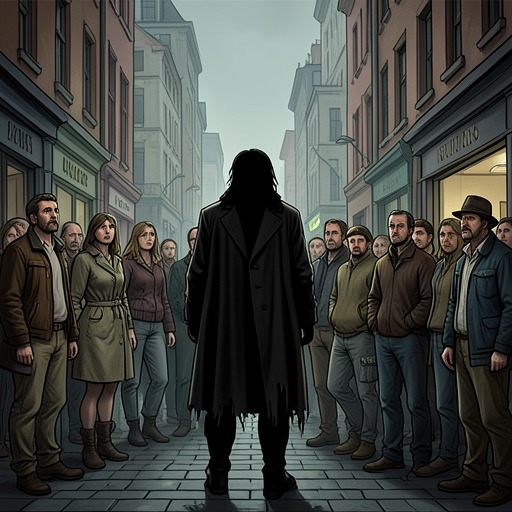
God Hates Fangs
A History of the Vampire in Popular CultureGod Hates Fangs is a slogan from True Blood that gives the series’ vampire politics an unmistakably civil-rights vocabulary. By echoing the language of religious denunciation and anti-gay protest, it transforms the vampire’s traditional status as a feared predator into that of a publicly stigmatized minority demanding recognition, protection, and equality. Its force lies in the tension between the slogan’s comic sharpness and the serious history of exclusion that it evokes.
Meaning and Cultural Context
In True Blood, vampires have spent centuries hiding from humans because they are feared as killers and potential targets. The arrival of Tru Blood, a synthetic blood substitute, allows them to live openly in small-town Louisiana and to claim that peaceful coexistence is possible. The slogan God Hates Fangs belongs to the hostile side of that public struggle: it marks vampires as morally contaminated and presents their existence as a social threat rather than simply a supernatural fact.
The phrase is paired with the expression coming out of the coffin, which adapts the language of coming out from LGBT+ civil-rights movements. Together, the two expressions establish a deliberate analogy. Vampires become a visible minority emerging from secrecy, while their opponents borrow the rhetoric of religious condemnation associated with campaigns against gay people. The analogy does not erase the danger posed by predatory vampires, but it makes the demand for equality inseparable from questions of fear, prejudice, and collective identity.
From Monster to Minority
The slogan depends on a long history in which vampires have been repeatedly reshaped by changing cultural expectations. Varney, first published in 1845 as a Penny Dreadful, helped establish recognizable features such as sharpened, fang-like teeth. Yet Varney was also made sympathetic: despite his murderous tendencies, he fought his animal instincts and eventually killed himself to escape his eternal fate. The vampire could therefore become both a monster and a figure trapped by an unwanted identity.
Carmilla, serialised from late 1871 to March 1872, developed another influential pattern. Its central vampire is emotionally and physically predatory, active at night and increasingly selective and elegant in the way she feeds. Carmilla was also openly attracted to women at a time when same-sex relationships were far from socially acceptable. The combination of erotic danger and social taboo gave the vampire a double function: the creature embodied both forbidden desire and the fear projected onto people whose identities violated dominant norms.
Later adaptations changed the visual and emotional register again. In Nosferatu, Count Orlok is threatening in appearance and manner, without the erotic glamour associated with later vampires. The film’s Expressionist darkness presents vampirism as menace, while its legal history reveals another kind of cultural struggle: after Stoker’s family succeeded in court, Prana-Film was ordered to destroy every copy, but one copy had already escaped abroad. Across these forms, the vampire moved between predator, outsider, forbidden lover, and contested cultural property. God Hates Fangs draws on that accumulated history while redirecting it toward public stigma.
The Slogan in True Blood
True Blood makes the metaphor explicit by presenting vampires who are out of the coffin and demanding equality. Its vampires are not merely hidden creatures waiting to attack; they are a community attempting to enter ordinary social and political life. The synthetic blood substitute offers a technological solution to feeding, but it does not settle the deeper question of whether humans can trust beings shaped by centuries of feeding, killing, and concealment.
The slogan’s sharpness comes from this unresolved contradiction. Vampires can present themselves as a persecuted population and still contain individuals who regard humans as prey. Sookie Stackhouse, a telepathic waitress who becomes romantically involved with Bill Compton, refuses to simplify that conflict. She is not prepared to be treated as a walking buffet, and her resistance prevents the civil-rights analogy from becoming a sentimental excuse for vampiric violence. Because she is unaffected by glamour and already suspicious of other people’s motives, she evaluates vampire claims of equality without surrendering her own safety.
The series therefore uses God Hates Fangs both critically and theatrically. The phrase makes prejudice visible, but its exaggerated wording also exposes the way moral campaigns turn complicated populations into symbolic enemies. Vampires are asked to prove that they can live peacefully, while humans are asked to confront the fear and hostility that helped keep them hidden. The slogan condenses that unequal burden into three memorable words.
Stigma, Outsiders, and Public Fear
The expression belongs to a wider pattern in which vampirism functions as a metaphor for outsiders and intruders: figures who fascinate people while also provoking suspicion. Stories about Liverpool, for example, connect vampire legends with public anxiety about immigrants arriving through the port’s docks. In a multicultural area such as Toxteth, legends and superstitions could arrive with each cargo ship, while social and ethnic groups became potential targets for scapegoating. God Hates Fangs operates within the same symbolic economy, but it gives the outsider a public voice and a political demand.
The comparison also illuminates the treatment of people who claim to be real vampires. Such communities may be mocked as eccentric, yet the evidence describes internal ethical rules: members feed from willing donors, test donated blood to reduce the spread of disease, support one another, and try to persuade wider society that their intentions are responsible. The community even contains distinctions between people drawn mainly to gothic fashion and blood drinkers who regard their practices as more serious. The gap between appearance and conduct complicates the easy assumption that visible strangeness proves danger.
A similar process of labelling appears in the history of horror-comics censorship. Fredric Wertham, despite his reputation as a forward-thinking psychiatrist who treated black patients at a mental-health clinic in Harlem, argued that horror comics caused juvenile delinquency. He cited the fact that 95 per cent of children in reform schools read horror comics as if it proved causation. The resulting public pressure helped produce the Comics Code Authority, whose arbitrary restrictions included the words zombie, crime, and terror and required criminals to be punished. As with the slogan’s anti-vampire rhetoric, the issue was not only the alleged threat but also the power to define a cultural form or population as dangerous.
From Demonisation to Self-Definition
The phrase’s historical importance within the book’s larger argument lies in its reversal of the vampire’s traditional position. Earlier stories and films often organise fear around the creature’s body: Varney’s fangs, Carmilla’s nocturnal predation, or Count Orlok’s threatening face. Modern portrayals increasingly allow vampires to be good as well as bad, to live among humans, and to become versions of whatever social or emotional identity a story requires. God Hates Fangs belongs to that later stage, when vampirism can represent not only death and appetite but also minority status, public visibility, and resistance to imposed shame.
That reversal parallels the emergence of goth culture in Britain in the early 1980s. Growing from post-punk clubs during political unrest and economic depression, goth developed from a musical genre into a culture with its own aesthetics, community, and heritage. Its practitioners’ relationship to vampire imagery is not simply decorative. Nadia van der Westhuizen describes goth as a safe space in which a person can be fully themselves, while makeup and clothing project an internal identity onto the exterior and create a “true” face. The vampire’s visual markers, once used to identify a monster, can thus become materials for chosen self-definition.
God Hates Fangs remains effective because it holds those transformations together without making them identical. The slogan recalls persecution, religious condemnation, and the fear of outsiders, yet it is attached to beings who may still be violent. It turns a familiar sign of monstrosity into a contested social label, preserving the old threat while asking who has the authority to name a population evil. In True Blood, the vampire’s movement out of secrecy is therefore not a simple march toward safety; it is a struggle over whether difference must remain hidden, assimilate, or claim equality on its own terms.