Gorbals Vampire incident
A History of the Vampire in Popular CultureThe Gorbals Vampire incident was a mass vampire hunt in Glasgow in September 1954, when hundreds of local children gathered in the Southern Necropolis after rumours spread that a vampire with iron teeth had killed two children and was seeking more victims. No such murders or disappearances had occurred that year, yet the belief generated a real public action: children brought stakes, knives, and even dogs into a neglected cemetery. The episode’s decisive consequence was not the discovery of a monster but the conversion of an unverified story into a national argument about children, horror comics, public order, and state censorship.
Rumour and Historical Setting
The incident belonged to a wider history in which fear of the dead supplied an explanation for diseases, unexplained deaths, and social instability. During the nineteenth-century vampire panic in New England, tuberculosis was interpreted by some communities as the dead returning to drain the life force of surviving relatives. Earlier, during the eighteenth-century vampire craze, villages in eastern Europe had exhumed and staked suspected vampires. In each case, limited medical knowledge made a supernatural account feel more manageable than an invisible disease or an apparently arbitrary sequence of deaths.
Glasgow in 1954 was also a society accustomed to treating printed stories as potential causes of social danger. The nineteenth century had combined industrial transformation with reports of witchcraft treated as fact, while the second Industrial Revolution made technological change appear almost magical. The Gorbals story therefore entered an already prepared cultural atmosphere: old supernatural motifs could be revived by modern newspapers, and childhood imagination could be interpreted as evidence of a wider crisis.
The Cemetery Hunt
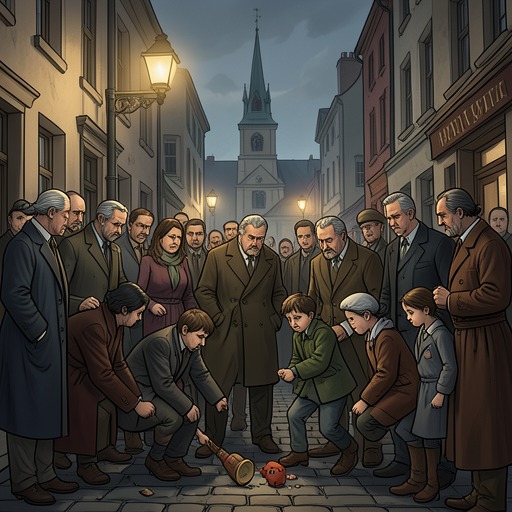
The immediate panic gathered force during the week before Thursday 23 September. Children began assembling at the Southern Necropolis, an unkempt and dilapidated cemetery containing nearly a quarter of a million graves. Their numbers were so great that police attempting to clear the grounds were overwhelmed. The hunters were not merely spectators: many carried weapons associated with vampire folklore, while some brought dogs, giving the gathering the appearance of an improvised expedition against a physical enemy.
The supposed threat was described as a vampire with iron teeth. The story claimed that it had already killed two local children and remained on the lookout for more victims, but the absence of factual reports did nothing to weaken the rumour. The event’s power lay in the distance between evidence and response. A danger with no confirmed victims nevertheless produced a crowd large enough to occupy a cemetery and require police intervention.
The Daily Mirror placed the incident on its front page on Saturday 25 September under the headline “AMAZING SCENE AS HUNDREDS OF CHILDREN STORM A CEMETERY,” adding the sub-header “The Toddlers Joined In.” Its reporter described walking through the cemetery as darkness fell while children clung to his coat and shouted, “Have you come to shoot him, Mister? Kill him, so we can sleep tonight!” The quotation preserved the children’s fear while also making the episode into dramatic national entertainment.
From Local Legend to Media Panic
Once the national press took up the story, imported horror comics became the preferred explanation. Dr H.S. Mackintosh, Glasgow’s Education Officer, argued that horror comics had gone beyond acceptable limits and called for government action. Local mothers were presented as sharing the anxiety; one reported that her seven-year-old son had returned home sobbing and begged that every window be closed because the vampire would get the family.
The Daily Mirror continued to amplify the issue. On 27 September it suggested that civic and welfare leaders might seek a ban on American horror comics, claiming that the publications were responsible for the hysteria. On 1 October, the newspaper reported that children had attacked a travelling family in a caravan by throwing stones and calling the occupants witches. A crowd reportedly reached about 300, and the incident broadened the panic from an imaginary cemetery monster to the persecution of living people marked as strange or suspect.
The suggested source of the legend was probably closer to Glasgow than the newspapers admitted. The Necropolis stood beside an ironworks known locally as Dixon’s Blazes, whose furnaces cast red light and smoke across the night sky. One boy later explained to the BBC that the smoke and red glow made the gravestones seem to leap and produced the impression of figures walking in the distance. The cemetery thus supplied the architecture of the Gothic scene, while industrial fire supplied its moving shadows and colour.
A second local source was Alexander Anderson’s 1879 poem “Jenny Wi’ the Iron Teeth,” which appeared on the Scottish primary-school curriculum. Children hunting the monster would have known its image of a threatening iron-toothed figure. The episode may therefore have grown from the collision of schoolroom folklore, industrial scenery, cemetery space, and the ordinary capacity of rumours to mutate as they pass from child to child. Its later attribution to comics was less a demonstrated origin than a convenient act of cultural blame.
Political Consequences and Censorship
The panic helped turn a brief local event into a legislative campaign. On Friday 1 October 1954, Alice Cullen, then the Member of Parliament for Glasgow’s Gorbals constituency, was reported as asking Home Secretary Sir David Maxwell Fyfe to introduce legislation banning the sale of horror comics in the United Kingdom. The request treated the children’s hunt as evidence of a dangerous media influence, even though the vampire itself had never been shown to exist and no child murders had been recorded.
A confidential memorandum sent on 25 November 1954 to the Home Office, the Secretary of State for Scotland, and the Minister for Education acknowledged a legal difficulty. Horror comics were not “obscene” under the existing law because the Obscene Publications Act 1857 generally applied that category to sexually explicit material. The memorandum nevertheless argued that such comics could be as harmful, or more harmful, to children and young persons, and that courts should receive comparable powers to restrict their circulation.
The argument culminated in the Children and Young Persons (Harmful Publications) Act 1955, which banned “horror comics.” The chronology made the connection plain: the law followed the 1954 incident and was brought in largely because of the political activity it stimulated. Samples were sent to Prime Minister Winston Churchill, including stories involving cowboys, private detectives, Frankenstein, and Captain Marvel; material that appears innocuous to modern readers was nevertheless judged unsuitable at the time.
The episode also formed part of a broader pattern in which comics were blamed for juvenile delinquency. Psychiatrist Fredric Wertham argued that horror comics were a root cause of criminal behaviour, reasoning from the claim that 95 per cent of children in reform schools read them to the conclusion that the comics taught children to become criminals. His testimony before the Senate Subcommittee on Juvenile Delinquency did not make comics the sole cause in the committee’s final report, but it encouraged the industry to police its content. The resulting Comics Code Authority restricted images and words, including “zombie,” “crime,” and “terror,” and required criminal conduct to receive punishment at the end of a story.
Meaning and Afterlife
The Gorbals Vampire incident shows how moral panic enlarges a weak signal into an institutional threat. The children’s gathering supplied the visible spectacle; newspapers supplied repetition and emotional framing; officials and campaigners supplied a policy remedy. The result was a feedback loop in which the alleged influence of horror comics was inferred from behaviour that the press itself was helping to dramatise. The scale of the response exceeded the evidence for the original danger.
The incident also reveals how vampire stories can become vessels for anxieties about outsiders. Liverpool’s many vampire legends are interpreted as possibly reflecting suspicion toward immigrants arriving through its docks, and the vampire often functions as a metaphor for fascinating yet distrusted intruders. The Gorbals panic similarly transformed uncertainty into an embodied enemy: children sought a figure with iron teeth rather than confronting the less theatrical conditions of urban fear, neglected spaces, sensational reporting, and adult anxiety about youth culture.
At the same time, the legend was not simply imposed by the press. The cemetery, the furnace glow, the poem taught at school, and the children’s own movement through the landscape gave it a local cultural life before national institutions attempted to explain it. The incident survived because it could be retold in several forms: as a frightening childhood memory, a newspaper spectacle, an argument for censorship, and evidence of the enduring ability of supernatural folklore to organize collective behaviour. In that sense, the Gorbals Vampire was never found, but the social machinery built around the search was entirely real.