Homosexuality
A History of the Vampire in Popular CultureHomosexuality is treated not as a supernatural condition but as a suppressed human desire whose legal and cultural history illuminates the vampire’s enduring association with secrecy, transgression, sexuality, and death. The book’s discussion moves from the nineteenth-century criminalization of male same-sex relationships to the openly queer predation of Carmilla, then onward to modern forms of vampire fiction and goth culture in which identities once coded as monstrous can become sources of community and self-definition.
Historical Constraint and Social Danger
In the world Bram Stoker inhabited, homosexuality was not merely stigmatized but exposed to direct legal punishment. Stoker witnessed his close friend Oscar Wilde brought down by the British legal system because of his sexual inclinations. The 1885 Criminal Amendment Act, expanded by the last-minute Labouchère Amendment, criminalized male homosexuality under the deliberately broad category of “gross indecency.” The law supplied no clear limits or contexts for interpretation, allowing a man to be accused and prosecuted on the suspicion of a third party, including an accuser with personal reasons to damage his reputation. Sexual identity therefore existed under the pressure of surveillance, accusation, social ostracism, and possible imprisonment.
Stoker’s personal circumstances made that pressure unusually immediate. His wife, Florence Balcombe, had previously been Oscar Wilde’s childhood sweetheart, yet Stoker remained in contact with Wilde throughout their adult lives and stood by him during his imprisonment and later self-imposed exile. Stoker was also described as having what would now be understood as crushes on other men. His long professional relationship with Henry Irving at the Lyceum Theatre was close, although the attachment appears to have been valued more deeply by Stoker than by Irving, who did not always treat him well. These relationships do not prove a single authorial intention for Dracula, but they place the novel within a life marked by same-sex intimacy, loyalty, constraint, and the danger of public exposure.
Stoker, Wilde, and Walt Whitman
The most conspicuous focus of Stoker’s affections was Walt Whitman, the American poet whose reputation was widely linked to homosexuality. That interpretation was reinforced by Leaves of Grass and by “I Sing the Body Electric,” poetry notable in the book’s account for its openness about sensual pleasure and the beauty of the human body. Stoker’s interest in Whitman is therefore presented as part of a broader pattern in which the author’s attraction to male figures coexisted uneasily with the moral language he publicly adopted.
That contradiction became especially stark in 1912, when Stoker declared that homosexual authors ought to be imprisoned. Some historians regard the statement as a smokescreen intended to conceal desires that remained illicit, though the book stresses that certainty is impossible. Stoker’s death in Pimlico on 20 April 1912 has likewise been read through this ambiguity. The registered cause included “locomotor ataxia, 6 months,” a condition involving loss of movement coordination that was often a polite medical designation for tertiary syphilis. Yet the evidence does not establish that syphilis caused his death: Stoker apparently retained the ability to write and manage paperwork almost until the end of his life, an ability that would be difficult to reconcile with the mental degeneration commonly associated with advanced infection.
Dracula and the Fantasy of Transgression
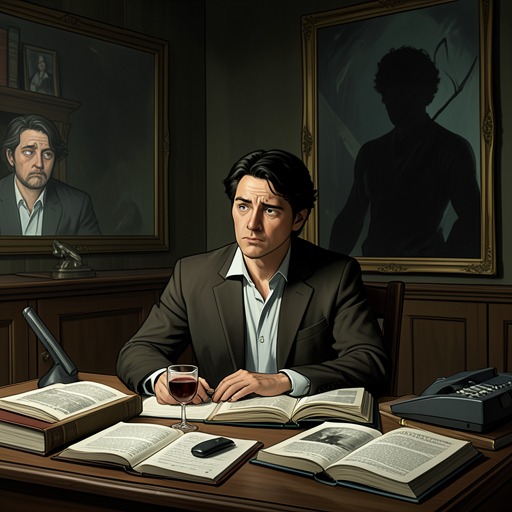
Against this background, Dracula can be read as a creation through which forbidden desires were displaced into supernatural form. The Count disregards polite society’s rules, pursues what he wants regardless of the victim’s gender, and brings bloodlust and sexuality into the same fictional space. His monstrous existence offers a fantasy of acting without the restraints that governed respectable Victorian identity. The book does not claim that Stoker consciously designed Dracula as a coded autobiography; instead, it argues that the novel’s freedom from fixed moral boundaries may have allowed desires to appear that could not safely be acknowledged in ordinary life.
This interpretation also clarifies why vampire fiction so often binds sexuality to death. Both sexual intimacy and killing involve the body, penetration, surrender, danger, and the crossing of boundaries, while guilt ordinarily helps regulate both private desire and public conduct. Fictional vampires can escape that guilt, at least temporarily. Their violence and eroticism become a controlled release for fantasies that would otherwise invite condemnation, particularly in cultures where departing from accepted sexual norms could lead to ostracism or death. Dracula’s moral structure accordingly remains unstable: the story presents a conflict between good and evil, but its sensual intensity repeatedly makes the distinction difficult to maintain.
Carmilla and the Queer Vampire
The connection between vampirism and same-sex desire becomes more explicit in Sheridan Le Fanu’s Carmilla, first serialized from late 1871 to March 1872. Carmilla is emotionally and physically predatory, sleeps through the day, prowls at night, and selects her victims with an increasingly refined style of feeding characteristic of nineteenth-century vampire fiction. Unlike the later image of the vampire as merely seductive or ambiguously erotic, Carmilla’s attraction to Laura is openly directed toward another woman, making desire itself part of the creature’s threat.
The narrative gives that transgression a distinctly social charge. Laura and her father encounter General Spielsdorf, whose account of the death of Laura’s friend Bertha links the tragedy to a young woman named Millarca. Her name is an anagram of Carmilla, and her arrival had closely resembled Carmilla’s own entrance into Laura’s household. The investigation identifies Millarca, Carmilla, and Mircalla as the same being; Baron Vordenburg eventually locates and destroys the vampire’s tomb near Karnstein. The plot thus converts female intimacy into evidence, investigation, and punishment, but it also allows Carmilla to possess a desire and an identity that nineteenth-century public culture rarely acknowledged openly.
Carmilla was therefore an openly gay woman in a period when lesbianism was far from socially acceptable. The book leaves uncertain whether the equation of girl-on-girl desire with evil was deliberate, but the ambiguity does not remove the effect. The vampire’s erotic power could horrify Victorian readers precisely because it placed female desire outside heterosexual control, while also titillating them through the same forbiddenness. Carmilla’s queerness is not an incidental decoration of the plot: it helps explain why her intimacy is represented simultaneously as seduction, danger, fascination, and moral violation.
From Monstrous Coding to Chosen Identity
The book’s later examples show that the association between homosexuality and vampirism does not remain fixed as a code for evil. Modern vampire fiction increasingly permits the supernatural figure to be sympathetic, ethically conflicted, openly queer, or simply different from traditional expectations. That widening imaginative freedom changes the function of the vampire: a body once used to mark forbidden desire as predatory can become a vehicle for exploring identity without requiring the character to be reduced to a villain. The movement is visible in the contrast between Carmilla’s nineteenth-century punishment and later representations that treat difference as a source of agency, intimacy, or community.
This shift does not eliminate the older machinery of stigma. The book compares the hierarchy within real vampire communities with the treatment of BDSM practitioners, whose desires have often been pathologized as abnormal before gaining limited public acceptance. Blood-drinking communities are described as regulating themselves through consent, tested donors, and mutual responsibility, while distinguishing serious practitioners from people who merely adopt gothic fashion. The comparison shows how a stigmatized identity may answer hostile labeling by developing its own ethical rules and collective language. What appears monstrous from outside can therefore be experienced internally as disciplined, social, and meaningful rather than chaotic or criminal.
Goth culture extends that process from fictional representation into visible social life. It emerged from post-punk clubs in northern England during the political unrest and economic depression of the early 1980s, first as a musical genre and then as a broader culture of music, literature, fashion, and aesthetics. Its attraction lies partly in transforming imagery associated with death, mourning, and the undead into a durable form of belonging. The culture’s continued vitality demonstrates that gothic self-presentation need not signify isolation or pathology; it can provide a shared language for people who feel themselves outside the heteronormative mainstream.
Dr Nadia van der Westhuizen describes that experience as an alternative position formed from childhood, while also emphasizing that a loving home and the ability to make friends prevented difference from becoming loneliness. She became involved in the goth scene while still young because its music, literature, aesthetics, and social life felt like a safe space in which she could be herself. For her, goth is not merely a style adopted from outside but a culture that connects people to their “tribe.” Her account gives social substance to the book’s larger movement from concealment to self-definition: identity is not only imposed by hostile observers but can also be claimed, performed, and shared by the people who live it.
That performative dimension is especially clear in clothing and makeup. Van der Westhuizen explains that even when practical work attire makes the appearance more subdued, elaborate makeup and clothing remain tied to her sense of self. She does not go out barefaced because the external image expresses an internal identity; the so-called “true” face is the one created through presentation. In this context, gothic styling reverses the older logic of the monster’s disguise. Instead of concealing forbidden difference beneath a respectable surface, the visible face makes an otherwise inward identity legible and turns the act of being seen into a form of belonging.
Sexuality, Otherness, and Cultural Power
The book also places homosexuality beside other identities that have been made suspicious through cultural narratives. Liverpool’s vampire legends, for example, are interpreted as possibly reflecting public anxiety about immigrants arriving through the city’s busy docks. Vampirism functions here as a metaphor for outsiders and intruders: figures who fascinate while provoking suspicion, especially in a multicultural port where unfamiliar customs and social groups continually enter public life. The comparison does not equate homosexuality with immigration, but it reveals a recurring structure in which the label of the vampire gathers fears about people perceived as refusing the dominant social order.
A similar process appears in the history of horror-comics censorship. Psychiatrist Fredric Wertham treated black patients in Harlem and was regarded as progressive on some racial questions, yet he argued that horror comics caused juvenile delinquency. His claim that 95 percent of children in reform schools read horror comics treated correlation as proof of causation and converted a medium into a suspected social contaminant. The resulting Comics Code Authority restricted words and images, including “zombie,” “crime,” and “terror,” and required criminals to receive punishment. The episode demonstrates how institutions create moral categories by presenting cultural forms as threats to vulnerable audiences, a logic that resembles the wider treatment of sexual and subcultural difference.
The persistence of that logic is shown by the prosecution of Mike Diana in 1994, when he became the first person convicted of “artistic obscenity” for writing and publishing Boiled Angel. He was fined and placed on three years’ probation, with a condition that he not draw cartoons. The Comic Book Legal Defense Fund, founded in 1986 to oppose censorship on free-speech grounds, lost the case but continued its campaign. Like the vampire’s repeated return from the coffin, disallowed images and identities reappear after institutional attempts to suppress them. The recurrence suggests that prohibition may regulate visibility without eliminating the desires, fears, or imaginative forms that produced the supposedly dangerous material in the first place.
Conclusion: From Stigma to Self-Definition
Across the book’s history, Homosexuality is not presented as a single fixed meaning but as a desire repeatedly forced to move between concealment, monstrosity, accusation, and self-possession. Stoker’s world made male same-sex intimacy legally dangerous; Carmilla transformed female desire into a source of supernatural terror; later vampire fiction, real vampire communities, and goth culture increasingly made room for identities that could be chosen, displayed, and organized on their own terms. The vampire remains a powerful figure because it can embody both the fear imposed by society on those marked as different and the fantasy of escaping that judgment. Its most enduring significance lies in this double movement: what begins as a story about forbidden bodies can become a language through which marginalized people recognize one another, construct ethical communities, and claim visibility without surrendering the complexity of desire.