Hungary
A History of the Vampire in Popular CultureHungary occupies a crucial place in the history of vampire belief because it appears not simply as a setting for supernatural stories, but as a site where unexplained death was converted into evidence of vampirism. Across the eighteenth and nineteenth centuries, reports associated with Hungary moved between village testimony, medical investigation, religious interpretation, literature, and newspapers, allowing the region to become one of the most durable sources of vampire authority and legend.
Disease, Death, and the Vampire Panic
In the nineteenth century, Hungary belonged to a wider eastern European region in which vampire explanations were attached to outbreaks of illness and successive deaths. The vampire panic in New England provides a parallel: tuberculosis, then known as consumption, spread rapidly through households, and families lacking modern medical knowledge imagined that the dead were returning to drain the life force of their surviving relatives. The same interpretive pressure operated in eastern Europe, where unexplained mortality made the dead into visible suspects and gave communities a target for fear.
The broader eighteenth-century vampire craze included village hunts, exhumations, and the staking of corpses believed to be dangerous. In 1731, thirteen deaths in rapid succession in a Serbian village produced precisely this kind of crisis. A doctor attributed the deaths to malnutrition, but residents rejected that explanation and insisted that vampires were responsible. Their certainty transformed burial grounds into investigative sites and persuaded officials to authorize procedures that would otherwise have appeared extraordinary.
Johann Flückinger’s later investigation made the Serbian outbreak especially influential because it was documented in detail. He and accompanying doctors and army officers reportedly found little decomposition in several bodies, together with apparently fresh blood in the mouths of some corpses and a plump appearance that seemed to contradict ordinary expectations about decay. His report treated vampirism as the only logical explanation for these abnormalities, helping turn local belief into an account that could circulate as official knowledge. Hungary therefore functioned within a larger regional network in which medical observation, military authority, and popular testimony reinforced rather than simply contradicted one another.
Reports from Hungary and the Problem of Evidence
A nineteenth-century newspaper story placed Hungary at the centre of a particularly dramatic vampire narrative. A reporter travelling there described waking in terror to find a cold, horrible creature pressing him down and attempting to fasten its mouth upon his throat. After the creature escaped through a window, the reporter was examined for puncture wounds and felt relieved when none were found. The episode was presented as an apparent personal encounter, but its authority depended on the surrounding claims of local witnesses and a landlord who insisted that similar attacks had already occurred.
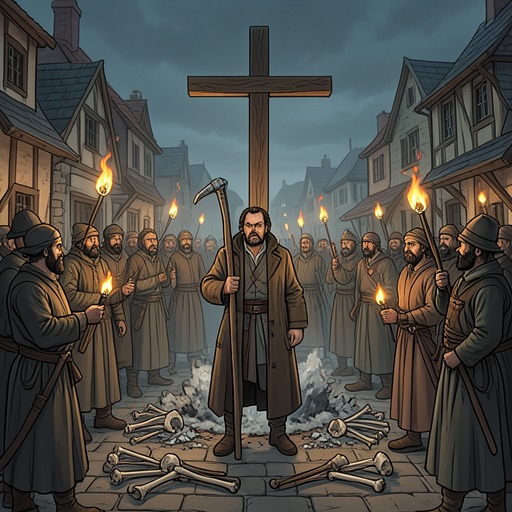
The same account led the reporter to a churchyard, where villagers were preparing to open the grave of Peter Dickowitz. Although Dickowitz had been dead for three weeks, residents claimed that he continued to harass the village. They also connected his death to his earlier assertion that he had survived a vampire attack, arguing that the only way to end the violence was to exhume suspected corpses and stake them through the heart. In this version of Hungary, the graveyard becomes both crime scene and courtroom: local men, the journalist, the corpse, and the vampire accusation all participate in a public trial of the dead.
The story was almost certainly fabricated or heavily adapted. Its details closely resemble the earlier Arnold Paole case, including the claim that Dickowitz had once cured himself by eating soil from his attacker’s grave and covering himself with blood. The report thus shows how Hungary could serve as a portable setting for recycled supernatural material. Newspapers could present foreign customs as evidence of uncivilized belief while simultaneously exploiting the sensational appeal of a supposedly witnessed vampire attack. The distant location gave the tale an exotic authority and protected it from immediate scrutiny.
Literary Hungary
Hungarian vampire reports also entered English-language literature. John William Polidori’s The Vampyre refers in its introduction to a supposedly credible account of vampirism in the Hungarian village of Madreyga, involving a man called Arnold Paul. Although the location differs from the Serbian episode documented by Flückinger, the resemblance makes clear that Polidori was drawing on that earlier account. Hungary therefore appears not only as a remembered place in folklore but as a literary resource from which the modern English-language vampire could be assembled.
The Vampyre, published in 1819, transformed this borrowed material into the figure of Lord Ruthven, who befriends Aubrey and attacks Aubrey’s closest relations. The publication was falsely attributed to Lord Byron, whose name increased its commercial and cultural force, but the story’s introduction still reveals the importance of Central and eastern European reports in shaping literary convention. The region’s alleged cases supplied an atmosphere of documentary credibility even as the narrative moved into aristocratic fiction.
Lord Byron had already invoked Hungarian and Greek vampire traditions in The Giaour, printed in 1813. His discussion described reports of foul feeders and referred to stories from Hungary and Greece as singular and supposedly well attested. This literary framing helped establish a recurring pattern: Hungary was treated as a place where superstition could be reported with the language of testimony, then repurposed by writers seeking to give the vampire an ancient, foreign, and unsettling genealogy.
Authority, Media, and Cultural Memory
The importance of Hungary lies partly in the instability of the authorities who speak about it. Villagers identified vampires through patterns of death and disturbances attributed to corpses; doctors offered explanations based on disease or malnutrition; military surgeons recorded bodily appearances; monks such as Augustin Calmet collected reports of revenants and vampires; and journalists dramatized alleged encounters for distant readers. None of these voices possessed uncontested control over meaning. Instead, the vampire emerged from their competition, as physical signs, religious assumptions, narrative habits, and institutional prestige were repeatedly combined.
The medical interpretation of corpses complicates the apparent evidence. Blood around the mouth or inside a body can be explained by purge fluid, produced as decomposing tissues break down and pressure forces dark red-black liquid through the mouth and nose. A body that appears insufficiently decomposed may have been preserved by cold, airtight burial, heavy clay soil, or reduced bacterial activity. Saponification can also produce adipocere, or corpse wax, leaving a body with wax-like features and an unexpectedly intact face. Such processes do not erase the historical reality of fear, but they show how ordinary post-mortem changes could be absorbed into a supernatural explanation.
Hungary consequently survives in vampire culture as both place and method. It denotes the imagined borderland where the dead might return, yet it also records the mechanisms by which communities interpret disaster: illness becomes attack, decay becomes proof, testimony becomes literature, and journalism turns repetition into apparent confirmation. Later readers inherit not a single verified event but a layered cultural memory in which Hungarian geography, Serbian investigations, literary adaptation, and sensational reporting have become inseparable from the modern idea of the vampire.