Interview with the Vampire
A History of the Vampire in Popular CultureInterview with the Vampire is significant because it makes the vampire’s inner life as important as the vampire’s appetite. Its central tragedy is not merely that Louis de Pointe du Lac becomes a blood-drinking immortal, but that the escape from death he seeks leaves him unable to escape grief. The narrative’s vampires are predators, companions, dependants, performers, and ethical failures at once; their immortality intensifies human suffering rather than curing it.
Origins and Cultural Position
Interview with the Vampire belongs to a historical development in which the vampire changed from a crude revenant into an articulate, emotionally complicated figure. Earlier works helped establish the modern vocabulary of the type: Varney the Vampire introduced familiar features such as sharpened, fang-like teeth and made its murderous protagonist unexpectedly sympathetic, while Carmilla refined the image of the elegant nocturnal predator. Bram Stoker’s Dracula then supplied the most influential model of the fully formed vampire: a personality with plans, desires, moral character, and a richly developed human conflict at its centre. Interview with the Vampire inherits that tradition but shifts its emphasis decisively inward, asking what eternal life feels like from the creature’s own perspective.
The novel’s placement within this tradition also matters because later popular culture increasingly permitted vampires to become almost anything. Modern vampires can be villains, heroes, lovers, outsiders, comic figures, or figures of social liberation rather than merely monsters to be destroyed. Interview with the Vampire is one of the works that made this flexibility possible. Its vampires remain dangerous, but their danger is inseparable from loneliness, attachment, self-loathing, and the need to construct a meaning for existence after ordinary human limits have disappeared.
Composition and Frame
Anne Rice wrote Interview with the Vampire after the death of her young daughter, and Claudia emerged as an immortal distraction shaped by that personal tragedy. This origin gives the story’s treatment of childhood, loss, and impossible continuation a particular weight. Claudia is not simply a frightening child vampire; she embodies the contradiction of a mind that develops while its body remains permanently prepubescent. The result is an image of grief made flesh: growth continues psychologically, but the body refuses the passage of time that would make ordinary development possible.
In the 1995 film adaptation directed by Neil Jordan, Louis is played by Brad Pitt and recounts his existence to the journalist Daniel Molloy, played by Christian Slater. Molloy is initially sceptical, so the interview establishes a tension between testimony and disbelief. Louis’s account is therefore both confession and performance: he presents the history of his transformation, his association with Lestat de Lioncourt, and the creation of Claudia while the listener tests whether such a story can be accepted as truth. The frame gives the vampire a voice without making that voice fully trustworthy or morally exculpatory.
Louis’s Transformation and Moral Conflict
Louis’s human life begins in catastrophe. At twenty-four, he is already a widower, and grief over the deaths of his wife and child has hollowed out the successful plantation he once managed. He deliberately courts danger because he hopes death will reunite him with the people he has lost. His desire for vampirism is therefore not a hunger for power or a romantic pursuit of endless youth. It is an attempt to turn death into an escape route.
Lestat identifies Louis as a potential ally and offers to transform him. Louis accepts because immortality appears to promise release from torment, but the bargain produces the opposite result. He cannot die as a human being and cannot rejoin the dead; instead, he is trapped in an eternity that preserves the very pain he wanted to end. The transformation converts grief from a finite human experience into a permanent condition, making undeath a prison built from the desire to escape mortality.
The relationship between Louis and Lestat is structured by unequal moral and emotional positions. Lestat possesses a bratty, privileged confidence and hides a desperate loneliness beneath it, while Louis retains enough empathy to feel repelled by attacking humans. Lestat has no comparable moral restriction. Their conflict is consequently a struggle over both survival and interpretation: Lestat treats vampiric existence as a fact to be embraced, whereas Louis continues to measure it against human ethical standards. The difference prevents Louis from becoming merely a glamorous predator, but it also leaves him unable to inhabit immortality without guilt.
Claudia and the Vampire Family
Louis’s moral hesitation reaches its most consequential point when he feeds from the orphaned Claudia in a moment of desperation. Lestat then transforms Claudia and presents her to Louis as a gift. The gesture appears to create a family, but its underlying purpose is political and coercive. Claudia is a pawn in Lestat’s effort to keep Louis beside him, a token used to bind his companion more tightly to their shared existence.
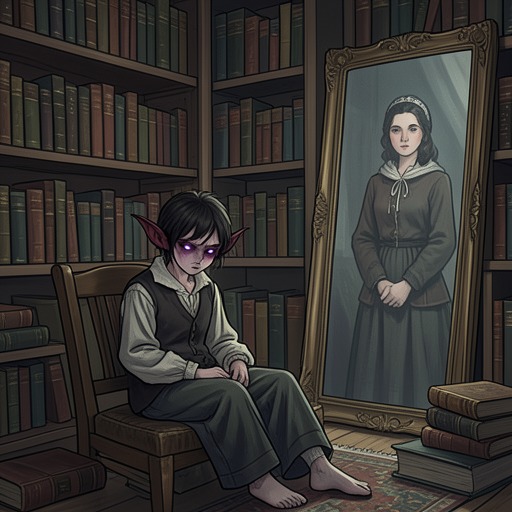
Claudia becomes the emotional and structural centre of the household’s collapse. Her mind matures while her body remains fixed in childhood, producing a disturbing mismatch between adult intelligence and prepubescent appearance. The story thus joins immortality to arrested development: the vampire body may be preserved, but preservation is not the same as freedom. Claudia can acquire knowledge, anger, and strategic purpose, yet she cannot acquire the physical form that would allow those qualities to be recognised without distortion.
This contradiction gives Interview with the Vampire its uneasy tone. Modern vampire fiction often makes vampirism inherently sexual, but Claudia’s adult consciousness inhabiting a child’s body disrupts that convention and exposes its ethical instability. Like Eli in Let the Right One In, Claudia is a walking dichotomy, an adult trapped within a child’s outward form. Her presence makes the vampire family more than a melodramatic household: it becomes a study of possession, dependency, and the violence of turning another person into a permanent instrument of one’s own emotional needs.
Gender, Sexuality, and Power
Interview with the Vampire participates in the wider tradition of using vampirism to represent forbidden desire and contested bodily power. The history of the form includes female figures such as Lamia, whose paranormal power is framed as evil, and Carmilla, whose emotional and physical predation is connected to a same-sex desire that nineteenth-century society treated as both threatening and titillating. Such representations reveal how vampire stories can make gender and sexuality visible precisely by placing them under the sign of monstrosity.
Rice’s narrative complicates that inherited pattern by allowing its vampires to speak at length about attachment, desire, and identity rather than leaving those matters to the fearful observations of human victims. Yet the distribution of power remains unstable. Lestat uses transformation as an instrument of control, Louis’s empathy becomes a source of suffering rather than authority, and Claudia’s intelligence grows inside a body over which she has no control. The household’s intimacies are therefore inseparable from coercion: love, companionship, instruction, and ownership repeatedly occupy the same space.
The film’s casting and production history also sharpen this tension. Kirsten Dunst was eleven when she played Claudia, an adult woman in a confused immortal child’s body, and she later described the required romantic physicality with Louis as uncomfortable because Brad Pitt seemed like an older brother to her. That discomfort is not incidental to the character’s function. It exposes the gap between the story’s supernatural premise and the ordinary ethical reactions that the premise cannot erase.
Adaptation and Continuing Influence
Neil Jordan’s 1995 film brought the narrative’s central conflict to a broad modern audience while preserving its emphasis on the vampire as a speaking, suffering subject. Louis remains the eponymous vampire whose account is received by Daniel Molloy, while Lestat becomes the charismatic force who converts grief into an endless dependency. The adaptation also makes Claudia’s presence central to the story’s discomfort, ensuring that the spectacle of immortal beauty never fully overwhelms the implications of bodily imprisonment.
The work’s influence can be understood against the many later directions taken by vampire culture. True Blood presents openly living vampires in Louisiana who seek equality after centuries of concealment, aided in theory by Tru Blood, a synthetic blood substitute. Twilight turns the human desire for transformation into Bella Swan’s willingness to risk her soul and life for Edward Cullen. Interview with the Vampire stands apart from both tendencies: its immortality is not a convenient identity or a glamorous romantic solution, but a condition that preserves moral injury, dependency, and loss.
The subject also proved adaptable beyond serious literary and cinematic drama. Vampires were later made into musicals, though Lestat, Elton John’s adaptation of Rice’s novel, was received with almost universal hostility and was described in reviews as undignified, stiff, soporific, and simply “Bloody Awful.” The failure of that stage version did not diminish the importance of the source narrative. Instead, it demonstrates how difficult the work’s mixture of eroticism, grief, philosophy, and predation is to transfer into a form that demands public spectacle and musical uplift.
Interview with the Vampire ultimately endures because it refuses to separate the vampire’s supernatural condition from ordinary human contradictions. Louis wants death and receives immortality; Lestat wants companionship and creates captivity; Claudia gains an adult mind but loses the possibility of an adult body. These reversals make the narrative a defining example of the modern ethical vampire: a predator whose tragedy is not that humanity has vanished, but that enough of it remains to make eternal life unbearable.