Laura
A History of the Vampire in Popular CultureLaura is the young woman at the centre of Sheridan Le Fanu’s Carmilla, where an apparently innocent friendship becomes an encounter with a predatory vampire. Her importance lies in the way the story makes her both witness and threatened participant: Carmilla’s attraction to her is emotionally charged, physically dangerous, and inseparable from the older vampire’s assumed identities. Through Laura, the vampire tale becomes a drama of intimacy, recognition, and violation rather than merely a story about a monster attacking from outside.
Identity and Introduction
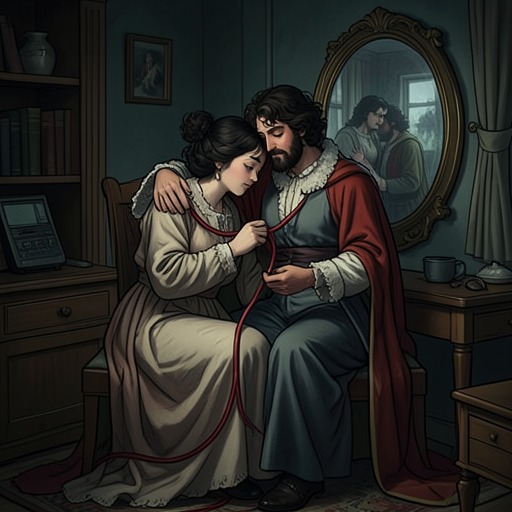
Laura lives with her father in a household that is welcoming but vulnerable to deception. Carmilla arrives as a young woman who needs somewhere to stay, and Laura’s family, described as kindly though rather gullible, has no real understanding of their lodger’s background. Laura nevertheless does not meet Carmilla as a complete stranger. The two young women recognise one another immediately because each has previously encountered the other in a childhood dream. That shared dream gives their relationship an atmosphere of romantically entwined fate before either woman can understand what the recognition means.
Laura’s position is further complicated by an inherited image. A portrait returned from restoration depicts her ancestor Mircalla, whose appearance closely resembles Carmilla’s. The painting turns resemblance into evidence without yet making the evidence intelligible. Laura is therefore surrounded by signs of continuity between past and present: the dream links their childhoods, while the portrait links Carmilla to Laura’s family history. The vampire’s approach is not presented as a random assault but as a return disguised as companionship.
Life Under Carmilla’s Influence
Carmilla is an unusually demanding guest, and Laura is the person most directly exposed to her habits. Carmilla sleeps through the day, spends the night apparently sleepwalking, and occasionally makes romantic overtures toward Laura. She also refuses to join the family in prayer, a conspicuous violation of early nineteenth-century religious expectations and a warning that Laura’s household does not know how to interpret. Laura’s gratitude for Carmilla’s companionship is heightened by the mysterious death of her closest friend, leaving her emotionally receptive to the new relationship even as the circumstances surrounding it become increasingly disturbing.
The structure of Laura’s experience follows the characteristic pattern of vampire fiction: attraction precedes recognition, and recognition arrives only after bodily and social danger has already taken hold. Carmilla’s intimacy does not simply oppose Laura’s domestic world; it enters that world as care, attention, and companionship. Laura is consequently placed in the difficult position of responding to a person who appears emotionally close while remaining fundamentally unreadable. The story’s terror grows from that contradiction rather than from Carmilla’s mere appearance.
Laura and her father eventually travel without Carmilla, who is asleep when they leave because it is daytime. They meet General Spielsdorf, the uncle of Laura’s deceased friend Bertha, and hear the circumstances of Bertha’s death. Before dying, Bertha had befriended a young woman called Millarca. Millarca had appeared under circumstances almost identical to those of Carmilla’s arrival, and her name is an anagram of Carmilla. Laura’s private experience is thereby connected to a repeated predatory pattern: the companion who has entered her life has already entered another young woman’s life under another name.
Recognition and the Destruction of Mircalla
The testimony about Bertha allows Laura, her father, and General Spielsdorf to understand that Carmilla, Millarca, and Mircalla are the same person. The portrait, the anagram, the similar circumstances of arrival, and the deaths of the young women converge into an explanation. Laura’s role changes at this point from isolated companion to member of a group pursuing a shared threat. The party travels to nearby Karnstein to find Mircalla’s tomb so that the vampire can finally be destroyed.
Carmilla does not surrender her hold over the situation simply because her identities have been exposed. When she appears while General Spielsdorf and Laura are alone, she flies into a rage and again avoids the General’s attempts to kill her. The scene preserves the asymmetry that has defined Laura’s relationship with her: Laura has been drawn into Carmilla’s sphere, but Carmilla retains the initiative, the mobility, and the power to decide when the confrontation will occur.
The final destruction is carried out by Baron Vordenburg, who destroys the vampiric Mircalla. Laura is therefore not the agent who kills her attacker, but the person through whom the threat has been emotionally and narratively registered. The ending restores a measure of order by identifying and destroying the vampire, yet it cannot erase the disturbing fact that the danger arrived through affection and recognition. Laura’s experience gives the resolution its cost: the revelation of Carmilla’s true identity also transforms a treasured companionship into evidence of predation.
Relationships and Thematic Significance
Laura and Carmilla form one of vampire fiction’s most influential pairings because their relationship combines emotional closeness with feeding and danger. Carmilla’s romantic overtures make desire part of the vampire’s method of approach, while Laura’s appreciation of her companionship prevents the relationship from being reduced to a simple contest between good and evil. Laura is not merely pursued by a creature who looks frightening; she is drawn toward someone whose apparent tenderness and historical identity conceal violence.
The story’s treatment of Laura also reflects the social pressures surrounding same-sex desire in the nineteenth century. Carmilla is described as an openly gay woman long before lesbianism was regularly acknowledged in public, and the account notes that same-sex relationships were far from socially acceptable during the period. Her predatory sexuality could therefore horrify and titillate Victorian readers at once. Laura’s proximity to Carmilla makes her the point at which forbidden intimacy, fear, and cultural fascination meet, even though the evidence does not present Laura herself as a deliberate rebel against social norms.
Laura’s narrative function extends beyond her individual fate. Her story belongs to the nineteenth-century transformation of the vampire from the ugly revenant of older folklore into an elegant, selective, and sexually charged figure. Earlier tales describe creatures such as Lamia, Astryiah, the impundulu, and the revenant as blood-drinking beings shaped by local beliefs, religious explanations, and fear of unexplained death. In Carmilla, the threat has become more intimate: it sleeps by day, moves through a household at night, chooses companions, and uses emotional attachment as part of its predation. Laura is the human figure who makes that transformation legible.
Her position also anticipates later vampire narratives in which outsiders may become sympathetic, desirable, openly present, or even morally acceptable. The broader tradition moves from the sharpened teeth and enormous serial scale of Varney the Vampire, through the threatening and non-erotic Count Orlok of Nosferatu, toward modern vampires who can be good as well as bad. Laura remains anchored in the earlier Gothic pattern, where attraction and danger cannot be safely separated. Her story endures because the vampire is defeated, but the intimacy that enabled the threat remains the most memorable part of the encounter.