Lily Munster
A History of the Vampire in Popular CultureLily Munster is the vampire wife and mother at the center of The Munsters, the 1964–1966 television comedy that made a family of recognizable monsters into a suburban household. She is important not because the series explains vampirism in elaborate supernatural terms, but because it places an unmistakable vampire inside the routines, loyalties, frustrations, and assumptions of an American family. Lily’s presence converts the vampire from a solitary predator or aristocratic outsider into a working-class homemaker who believes that she and her relatives are normal.
Identity and Appearance
Lily is explicitly a vampire, and her appearance draws on the visual language established by the Universal monster films. The Munsters’ writers could use those designs because Universal owned the franchise, allowing Lily to be dressed in the familiar style associated with cinematic vampires. Her identity is therefore immediately legible: she belongs to a tradition of dark clothing, supernatural ancestry, and horror imagery rather than merely resembling an eccentric human woman.
That clarity distinguishes Lily from Morticia Addams, whose paranormal background and powers are never explained. The Addams Family leaves open the possibility that Morticia is simply a glamorous woman with an intensely Gothic taste in clothes, whereas Lily’s vampirism is part of the settled fact of her family life. The series does not make her mysterious by withholding what she is. Instead, it makes her comic by showing how little her undead identity seems to matter to her sense of everyday normality.
Domestic Life and Family Role
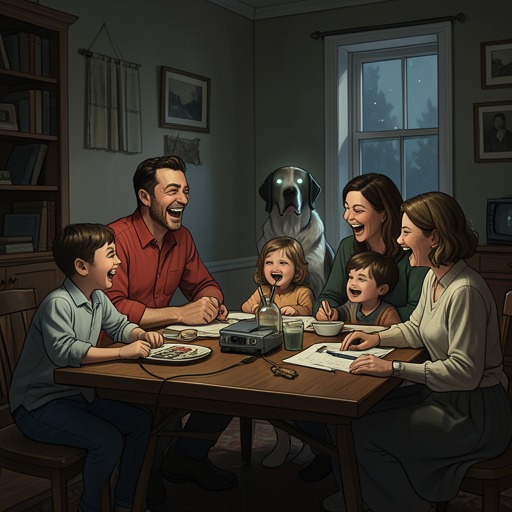
Undead or not, Lily is presented first as a working-class wife and mother. She loves her family even when they drive her mad, and she adores her bumbling husband, Herman Munster. Her marriage is not treated as a gothic seduction or a tragic encounter between predator and victim; it is a domestic partnership shaped by affection, irritation, and the ordinary pressures of family life. The supernatural is folded into the household rather than allowed to replace its emotional structure.
Lily is also the daughter of Grandpa Munster, whose full name is Count Vladimir Dracula, or Sam to his friends. His family history is comically extravagant: he has fallen for a succession of mortal women, married 167 times, and remains proud that he is still friends with all of them. Lily’s own childhood is correspondingly presented through grotesque domestic abundance. She once describes having a whole mausoleum full of brothers and sisters to play with, turning the cemetery into the equivalent of a crowded family home and making death culture part of a child’s familiar background.
Her relation to Herman and Grandpa gives Lily two connected forms of authority. She is the stabilizing spouse within her immediate household, but she also belongs to an older vampire lineage represented by Grandpa. The family’s history is bizarre by human standards, yet Lily does not use it to claim aristocratic superiority. The Munsters’ immortality and ancestry are simply inherited circumstances within a family that still has to live together.
Normality and Otherness
The central irony of Lily’s character is that she does not understand herself as monstrous. The Munsters are convinced that they are an average family trying to get by. Their neighbors’ surprised reactions do not lead them to recognize themselves as supernatural outsiders; at most, those reactions leave them slightly confused. Lily’s confidence in her own normality is therefore not a disguise. It is the family’s genuine social perspective.
This reversal changes the usual direction of the vampire story. Traditional vampires are often defined through secrecy, predation, and the fear that an apparently civilized figure conceals a dangerous nature. In The Munsters, the danger is displaced by domestic comedy. Lily’s vampirism remains visible, but the emotional center of the character is tolerance and attachment rather than concealment. The real social problem is not that the family sees itself as different, but that other people insist on interpreting its appearance as evidence of abnormality.
The family’s outsider status also intersects with social prejudice. Grandpa is sometimes discriminated against, but the immediate reason is generally his immigrant background rather than fear of the occult. Meanwhile, Marilyn Munster, Lily’s human niece, believes that she is the freak of the family because she lacks any paranormal quality. Lily’s household thus reverses the conventional meaning of the monster: the visibly supernatural relatives feel included, while the ordinary human becomes the anomalous member.
Comic Reworking of the Vampire
Lily’s characterization belongs to a broader transformation in vampire fiction. Earlier literary vampires established a progression from the revenant and bloodsucker toward increasingly recognizable modern forms. Varney introduced sharpened, fang-like teeth and was given a surprisingly sympathetic inner struggle; Carmilla developed the elegant nocturnal predator; and Dracula became the fully rounded vampire with plans, personality, and moral purpose. Film then reshaped the type again. Count Orlok in Nosferatu was threatening and non-erotic, while Bela Lugosi’s Dracula fixed the image of the suave classic vampire for mass audiences.
Lily inherits that visual history but changes its function. The old signs of monstrosity become part of a television family’s identity rather than the equipment of an isolated villain. Her vampire status is neither denied nor explained away. It is made compatible with marriage, motherhood, embarrassment, loyalty, and the conviction that one’s relatives are fundamentally kind. That mixture makes her a comic example of the later freedom of vampire fiction, in which vampires can be villains, sympathetic figures, or members of a family that regards itself as unremarkable.
The series also anticipates the continuing cultural movement of the vampire away from a single fixed model. Later portrayals would make vampires openly social, ethically conflicted, romantic, or even ordinary, while the Goth subculture would carry vampire and mourning imagery into music, fashion, and everyday self-presentation. Lily is an earlier television version of that same expansion: she preserves the recognizable silhouette of the vampire while relocating its meaning from solitary horror to communal identity.
Narrative and Thematic Significance
Lily’s decisive narrative role is to make the supernatural domestic. Through her, vampirism becomes a condition of family belonging rather than merely a threat to human life. The character does not need a transformation arc, a cure, or a final defeat. Her stability is the point. She remains a vampire, a wife, and a mother at the same time, and the comedy arises from the fact that these categories coexist without seeming contradictory to her.
Her family’s belief that they are normal also gives The Munsters its larger social critique. The household is loving and tolerant toward people who do not fit in, even as its own members are judged by their appearance and background. Lily therefore embodies a reversal of the monster metaphor: the supposedly frightening family displays ordinary forms of care, while the surrounding society supplies the pressure to categorize and exclude. In that sense, her black dresses, vampire ancestry, and mausoleum childhood are less important than the domestic ethics they contain. Lily Munster makes the vampire recognizable not by making her human, but by showing that monstrosity and family normality can occupy the same home.