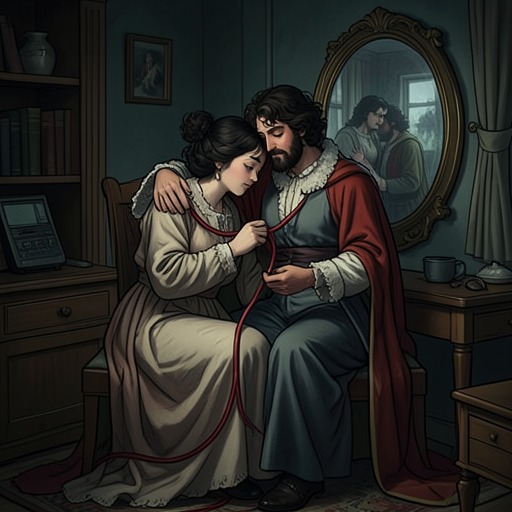
Miriam Blaylock
A History of the Vampire in Popular CultureMiriam Blaylock is the elder vampire at the center of The Hunger, a figure whose immaculate beauty masks an existence governed by appetite and control. In The Hunger, vampirism is never named, yet the film identifies Miriam through its night-bound predators, its blood exchanges, and its vision of immortality as a fate worse than death. She offers eternal life to companions, but what she actually grants is continued existence without any guarantee of youth, freedom, or release.
Identity and Appearance
Miriam is presented as an ancient, manipulative vampire whose elegance is inseparable from her danger. She moves through the film as a glamorous predator, accompanied by John, an eighteenth-century cellist whom she has made her companion and lover. Her beauty gives her power over those around her, allowing predation to appear at first as intimacy and transformation to resemble a gift. The attraction is deliberately double-edged: Miriam is ethereally beautiful, but her beauty conceals an instinctive creature that has used human beings for centuries as both nourishment and company.
Her world is nocturnal and aristocratic rather than monstrous in the traditional sense. The Hunger opens with Miriam and John stalking victims in a nightclub, while Bauhaus performs Bela Lugosi’s Dead on a large screen. The setting establishes Miriam as part of a modern gothic culture of music, fashion, eroticism, and death, but it also places her within an older pattern. Like the elegant night creatures that emerged in nineteenth-century vampire fiction, she sleeps by day, hunts selectively, and feeds with calculated intimacy rather than open savagery.
Immortality and the Horror of Decay
Miriam’s central promise is eternal life, but her method exposes the instability of that promise. John has been told that he will live forever beside her, and in one literal sense she has not deceived him: he does possess eternal life. What he lacks is eternal youth. After two hundred years of glamorous undeath, he begins to age decades within a matter of days. His body enters a rapid and irreversible decline, transforming the fantasy of immortality into a spectacle of helpless deterioration.
John responds by killing and feeding in a desperate effort to halt the process, but neither violence nor blood can restore him. He seeks advice from Sarah Roberts, a leading gerontologist, but is rebuffed; he then begs Miriam to kill him so that the process can end. Her refusal reveals the cruelty embedded in her system. Miriam does not merely create companions and lose interest in them. She binds them to an existence from which they cannot escape, then treats their suffering as an unavoidable inconvenience of her own survival.
Instead of granting John the death he requests, Miriam places him in one of the coffins in her attic. The coffins contain her previous lovers, whose cries for true death continue while she leaves them behind. Their condition gives material form to the film’s most severe idea: undeath is not life extended indefinitely, but awareness trapped inside a body that has lost the possibility of renewal. Miriam’s lovers are not simply dead companions. They are abandoned remains of her appetite, preserved as witnesses to the cost of her immortality.
Relationships and Predation
Miriam’s relationship with John combines affection, possession, and exploitation. He is her companion and lover, but he is also a dependent whose continued existence is structured by her power. She has promised him eternity and supplies the knowledge and blood economy by which he survives, yet she withholds the only mercy he finally wants. Even her tears when she entombs him do not amount to moral recognition. Her sadness is pragmatic and habitual, the grief of a predator moving on to the next source of sustenance.
Her relationship with Sarah follows the same pattern but introduces a reversal. After recognising that something is terribly wrong with John, Sarah returns to Miriam’s apartment and is seduced by her. Miriam feeds from Sarah before Sarah understands what is happening, while Sarah apparently takes some of Miriam’s blood in return. When Sarah later demands an explanation, Miriam presents the exchange as an act of generosity, claiming to have given her everlasting life. The offer repeats Miriam’s familiar strategy: desire is awakened first, and the consequences of transformation are disclosed only afterward.
Miriam intends Sarah to replace John as her companion. Sarah is therefore not merely another victim but the next link in a succession through which Miriam preserves herself. The pattern resembles an inheritance, yet it is an inheritance of domination rather than care. The older vampire survives by passing the burden of her condition to another person, and each new companion is positioned to become both intimate partner and future discarded body.
Sarah’s Reversal and Miriam’s Ending
Sarah eventually outplays Miriam. Instead of remaining the passive recipient of the older vampire’s promise, she forces Miriam to swallow Sarah’s blood, reversing the expected direction of the feeding. Miriam is then attacked by her own victims, who have begun to rise from their tombs. As she falls, she ages through the centuries that had remained missing from her body, undergoing at once the accumulated time she had imposed on others and the decay she had denied herself.
The ending completes Miriam’s logic through visual repetition. A large draped box, conveniently coffin-sized, stands behind a mesh screen while Sarah looks out over the city from her balcony. Miriam’s voice screams Sarah’s name from inside the box. The predator who had placed John and her former lovers into enclosed spaces is now confined herself, and the voice that once controlled the fate of companions has become an unanswered cry. Her immortality ends not as liberation but as entombment, echoing the fate she repeatedly inflicted on others.
Sarah already has a young female companion beside her while Miriam’s cries continue from the tomb. The bloody succession has therefore not been broken completely. Miriam has been defeated, but the structure she created survives in altered form: one vampire replaces another, one companion becomes the next possible source of life, and the promise of survival remains entangled with the sacrifice of someone else.
Narrative and Thematic Significance
Miriam embodies The Hunger’s interpretation of vampirism as a system in which an alpha figure sacrifices others in order to continue living. The film passes the bloody baton from one vampire to the next, presenting predation as both intimate and institutional. Miriam does not need open domination at every moment because beauty, erotic attention, and the promise of eternity make submission appear voluntary. Her victims enter the relationship seeking love, companionship, or transcendence, only to discover that the terms have been controlled from the beginning.
Her sexuality is therefore inseparable from her violence. The encounter with Sarah is carefully staged as sensual rather than merely sensational: Miriam plays the Flower Duet from Lakmé at the piano while the women move toward the bedroom, and the languorous movements and soft-focus curtains lull the viewer into expecting romance. The musical atmosphere changes only gradually, with a low pulse signalling that the scene’s tenderness is becoming predation. Miriam feeds before Sarah understands the danger, making erotic surrender and bodily violation part of the same choreography.
The scene also gives Miriam a form of agency rarely granted to female vampires in older traditions. She is as animalistically seductive and deadly as any male predator, yet the characters are strongly written and acted rather than reduced entirely to spectacle. Even so, her apparent liberation from conventional gender roles does not produce an ethical alternative. Miriam is powerful because she refuses ordinary moral limits, but her power is organised around using others as food, lovers, replacements, and containers for the suffering she will not bear herself.
The film was criticised on release for its slow pace and thin plot, but its gothic atmosphere helped it acquire a cult following. Miriam is central to that endurance. She unites the pale, languorous beauty audiences expect from a modern vampire with a much harsher conception of immortality, in which centuries do not produce wisdom or moral development. They produce repetition. Miriam continues to feed, seduce, transform, and discard until the abandoned victims return to reverse the pattern. Her final imprisonment makes the consequence unmistakable: the beautiful promise of eternal life is also a machinery of eternal hunger.