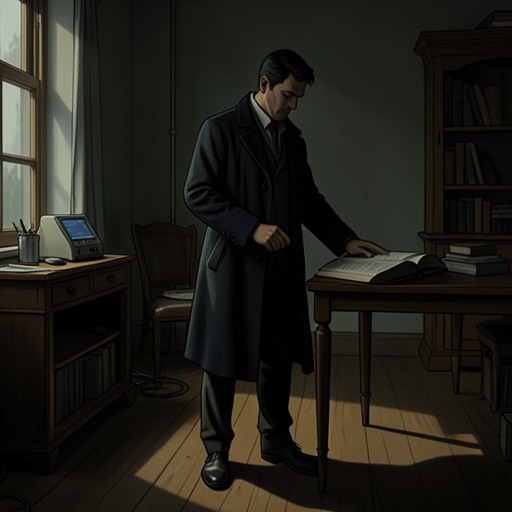
Mitchell–Herrick relationship
A History of the Vampire in Popular CultureThe Mitchell–Herrick relationship is the central vampire bond in Being Human’s account of inherited violence and moral responsibility. Herrick is the vampire who made Mitchell on a battlefield, giving their connection the structure of maker and created, but Mitchell’s attempt to live ethically turns that structure into a source of shame, loyalty, and conflict. Although Mitchell rejects Herrick’s values, he cannot entirely sever himself from the vampire who created him.
Origin and Asymmetry
Herrick’s role in Mitchell’s afterlife is defined by the verb “made”: he is the origin of Mitchell’s vampirism and therefore the figure through whom Mitchell’s past violence remains present. The relationship is unequal from the beginning, because Herrick possesses the authority of the maker while Mitchell bears the consequences of having been made. Mitchell has spent much of his afterlife killing people, and his effort to reclaim his humanity is inseparable from the legacy established by Herrick.
That history gives Herrick more than the function of a remote backstory. He represents the model of vampirine existence from which Mitchell is trying to escape: feeding as instinct, killing as inevitability, and moral resistance as pointless self-denial. Mitchell’s attachment to him therefore persists beneath the surface of hatred. The bond is not sentimental; it is the durable dependence created by violence and origin.
Mitchell’s Rejection of Herrick’s Code
Mitchell attempts to remain on the side of good while struggling against what the series presents as an addictive animal impulse in vampire blood. His friendship with George Sands and Annie Sawyer becomes his link to humanity, and together they learn how to “be human.” Herrick stands opposite that project. He embodies the possibility that Mitchell could abandon restraint and accept the easiest version of his afterlife: feeding freely and treating human deaths as unavoidable.
The conflict becomes explicit when Mitchell prevents Seth from feeding on patients at the hospital. Seth insists that Mitchell cannot stop because feeding is what vampires are. That claim echoes the logic associated with Herrick, but Mitchell’s resistance shows that he refuses to treat his nature as a complete moral explanation. His relationship with Herrick is consequently also a struggle over whether origin determines conduct.
Repetition Through Lauren
Mitchell reproduces Herrick’s violence when he turns Lauren at the beginning of the story. During a one-night stand that goes disastrously wrong, he bites her and leaves her to awaken among strangers. Lauren’s accusation, “It should have been you,” makes the ethical structure of the act unmistakable: Mitchell has imposed vampirism on another person while avoiding the fate he inflicted.
Lauren’s transformation is not presented as a simple descent into villainy. She remains bubbly, fun-loving, and energetic, but her new existence carries panic and malice. Her reckless behavior grows from fear of what she has become and from the way Mitchell abandoned her. The contrast between Herrick “making” Mitchell and Lauren’s description of Mitchell as having “took” her is crucial. The first phrase suggests a vampire origin; the second conveys a brutal sexual violation. Mitchell’s relationship with Herrick thus returns in altered form through Lauren, revealing that his rejection of Herrick’s principles has not prevented him from reenacting the maker’s power.
Loyalty, Captivity, and the Unresolved Bond
Mitchell outwardly hates Herrick and everything he represents, yet he cannot bring himself to leave his maker when Herrick is in need. This divided response culminates in Mitchell keeping a deranged Herrick in the loft, where the older vampire becomes a murderous and deeply troublesome presence. The domestic setting does not neutralize the danger. Instead, it turns the creator–created relationship into an intimate captivity in which care, control, resentment, and obligation occupy the same space.
Mitchell’s decision to keep Herrick close shows that moral opposition does not produce emotional freedom. He wants to define himself against his maker, but his continued care for Herrick suggests that the bond remains part of his identity. Herrick is simultaneously the source of Mitchell’s guilt, the embodiment of the life he rejects, and the dependent figure Mitchell refuses to abandon.
Narrative Significance
The relationship gives Being Human its clearest image of vampirism as addiction rather than merely immoral indulgence. Mitchell’s struggle is not solved by declaring himself different from Herrick; every attempt to be good is tested by past killings, present cravings, and the damage he causes to Lauren. Herrick’s influence operates as both direct history and recurring pattern.
Their bond also complicates the series’ distinction between good and evil. Mitchell believes himself morally better than Herrick, but his treatment of Lauren proves that he can commit comparable harm. At the same time, his remorse and effort to preserve human moral boundaries prevent him from collapsing entirely into Herrick’s model. The Mitchell–Herrick relationship therefore presents vampirism as an inheritance that can be resisted but not easily disowned: the maker creates the condition, while the created must decide what responsibility remains possible within it.