Moral panic
A History of the Vampire in Popular CultureMoral panic names a social process in which fear outruns evidence and turns an ambiguous danger into a public enemy. In the book’s vampire history, the process repeatedly joins an alleged threat, a vulnerable population, an amplifying medium, and an institutional response: children become hunters, newspapers convert rumours into national drama, politicians demand new powers, and communities project anxieties about disease, sexuality, migration, or cultural change onto figures marked as monstrous.
Definition and Historical Conditions
Moral panic flourishes when established explanations no longer seem sufficient. The nineteenth century combined rapid technological and social change with intense curiosity about spiritualism, witchcraft, and the supernatural. The second Industrial Revolution transformed daily life so quickly that new technologies could appear magical, while older religious beliefs remained a source of stability. Victorian culture therefore held together industrial discovery and credulity, prim delicacy and delight in the macabre; newspapers could report witchcraft as fact even as modern knowledge was expanding.
Disease made this uncertainty especially acute. During the nineteenth-century New England vampire panic, tuberculosis spread rapidly through households, yet its causes and transmission were poorly understood by the public. Because the illness seemed to consume a victim’s health and then appear among surviving relatives, communities imagined that the dead were returning to drain the life force of the living. Earlier stories about women killing babies and children may likewise have absorbed experiences that would now be associated with sudden infant death syndrome or malnutrition. A child could be put to bed apparently healthy and found dead the next morning, leaving bereaved parents to seek a supernatural cause in a world where religion often explained what science could not.
The same pattern appeared in early modern Europe. During the eighteenth-century vampire craze, entire villages dug up corpses and staked them after a succession of deaths. In 1731, thirteen people died in one Serbian village, and residents rejected a doctor’s explanation that malnutrition was responsible. They insisted that vampires had attacked the community, persuading officials to exhume suspected bodies. Johann Flückinger and accompanying witnesses found corpses that showed little decomposition and appeared plump, observations that strengthened rather than dissolved the local interpretation. The physical condition of the bodies became evidence within the panic’s own logic.
The Gorbals Vampire and Media Amplification
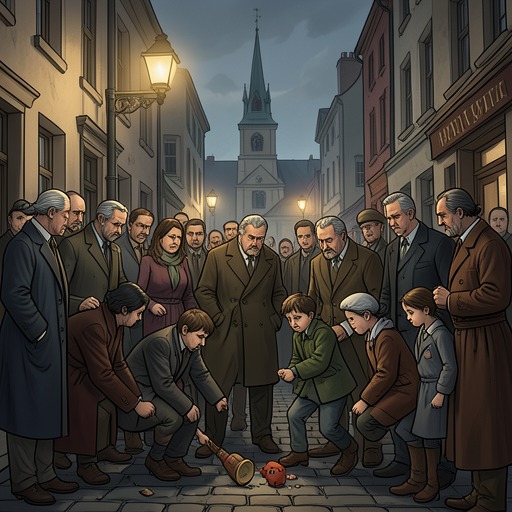
The Gorbals Vampire incident shows how a small, unsupported rumour could become a national controversy. In September 1954, hundreds of children gathered at Glasgow’s Southern Necropolis after hearing that a vampire with iron teeth had killed two children and was still hunting for more. There had been no reports of child murders or disappearances that year, but the absence of factual support did not prevent the story from mobilising fear. Children arrived carrying stakes and knives, some accompanied by dogs, while police struggled to clear the dilapidated cemetery, which contained nearly a quarter of a million graves.
The Daily Mirror transformed the episode into spectacle. Its 25 September front page announced an “AMAZING SCENE AS HUNDREDS OF CHILDREN STORM A CEMETERY,” while its subheading, “The Toddlers Joined In,” made the scale of the excitement part of the story. The report’s description of children clinging to a journalist and demanding that the vampire be killed so they could sleep gave the rumour an emotional immediacy that ordinary denials could not match. The newspaper simultaneously dismissed the story as foolish and heightened its drama, an important contradiction in the mechanics of panic.
Once national coverage began, imported horror comics were identified as the cause. Dr H. S. Mackintosh, Glasgow’s Education Officer, argued that horror comics had exceeded acceptable limits and called for government action. Mothers’ testimony supplied a domestic image of the supposed danger: one seven-year-old, frightened by the vampire, reportedly begged for every window to be closed. By 27 September, the Daily Mirror was asking whether horror comics should be banned and reporting that civic and welfare leaders believed American publications were responsible for the hysteria. The alleged vampire thus became evidence in a wider campaign against a medium associated with children, violence, and foreign cultural influence.
From Public Alarm to State Regulation
The campaign moved from newspaper agitation to demands for expanded legal authority. A confidential memorandum circulated on 25 November 1954 acknowledged that the existing Obscene Publications Act 1857 was generally concerned with sexually explicit material, so horror comics did not fit its established definition of obscenity. Yet the memorandum argued that such comics could be “just as harmful, if not more harmful to children and young persons,” and therefore urged Parliament to give courts comparable powers to restrict their circulation. The language shifted the issue from a disputed rumour in a Glasgow cemetery to a problem of administrative protection: once children were defined as a vulnerable audience and illustrated horror as a corrupting influence, censorship could be presented as preventive care rather than as a response disproportionate to the evidence.
Transatlantic Scapegoating and Institutional Feedback
The British response also belonged to a wider transatlantic pattern in which comics were treated as engines of juvenile disorder. In November 1953, psychiatrist Fredric Wertham claimed in Ladies Home Journal that juvenile delinquency had risen by about 20 percent since 1947 and that younger children were committing increasingly serious and violent acts. He argued that comic books described the same crimes and left them unpunished, presenting reading matter as a practical education in criminality. Wertham’s authority made the accusation especially influential because he had otherwise acquired a reputation as a progressive psychiatrist: during an era of segregation, he treated black patients at his Harlem clinic and was cited in court cases involving segregation. Yet his conclusion that horror comics caused delinquency rested on a classic confusion of correlation with causation. He pointed to the fact that 95 percent of children in reform schools read horror comics and treated that shared habit as proof that the comics had taught them to become criminals. Called before the Senate Subcommittee on Juvenile Delinquency, Wertham helped move the controversy from public commentary into formal investigation. The inquiry did not wholly blame comics for rising youth crime, but its recommendation that publishers assume greater responsibility produced the Comics Code Authority. Its arbitrary restrictions singled out words such as “zombie,” “crime,” and “terror,” while requiring stories to end with criminals appropriately punished; the result was a sanitised medium that increasingly relied on super heroes rather than situations that might be translated into ordinary life.
The regulatory pattern did not end with the 1950s. In 1994, comic artist Mike Diana became the first person convicted of artistic obscenity for writing and publishing Boiled Angel. The Comic Book Legal Defense Fund, founded in 1986 to contest comic-book censorship on free-speech grounds, took up his case but lost: Diana was fined and placed on three years’ probation, including a condition that he draw no cartoons. His prosecution demonstrates how a panic can outlive the incident that supposedly justifies it. In the Gorbals episode, the alleged vampire had no confirmed victims; nevertheless, an excited crowd, sensational coverage, expert testimony, and legislative pressure converted an unsupported story into a durable regulatory precedent. The same structure appears whenever institutions respond to the circulation of frightening images more aggressively than to demonstrable harm.
Panic Beyond Comics: Outsiders, Desire, and Identity
Moral panic does not require a dangerous object so much as a population willing to treat difference as danger. The book connects vampire legends in Liverpool with suspicion toward the immigrants who entered the port through its busy docks during the nineteenth and twentieth centuries. In this reading, vampirism becomes a metaphor for outsiders and intruders: figures who fascinate precisely because they are unfamiliar, yet are also treated as threats. Port cities make such fears especially volatile because ships continually bring new legends, customs, and social groups into contact. Liverpool’s multicultural Toxteth, associated with people who could not or would not live in more affluent districts, becomes a setting in which tolerance and scapegoating coexist; even an easy-going city eventually finds someone to cast as its bogeyman.
The same mechanism can attach itself to sexual difference. In Carmilla, Carmilla’s openly erotic relationship with Laura gains force from its nineteenth-century setting, when same-sex relationships were far from socially acceptable. Whether or not the story consciously treats female desire as evil, the lesbian vampire combines attraction and transgression in a form designed to horrify and titillate Victorian readers. The monster is therefore not merely an external predator: she embodies a desire that respectable culture cannot comfortably acknowledge, making moral condemnation a way of disciplining what the culture has marked as deviant.
Contemporary identity can instead turn the label of difference into a chosen community. Accounts of the real vampire subculture describe an internal hierarchy in which people who drink blood regard gothic fashion as less serious, while committed participants feed from willing donors whose blood is tested to reduce disease transmission. Their rules present the community as responsible and mutually protective, and their comparison with the BDSM community shows how practices condemned as abnormal may be pathologised before mainstream society gradually becomes more willing to recognise diverse sensory and sexual lives. The contrast is crucial: panic imposes an identity from outside, whereas subcultural affiliation allows people to claim, regulate, and reinterpret the identity themselves.
The interview with Dr Nadia van der Westhuizen gives this counter-history a personal vocabulary. She describes herself as alternative to the heteronormative mainstream from childhood, but also stresses that a loving, supportive home and the ability to make friends prevented difference from becoming isolation. Her early involvement in the goth scene supplied a social space in which music, literature, aesthetics, and affiliation felt like a truthful reflection rather than a costume. Clothing and makeup remain part of that identity: although daily dress may be more practical than an event outfit, she does not go out barefaced because the exterior presentation is understood as the visible form of an internal self. Goth culture consequently reverses the logic of moral panic. What outsiders may read as threatening theatricality can function for its participants as culture, connection, and a means of living more fully.
The Highgate Vampire and Self-Generating Myth
The Highgate Vampire affair reveals a further stage in the process, when the alleged threat is enlarged not only by newspapers and institutions but also by people who actively perform expertise. Highgate Cemetery’s West Cemetery, with its ageing tombs, gothic decline, and tens of thousands of graves, provided an exceptionally persuasive landscape for supernatural speculation. In February 1970, David Farrant reported to the Hampstead and Highgate Express that he had seen a grey, ghost-like figure through the gates on Swains Lane on three occasions. Other correspondents added claims that the being floated and had glowing red eyes, turning an uncertain sighting into a developing catalogue of signs.
Sean Manchester, who called himself a vampire hunter and president of the British Occult Society, supplied the decisive escalation. He identified the apparition as an Eastern European vampire and announced his intention to exorcise it publicly. The newspaper’s headline, “Does a wampyr walk in Highgate?”, gave the claim a memorable form, while Manchester’s appearance on ITV’s Today programme on Friday 13 March 1970 promised a spectacle rather than an investigation. Hundreds of would-be hunters climbed the cemetery walls and entered the grounds as police attempted to restore order. The crowd’s size became further apparent evidence that something extraordinary was happening, even though the mobilisation demonstrated the power of publicity more clearly than the existence of a vampire.
The affair then acquired the durability of an urban myth through rivalry. Manchester’s claims expanded a thin story into a larger mythology, while Farrant responded with open hostility, a satirical comic strip portraying Manchester as a paranoid maniac whose schemes were defeated by Farrant. Their proposed “magician’s duel” on Parliament Hill on Friday 13 April 1973 never took place, but the rivalry kept the story in circulation. In 2011, Farrant filmed himself raising a toast to an effigy of Manchester’s head on a silver platter, a theatrical gesture that showed how accusation, performance, and counter-performance had become inseparable. Moral panic here no longer simply spreads from rumour to crowd to law; it becomes self-renewing drama, sustained by competing claimants, media attention, and the pleasure of inhabiting a frightening story.
Significance
Across disease scares, vampire hunts, censorship campaigns, subcultural stigma, and urban legends, moral panic converts uncertainty into an object that can be named and attacked. Its targets vary: unexplained deaths, children’s reading, imported images, migrants, queer desire, goth appearance, or a supposed undead figure in a cemetery. What remains consistent is the disproportion between confirmed harm and social reaction. The Gorbals Vampire incident had no recorded child murders, yet it helped produce national headlines, political demands, and the Children and Young Persons (Harmful Publications) Act 1955, whose broad language remains in force. The Highgate Vampire generated hundreds of hunters from a ghostly report and competing personal claims. Such episodes show that fear is not merely an emotion awaiting facts; it is a social process that selects facts, assigns blame, amplifies symbols, and gives institutions a reason to intervene. Vampire stories endure partly because they make that process visible: the supposed monster often reveals less about the supernatural than about the community that needs one.