New England
A History of the Vampire in Popular CultureNew England is the principal North American setting for the nineteenth-century vampire panic, a region where tuberculosis was spreading rapidly through households while medical knowledge and hygiene remained limited. As deaths accumulated, the dead were imagined as returning to drain the life force of surviving relatives. The resulting stories did not merely express fear: they organized suspicion within families, justified the opening of graves, and converted corpses into alleged evidence of an invisible epidemic.
Disease, Death, and Local Explanation
Tuberculosis, widely known as consumption because it seemed to consume its victims’ health, was highly contagious, yet its transmission was poorly understood by many communities. When several members of one household died in succession, people could not reliably know who would be next or why some relatives survived while others did not. The first victim could therefore be reimagined as an active cause of later deaths, returning from the grave to steal the vitality of the living.
This explanation gave a frightening pattern a visible agent. Folk belief offered a form of control when medical knowledge could not provide one: fear could be directed toward a corpse, a grave, or an alleged vampire instead of remaining an unmanageable response to illness. In New England, as elsewhere, supernatural accusation became a social answer to an epidemiological crisis, even when the rituals used to combat it had no effect on the disease itself.
The Exeter Case
The most detailed New England example centered on Lena “Mercy” Brown, the nineteen-year-old daughter of George and Mary Brown in Exeter, Rhode Island. Tuberculosis killed Mercy’s mother, Mary, in 1883 and her eldest daughter, Mary Olive, in 1886. Mercy and Edwin, George’s remaining children, contracted the disease in 1891, and Mercy died in January 1892. With Edwin still ill, friends and neighbours persuaded the reluctant George to disinter the family dead in the hope of discovering and stopping a supernatural source of infection.
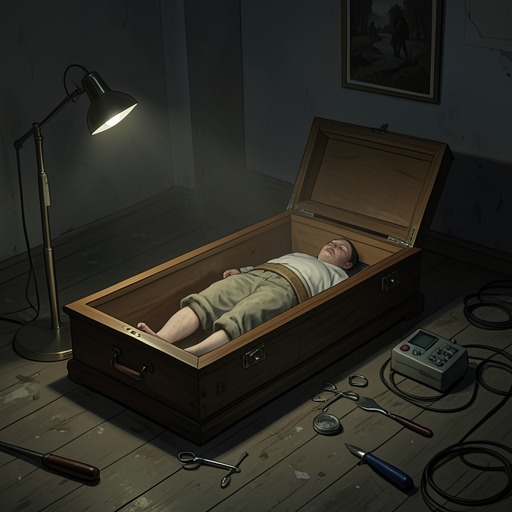
The exhumation appeared to confirm the villagers’ suspicions. Mary and Mary Olive’s bodies showed decomposition consistent with the time they had spent underground, but Mercy’s corpse seemed unusually fresh. The circumstances had an ordinary physical explanation: she had been dead for less than two months during the coldest part of the year, and her coffin had been stored in a crypt because the frozen ground was too hard to excavate. A local doctor also found signs of tuberculosis in her lungs and argued that the absence of decay was not evidence of vampirism.
Medical objections were disregarded. Mercy’s heart and lungs were removed and burned on a pyre built on nearby rocks. Her ashes were then mixed with water and given to Edwin as a medicinal drink, turning the ritual treatment of a supposed vampire into an attempted cure for tuberculosis. The remedy failed, and Edwin died on 2 May 1892. The family’s loss thus continued despite the exhumation, the burning, and the ingestion of the ashes; the ritual displaced medical understanding without preventing the outcome it was meant to avert.
Panic as Communal Practice
New England’s vampire panic belonged to a broader eighteenth- and nineteenth-century pattern in which communities opened graves, inspected bodies, and searched for physical signs that the dead were feeding on the living. Such actions made collective fear tangible. Relatives, neighbours, doctors, and local authorities occupied competing positions within the same scene: the community demanded an explanation, medical observers supplied objections, and ritual action promised immediate protection.
The Exeter episode also reveals how the corpse could become a contested document. Freshness, blood, and delayed decomposition were read by believers as proof of continued life, while medical interpretation treated them as consequences of season, burial conditions, and disease. The disagreement was not simply between belief and disbelief; it concerned which authority had the right to decide what a dead body meant. In the absence of shared confidence in scientific explanation, physical irregularity could be absorbed into an older supernatural vocabulary.
Historical and Cultural Significance
The panic emerged during a period when societies were changing quickly and many people held scientific curiosity alongside older spiritual beliefs. The nineteenth century combined industrial development and technological discovery with continued reports of witchcraft treated as fact. In that cultural environment, supernatural explanations could survive beside modern institutions rather than existing only outside them.
New England therefore functions as more than a geographical backdrop. It is a case study in the production of Vampire panic: disease created repeated deaths, grief sought a cause, communal suspicion identified the dead as agents, and ritual inspection transformed uncertainty into apparent proof. The story of Mercy Brown remains significant because it shows how a community can convert an ordinary process of infection into a narrative of predation, and how the desire for control can make a destructive explanation feel more persuasive than an incomplete but better-supported medical one.