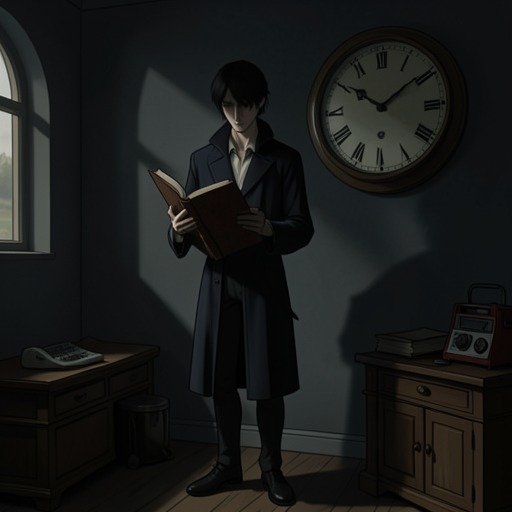
Peter Radley
A History of the Vampire in Popular CulturePeter Radley is the middle-class family doctor at the center of Matt Haig’s The Radleys, living with Helen and their teenage children in a quiet Yorkshire village while concealing that the family are vampires. His decisive significance lies in the tension between professional normality and private appetite: Peter can pass as an ordinary member of the community, but the family’s safety depends on managing a hunger that abstinence makes psychologically unbearable. When his daughter Clara kills a classmate who sexually assaults her, the event exposes the fragility of the identity Peter has built and forces the entire family to confront what it has tried to repress.
Identity and Hidden Nature
Peter’s public identity is deliberately unremarkable. He is a family doctor, part of a respectable household whose apparent banality helps the Radleys remain undiscovered. Alongside Helen, an artist, he has constructed the image of a conventional middle-class family in a quiet village, disguising their supernatural condition beneath what the narrative presents as a heavy layer of beige normality.
That disguise is more than a practical concealment. Peter belongs to a version of vampirism defined not by animal savagery but by addiction. The Radleys can technically survive without blood, yet abstinence resembles an addict’s attempt to live without heroin or an alcoholic’s effort to stop drinking: physically possible, but accompanied by severe mental strain. Peter’s restraint therefore has an ethical and emotional cost. His effort to appear human is also an effort to make his family safe, stable, and socially invisible.
Family Crisis and Plot Trajectory
The crisis begins when Clara accidentally murders a classmate who sexually assaults her. Her action makes the family’s hidden nature suddenly dangerous, because the murder threatens both Clara’s freedom and the secret that protects every Radley. Peter and Helen must respond not only as parents trying to prevent repercussions, but also as vampires attempting to preserve a human life they have built around denial.
Peter’s objective is consequently double-edged. He wants to save Clara and prevent discovery, yet the means of doing so require the family to acknowledge the reality it has refused to face. The threat is not simply an external investigation or the possibility of death. The deeper danger is that the family’s strategy of suppression has made honest stability impossible. Their attempt to avoid their true nature becomes the cause of their eventual downfall, leaving them with no option but to assemble a compromised existence as a human-vampire hybrid.
Relationships and Responsibility
Peter’s most important relationships are familial. His partnership with Helen is tested by the need to protect Clara and preserve the household’s secrecy, while his role as a father turns the supernatural problem into an ethical one. He cannot treat Clara’s act as merely a criminal incident, because it reveals a condition shared by the entire family. Nor can he protect her without confronting the appetite and violence that the family has spent years denying.
The Radleys are not presented as a harmonious household. Emotional betrayals break through the family’s carefully maintained appearance, and the members do not always like one another. Nevertheless, their devotion is enduring. Peter’s paternal responsibility operates within that contradiction: the family is divided by fear, secrecy, and conflicting desires, yet its members remain permanently entwined. His attempts to secure safety for his children therefore become inseparable from the family’s willingness to admit what they are.
Change and Consequences
Peter’s central change is a movement from denial toward reluctant recognition. At first, the family’s human stability appears worth preserving at almost any cost. Blood is treated as something that can be refused, and ordinary life as something that can be maintained through discipline. Clara’s attack makes that arrangement untenable. The family can no longer pretend that suppression has made them ordinary; it has merely concealed the pressure building beneath ordinary appearances.
The consequence is not a clean restoration of human normality. The Radleys’ eventual patchwork existence as a human-vampire hybrid is a compromise produced by crisis rather than a triumphant solution. Peter’s attempt to protect his family survives only in altered form, because the family’s safety can no longer depend on the complete rejection of its vampire identity.
Narrative Significance
Peter embodies a modern transformation of the vampire figure. Earlier literary vampires increasingly acquired elegant nocturnal habits, selective feeding, and recognizable personalities, while later portrayals allowed vampires to become sympathetic, ethical, comic, or socially integrated. Peter belongs to this movement toward the vampire next door: he is not an isolated aristocratic predator but a doctor, husband, and father trying to function inside an identifiable human community.
His story also gives vampirism the structure of a social stigma. Like other groups treated as abnormal or dangerous, the Radleys must manage appearance, disclosure, and the fear of being classified as something outside ordinary society. Peter’s professional respectability does not resolve that exclusion; it merely conceals it. The novel’s pathos comes from the recognition that the family cannot achieve genuine happiness while denying its own nature, even though revealing that nature threatens the very stability Peter has spent his life defending.