Sean Manchester
A History of the Vampire in Popular CultureSean Manchester became the most forceful public architect of the Highgate Vampire myth. Presenting himself as a vampire hunter and as the president of the British Occult Society, he recast an uncertain apparition in a London cemetery as an Eastern European vampire, promised a public exorcism, and helped turn a handful of reports into a mass spectacle. His significance lies less in proof of the supernatural than in the power of a confident interpretation to organize attention: once Manchester named the apparition, the press, the police, rival investigators, and hundreds of spectators began acting inside the story he had helped create.
Identity and Entry into the Highgate Story
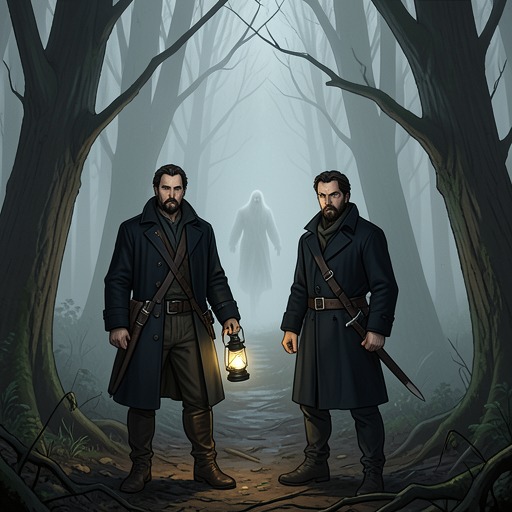
Highgate Cemetery, divided into East and West plots by Swains Lane, was already an atmospherically gothic site when the controversy began. The older West Cemetery had entered a period of decline in the 1970s, its ageing tombs, cloisters, and overgrown beauty making it a natural setting for horror cinema, including Taste The Blood of Dracula, starring Christopher Lee. In February 1970, David Farrant reported seeing a grey, ghost-like figure through the gates at night. Other witnesses supplied more elaborate details, including floating movement and glowing red eyes, but the entity was initially described as a ghost or spirit rather than a vampire.
Manchester supplied the decisive escalation. He told the press that the apparition was an Eastern European vampire and announced that he intended to exorcise it publicly. The claim gave the cemetery's ambiguous presence a fixed identity and converted scattered testimony into a recognizable supernatural threat. A newspaper headline, “Does a wampyr walk in Highgate?”, helped broadcast the new interpretation, while Manchester's public role made him appear not merely as a commentator but as an expert prepared to confront the alleged danger.
Public Spectacle and Media Amplification
Manchester's promised exorcism was scheduled for Friday 13 March 1970 and promoted through his appearance on ITV's nationally broadcast Today programme. The timing and medium intensified the drama: a local cemetery legend was no longer confined to neighbourhood gossip but was presented to a national audience as an imminent occult event. Public interest became so intense that hundreds of would-be vampire hunters climbed the walls of the dilapidated cemetery and swarmed its grounds, forcing police to intervene and attempt to restore order.
The episode illustrates how a moral panic can expand through naming, repetition, and performance. The available evidence began with a reported figure and competing descriptions, but Manchester's vampire theory supplied a more vivid and culturally familiar threat. The press magnified the claim, the crowd enacted it through a physical hunt, and the police response gave the incident the appearance of a public emergency. In that process, the question of whether a vampire existed became inseparable from the visible fact that people were behaving as though one did.
Rivalry with David Farrant
Manchester's relationship with Farrant developed into the central conflict of the Highgate affair. Their disagreement was not simply personal; it concerned the nature of the entity itself. Farrant generally retained the language of a ghost or spirit, whereas Manchester insisted that it was unquestionably a vampire. The two explanations occupied different positions between uncertainty and supernatural certainty, and their rivalry kept the story alive after the original sightings had faded.
The antagonism grew increasingly theatrical. The men once declared that they would participate in a “magician’s duel” on Parliament Hill on Friday 13 April 1973, although the duel never took place. Farrant answered Manchester's claims through satire, creating The Adventures of Bishop Bonkers, in which Manchester appeared as a paranoid maniac whose plans were defeated by Farrant. In 2011, Farrant staged an even more pointed mockery by filming himself raising a toast to an effigy of Manchester's head, ceremonially presented on a silver platter. The rivalry continued until Farrant's death in 2019, ensuring that the supposed vampire remained attached to the biographies and performances of the men who argued over it.
Cultural Context and Interpretation
Manchester's intervention gained traction in a period unusually receptive to supernatural explanations. The nineteenth century had combined rapid industrial and technological change with spiritualism, séances, reported witchcraft, and a persistent appetite for occult interpretation. Earlier vampire panics in New England and eastern Europe likewise show how disease, unexplained deaths, and uncertain bodily evidence could be organized into stories of the undead. In such traditions, fear seeks a target and a ritual response: a corpse can be exhumed, a suspected vampire can be staked, and an apparently uncontrollable disaster can be given a shape.
The Highgate case translated that older pattern into a modern media environment. Newspapers and television did not merely record a pre-existing belief; they helped enlarge and stabilize it. The cemetery's architectural decay provided the gothic setting, the Friday-the-13th appointment supplied a charged date, and Manchester's title of vampire hunter offered a recognizable role through which the public could imagine the event. The myth therefore reveals how a supernatural narrative can be manufactured from uncertainty without requiring a single verified encounter.
Legacy and Narrative Role
With hindsight, the source presents much of the Highgate mythology as having been created or greatly expanded by Manchester himself. He spun a thin set of stories into a far larger mythology, while media attention gave the result the durability of an urban legend. His importance is consequently paradoxical: he did not establish the vampire's physical reality, but he helped establish the social reality of the belief, the hunt, and the controversy.
Manchester remains the figure who gave the Highgate apparition its most consequential name. By replacing the cautious category of ghost with the definite category of vampire, he transformed ambiguity into doctrine and observation into action. The enduring story is thus not only about a possible creature in a cemetery; it is about how authority, spectacle, rivalry, and public fear can make an unseen being seem present in the world.