Serbia
A History of the Vampire in Popular CultureSerbia occupies a crucial place in the book’s account of how vampire belief became attached to identifiable landscapes, bodies, and reports. In the early eighteenth century, eastern European communities treated successive deaths as evidence of attacks by the undead, while investigators, doctors, military officers, clergy, and newspapers helped transform local explanations into portable cultural knowledge. Serbia therefore appears not simply as a backdrop for vampire stories, but as a testing ground where fear, medicine, ritual, and authority confronted one another.
Epidemics, Villages, and the Undead
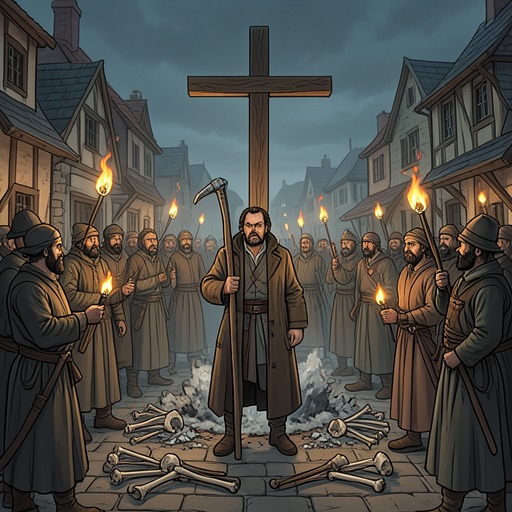
The Serbian material emerges within the eighteenth-century vampire craze, when entire villages became convinced that vampires were invading their communities. Suspected corpses were dug up and staked, and the urgency of these actions came from the frightening recurrence of death rather than from an abstract interest in folklore. In 1731, thirteen people died in one Serbian village in sufficiently rapid succession to alarm the population. A doctor specializing in infectious diseases was sent to investigate and attributed the deaths almost certainly to malnutrition, but the villagers rejected this explanation as inadequate and insisted that vampires were responsible.
The episode shows how a local disease model could organize communal action. The residents treated the dead as active causes of further mortality, so exhumation became a practical attempt to interrupt the chain of deaths. Their interpretation also reflects a wider historical condition: before scientific knowledge could explain many illnesses, a seemingly arbitrary sequence of fatalities left families unable to know who would die next or why. Folk belief supplied a target for fear and offered the appearance of control in circumstances otherwise governed by uncertainty.
Arnold Paole and Trstenik
A closely related Serbian case began in 1726 with Arnold Paole, a hadjuk who died in Trstenik after falling from a hay wagon and breaking his neck. Trstenik is identified as a village on the banks of the West Morava River in central Serbia. Before his death, Paole claimed that he had been plagued by a vampire some years earlier, probably in the region now known as Kosovo. He said that he had escaped by eating soil from the vampire’s grave and covering himself with blood, an act whose supposed protective logic was already difficult to reconcile with the idea of a creature that consumed blood.
When villagers began to fall ill soon after Paole’s death, they interpreted the sequence through his earlier testimony. The presumed Kosovo vampire had infected Paole, they concluded, and the dead hadjuk had now become a murderous creature of the night. Paole’s body was disinterred and was reported to show no signs of decomposition. The villagers also claimed that the nails on his hands and feet had fallen away and been replaced by fresh growth, and that he shrieked and bled from the wound when staked. They responded by cremating his remains, treating destruction of the corpse as the safest means of preventing further attacks.
Investigation and Official Authority
The Serbian reports acquired institutional weight when officials in Vienna sent Johann Flückinger, a respected military surgeon, to examine the earlier findings. He travelled with other doctors and army officers as witnesses. Their observations entered a documentary tradition that treated the condition of exhumed bodies as evidence requiring interpretation: many corpses appeared not to have decomposed substantially, and some seemed to have taken on a plump appearance. Flückinger’s report became part of the circulation through which a village crisis could be recast as an authenticated vampire investigation.
The authorities did not merely record the bodies; they acted upon the possibility that the dead might return. Flückinger and his men cut the heads off the suspected vampire corpses before reburying them, while Paole’s remains had already been cremated by his neighbours. These procedures reveal the unstable boundary between observation and ritual. Military and medical witnesses could bring official credibility to the case, yet the practical response still belonged to the logic of supernatural prevention: dismemberment, staking, and cremation were used to secure the living against the dead.
Bodies, Decomposition, and Explanation
Later medical discussion offers natural explanations for details that once appeared vampiric. Stories of blood around a corpse’s mouth or in its stomach predate modern knowledge of post-mortem change. Purge fluid, produced as body tissues break down, can seep from the mouth and nose and appear red-black. Pressure from gases and decomposing liquid inside the body can also create the impression of bleeding when a stake provides an outlet, while gases released under pressure may account for a corpse’s reported shriek.
The apparent freshness of Mercy Brown’s corpse in Exeter, Rhode Island, belongs to the same interpretive pattern, although it occurred outside Serbia. Her body had been dead for less than two months, had been kept in a crypt because frozen ground prevented burial, and was examined during the coldest part of the year; these conditions could explain the limited decay. Yet her heart and lungs were cut out and burned, and the ashes were given to her sick brother Edwin as a medicinal drink. The comparison underscores the book’s larger argument: different communities could convert ordinary bodily processes and contagious disease into evidence of vampirism, then pursue remedies whose violence followed from that interpretation.
Serbia in the Wider History of Vampire Belief
Serbia’s importance extends beyond the individual cases associated with it because the region helped give the vampire a recognizable vocabulary of place, language, and social fear. In Serbia and Bulgaria, the word “vampir” was commonly used for the creature that other traditions described through different names, while nearby accounts of the Vrykolakas combined wolf-like and vampiric characteristics. The eighteenth-century reports from Serbia therefore participated in a broader process by which varied revenant traditions were gradually gathered into the relatively standardized modern idea of the vampire.
This process was encouraged by the intellectual atmosphere of the period. The eighteenth-century vampire craze unfolded during an era when communities could respond to unexplained death through exhumation, staking, cremation, and official inspection, while educated Europeans increasingly circulated such reports as evidence of extraordinary phenomena. Antoine Augustin Calmet later collected and discussed accounts of revenants and vampires from Hungary, Bohemia, Moravia, and Silesia in The Phantom World, quoting testimony that presented vampirism in Hungary as attested by officers connected with the tribunal of Belgrade and by an officer of the emperor’s troops who claimed to have witnessed the proceedings. Serbia thus entered not only local memory but also the learned, documentary history through which European readers encountered the undead.
Serbia in Print and Cultural Memory
Serbia’s vampire cases became influential because they could be detached from their local circumstances and circulated as compelling evidence of the undead. Reports of eastern European corpses, investigations, and village fears reached the press, including London newspapers that presented the stories as accounts of the dead rising from their graves to drink the blood of the living. The region consequently became part of a wider European geography of supernatural danger, while the word “vampir,” commonly used in Serbia and Bulgaria, helped connect local terminology with the increasingly standardized literary vampire. The same cultural process transformed a frightening rural episode into a glamorous public image: in the mid-eighteenth century, the Earl of Sandwich named one of his racehorses “Vampire,” recognizing that the word could signify power and intimidation as well as horror. Later writers and scholars continued this work of cultural translation. Antoine Augustin Calmet’s The Phantom World gathered accounts of revenants and vampires from Hungary, Bohemia, Moravia, and Silesia, including testimony attributed to officers of the tribunal of Belgrade and an imperial military officer who claimed to have witnessed proceedings. Serbia therefore functioned both as a site of communal crisis and as a source of documentary authority, its graves and reports repeatedly reinterpreted through medicine, religion, journalism, and literature.
Serbia as a Medical and Cultural Case Study
Serbia’s vampire narratives also expose the difficulty of separating bodily evidence from the meanings imposed upon it. Reports of blood around the mouths or inside the stomachs of exhumed corpses circulated before modern medical knowledge could explain purge fluid, the decomposition of gastrointestinal tissue, and the pressure that drives dark liquid from the mouth and nose. A stake could release accumulated gases and fluids, producing the appearance of bleeding, while gas escaping under pressure might account for reports that a corpse shrieked when pierced. The bodies were therefore not simply discovered; they were read through competing explanatory systems. Villagers, doctors, military officers, and later readers selected different details as decisive, turning decomposition, apparent freshness, plumpness, or renewed nails into either proof of vampirism or evidence of ordinary post-mortem processes.
Serbia and the Formation of Vampire Knowledge
Serbia’s significance in the book lies in the way local experience became organized into a wider system of vampire knowledge. The eighteenth-century accounts did not remain isolated village stories: they were examined by doctors and military officers, recorded in reports, discussed by scholars, and carried by newspapers to readers far beyond the communities where the deaths occurred. That movement changed the status of the evidence. A corpse’s condition, a villager’s testimony, or a ritual performed at a grave could be presented first as an emergency measure, then as an official observation, and finally as material for European speculation about the undead. Antoine Augustin Calmet’s The Phantom World exemplifies this process by gathering accounts from Hungary, Bohemia, Moravia, and Silesia, including testimony attributed to officers of the tribunal of Belgrade and an imperial military officer who claimed to have witnessed the proceedings. Serbia thus became both a physical setting for vampire fears and a documentary reference point through which later readers imagined eastern European supernatural danger.
The region’s importance was also linguistic and comparative. In Serbia and Bulgaria, the word “vampir” was commonly used for the creature that neighboring traditions described through other names, while the Vrykolakas combined features associated with both the Werewolf and the Vampire. Such variation did not prevent cultural consolidation; instead, it supplied different local forms for an increasingly familiar figure. Reports from Serbia helped anchor that figure in recognizable practices—exhumation, staking, cremation, decapitation, and inspection—while later literature refined the rough revenant into a more selective, elegant, and psychologically developed predator. The path from Serbian village testimony to the literary forms represented by Varney and Carmilla was not a simple record of supernatural fact. It was a history of translation, in which fear, bodily change, medical uncertainty, institutional authority, and commercial circulation repeatedly remade the meaning of the dead.
Serbia and the Formation of Vampire Knowledge
Serbia’s importance in the book lies in the way local experience became organized into a wider system of vampire knowledge. The eighteenth-century accounts did not remain isolated village stories: they were examined by doctors and military officers, recorded in reports, discussed by scholars, and carried by newspapers to readers far beyond the communities where the deaths occurred. That movement changed the status of the evidence. A corpse’s condition, a villager’s testimony, or a ritual performed at a grave could be presented first as an emergency measure, then as an official observation, and finally as material for European speculation about the undead. Antoine Augustin Calmet’s The Phantom World exemplifies this process by gathering accounts from Hungary, Bohemia, Moravia, and Silesia, including testimony attributed to officers of the tribunal of Belgrade and an imperial military officer who claimed to have witnessed the proceedings. Serbia thus became both a physical setting for vampire fears and a documentary reference point through which later readers imagined eastern European supernatural danger.
Serbia and the Formation of Vampire Knowledge
Serbia’s importance in the book lies in the way local experience became organized into a wider system of vampire knowledge. The eighteenth-century accounts did not remain isolated village stories: they were examined by doctors and military officers, recorded in reports, discussed by scholars, and carried by newspapers to readers far beyond the communities where the deaths occurred. That movement changed the status of the evidence. A corpse’s condition, a villager’s testimony, or a ritual performed at a grave could be presented first as an emergency measure, then as an official observation, and finally as material for European speculation about the undead. Antoine Augustin Calmet’s The Phantom World exemplifies this process by gathering accounts of revenants and vampires from Hungary, Bohemia, Moravia, and Silesia, including testimony attributed to officers of the tribunal of Belgrade and to an officer of the emperor’s troops who claimed to have witnessed the proceedings. Serbia thus became both a physical setting for vampire fears and a documentary reference point through which later readers imagined eastern European supernatural danger.