Sister Agatha
A History of the Vampire in Popular CultureSister Agatha is the most intellectually formidable human opponent of Count Dracula in the 2020 BBC adaptation. A cynical and scientifically curious nun, she treats blood not as a symbol of helplessness but as a weapon, a medium of knowledge, and the means by which she can remain connected to Dracula after death. Her importance lies in the way the story turns an apparent victim–predator encounter into a reciprocal contest: Dracula enters Agatha through her blood, yet Agatha uses that same intimacy to expose his weakness and shape his final escape from immortality.
Identity and Introduction
Sister Agatha is introduced as a nun whose skepticism makes her unusually resistant to the supernatural explanations surrounding Dracula. Her religious position does not make her conventionally credulous; instead, she is defined by scientific curiosity, sharp interrogation, and a willingness to test the creature before her. When she is discovered hidden in a cabin during the doomed voyage of the Demeter, Dracula uses her as a scapegoat in an attempt to conceal his identity. The concealment fails because Agatha refuses the passive role assigned to her. She recognizes the power contained in blood and repeatedly turns confrontation into an experiment in control.
Her fascination with Dracula is inseparable from her opposition to him. The two are already clearly interested in each other before he drinks her blood, and their attraction is expressed through challenge rather than surrender. Agatha goads him into biting her with the words, “Come – suckle, boy,” making the encounter a deliberate provocation. Dracula claims that he will take her with him wherever he travels, but the promise refers to the enduring power of her blood rather than to her continued life as a companion. By drinking from her, he takes Agatha physically and mentally inside himself; at the same time, he creates the bond that later allows her influence to survive him.
Resistance and Blood-Bound Connection
Agatha’s resistance is active, bodily, and strategic. When Dracula attempts to make her a scapegoat on the Demeter, she answers not with flight but with another calculated use of blood: she bites her lip and spits her own blood at him. The gesture makes her body an instrument of knowledge and attack. Blood is not merely the substance Dracula requires to live; in Agatha’s hands, it becomes evidence, bait, and a means of forcing the vampire to acknowledge the connection he wants to control.
That connection later extends through her descendant Zoe Van Helsing. Zoe, terminally ill, drinks Dracula’s blood after taking samples in her gothic laboratory. The act completes a circle begun with Agatha. Memories, sensations, and emotions pass through the centuries and through Zoe’s mind, just as Elisabeta rises within Mina Murray in another version of Dracula’s story. Zoe does not simply remember an ancestor as historical information. Agatha becomes an active presence inside her, surfacing as Zoe’s life weakens and the boundary between the modern scientist and the centuries-dead nun begins to dissolve.
The transfer is both support and pressure. As Zoe deteriorates, Agatha props her up from within, while Agatha’s fascination with Dracula keeps the dying woman moving toward the confrontation that has been waiting across generations. In the modern penthouse, Dracula and Zoe are physically alone, but the scene contains two women who are increasingly difficult to separate. Zoe snaps between her own identity and Agatha’s, and the blood that connects them makes personal history behave like a living presence rather than a completed past.
Discovery and Conflict with Dracula
Agatha is the person who finally discovers Dracula’s true weakness, but the adaptation makes clear that she could not have done so without Zoe. Their achievement is therefore collaborative across time. Agatha supplies the original insight, courage, and adversarial knowledge; Zoe supplies the modern investigation and the body through which that knowledge can become decisive. The victory does not belong to either woman alone, because the story presents them as successive expressions of one continuing opposition.
Dracula is more physically and mentally tied to Agatha and Zoe than he would ever wish to admit. His power depends on taking others into himself, yet the blood bond also makes him vulnerable to the people he consumes. Agatha’s relation to him thus reverses the ordinary structure of vampiric predation. Dracula believes that drinking blood grants possession, but the act also carries the victim’s agency into the predator. Agatha remains inside the Count as memory and resistance, while Zoe turns that inherited intimacy into a means of ending him.
Their conflict also draws on the broader history of the vampire as a figure of forbidden otherness. Earlier vampire narratives increasingly made their predators elegant, selective, and emotionally complex; the story of Agatha and Dracula intensifies that development by making the nun neither merely innocent nor merely virtuous. Her challenge to him is charged with intellectual and physical intensity, and the blood tie makes attraction, hostility, knowledge, and danger inseparable. The same tradition that allowed Carmilla to embody openly transgressive desire is here redirected into a confrontation between a predatory immortal and a woman who refuses to let fear define the terms of contact.
Zoe, the Final Encounter, and Death
When Zoe reaches the end of her illness, Agatha’s presence inside her enables the final meeting with Dracula. Agatha has discovered the Count’s weakness, but Zoe is the person who can bring him into contact with it. Dracula then chooses to drink Zoe’s blood. The action is partly an attempt to transport Zoe’s spiritual form toward a kinder and less painful end, but it is not entirely altruistic: by drinking from her, Dracula takes himself with her.
Zoe’s blood is fatal to Dracula because her cancer contaminates what he consumes. In his body, the first mouthful reduces him to a retching, animalistic heap, with bloody-black vomit spilling from his mouth. The danger that destroys him is therefore not a conventional weapon but a condition carried through blood, the substance on which his existence depends. Zoe’s illness becomes both a threat to the vampire and the instrument through which his long-suppressed desire for death can finally be realized.
The final encounter takes place in a modern penthouse, where Zoe and Dracula are left with a table and centuries of accumulated anguish between them. In the death dream produced by Dracula’s final act, Zoe escapes the pain and loneliness of dying and lies entwined with her ancient adversary in their first and last truly intimate encounter. The dream does not erase their hostility; it gives their hostility a final form of closeness. Agatha, Zoe, and Dracula are joined by the blood that has carried memory and suffering from one generation to the next.
Narrative Role and Significance
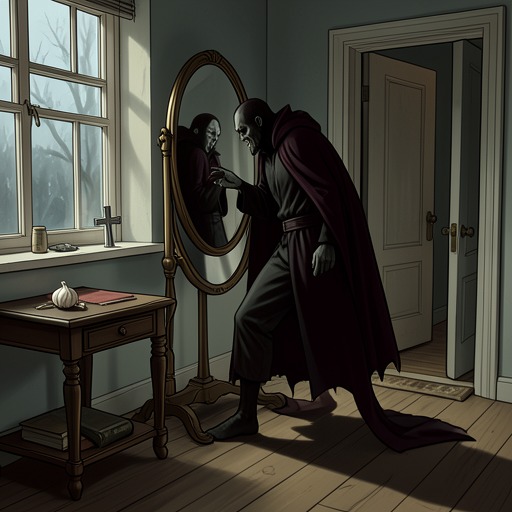
Agatha’s deepest discovery is psychological as well as physical. Through Zoe, the story reveals that Dracula is ashamed: ashamed that he cannot die, ashamed that he has outlived everyone around him, including his mortal family, and ashamed that he has been afraid to face death. His hatred of mirrors comes from seeing himself as an ancient, crumbling walking corpse rather than from fear that a mirror might expose him to others. Agatha’s long opposition therefore reaches beyond identifying a biological weakness. She helps reveal the self-loathing beneath Dracula’s theatrical power.
This makes Agatha the person who can meet Dracula as his equal. The final death is not presented simply as the triumph of a human hunter over a monster. Dracula walks into oblivion in the arms of the one person who has always matched him, and Agatha’s presence through Zoe gives that ending its emotional and intellectual shape. Dracula uses the situation for his own advantage, but his final kindness is genuine when he says, “After all this time, did you think I would let it hurt?” The line joins tenderness to manipulation, just as their entire relationship joins fascination to danger.
Sister Agatha consequently serves as the story’s counterforce to immortal isolation. She does not defeat Dracula by remaining untouched by him; she defeats him through the very intimacy he believes will give him possession. Her blood enters him, her memory survives in Zoe, her investigation exposes his weakness, and her presence accompanies him into final death. The result is a Gothic reversal in which the vampire’s greatest power—his ability to absorb others—becomes the route by which an adversary enters his interior world and helps him end it.