Slovakia
A History of the Vampire in Popular CultureSlovakia is significant in the book chiefly through Čachtice Castle, the aristocratic residence associated with Elizabeth Báthory and the setting against which her later Blood Countess legend is measured. It is not treated as a supernatural location in its own right; rather, its importance lies in the way a real Central European place becomes the historical anchor for stories of blood, youth, female power, and alleged atrocity.
Setting and Historical Association
Slovakia enters the narrative through the marriage of Elizabeth Báthory to the Hungarian nobleman Count Ferencz Nádasdy. When Elizabeth was fifteen, the couple moved to Čachtice Castle in Slovakia, which had been given to her as a wedding gift by Ferencz and the Nádasdy family. The castle thus appears first as a dynastic household and a material sign of aristocratic wealth, not as a crypt or lair. The couple had four children, although surviving accounts variously give the number as three or five, an uncertainty that already places the location within a tradition of disputed testimony.
The castle’s political meaning was reinforced by the position of the surrounding estates. During the Long Turkish War, which began in 1593 and involved Wallachia, Transylvania, and Moldavia, Ferencz was away fighting, leaving Elizabeth responsible for defending his properties. Those lands lay along the politically important route to Vienna and had previously been plundered by the Ottomans. Slovakia therefore functions in the account as a frontier landscape exposed to military pressure, dynastic calculation, and the burdens of aristocratic administration.
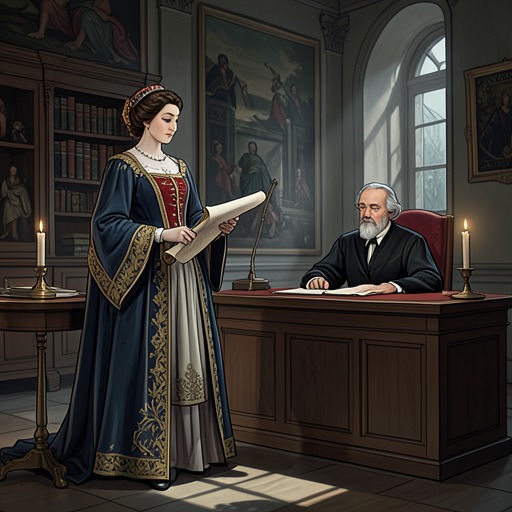
Elizabeth Báthory at Čachtice Castle
The evidence complicates the image later attached to Slovakia’s castle. Elizabeth was highly educated, belonged to one of the oldest and richest families in the region, and appears to have enjoyed unusual authority within her marriage. Ferencz trusted her opinions and advice more than was customary for the period, and he agreed to adopt her maiden name because the Báthory name was considered more illustrious than his own. Her authority was not confined to domestic life: while her husband was absent, she assumed responsibility for the welfare of people living under her jurisdiction.
Anecdotal evidence records Elizabeth personally intervening in several cases involving destitute women, including an incident in which she took up the case of a woman whose daughter had been raped and impregnated. This detail makes the castle’s later reputation more unsettling and more politically legible. The same woman later remembered as a predator of young women is also associated with the exercise of protective and judicial responsibility, so the location holds contradictory versions of female power rather than a single, stable meaning.
Legend, Power, and Reinterpretation
After Ferencz died in battle—or, more precisely, dropped dead during the campaign from an unknown illness—Elizabeth became one of the richest and most powerful people in the entire region. Her prominence made her politically dangerous. Her cousin Gabor was seeking the throne, and an alliance between him and Elizabeth could have threatened rival claimants to power. The account identifies György Thurzó de Bethlenfalva, a fervent Lutheran and Palatine of Hungary, as the figure who undertook the effort to remove her.
Against this political background, the stories attached to Čachtice Castle acquired their familiar vampiric form. Elizabeth is often said to have murdered countless young women and bathed in their blood to preserve her youth, a tale that supplies the archetype of the vain older woman killing youthful innocents to resist aging. The book states that the story is almost certainly false and emphasizes that, whether Elizabeth drank blood or not, the evidence does not justify accepting the legend as straightforward fact. Slovakia consequently becomes the geographical site where an accusation against a powerful noblewoman was later recast as the biography of a monstrous, blood-drinking countess.
Slovakia in the Book’s Wider Vampire Geography
The location’s role becomes clearer when set beside the book’s other treatments of vampirism. Vampire narratives repeatedly turn ordinary thresholds—graves, coffins, blood vessels, bodies, and domestic spaces—into sites where life and death become difficult to distinguish. A Jewish story describes an estrie whose open-mouthed corpse must be restrained with a spike driven through the mouth into the earth and then filled with stones. A separate legend places Odran of Iona beneath the foundations of a chapel, where being buried alive becomes a conflict over religious truth. These examples show how burial places and enclosed structures become charged spaces of uncertain identity.
Čachtice Castle belongs to the same imaginative geography, but with a distinct historical pressure. Its walls do not merely shelter a monster; they contain the collision between aristocratic privilege, gendered suspicion, political ambition, and the later desire to explain violence through the language of the supernatural. In that sense, Slovakia is less a backdrop than a site of conversion: a real castle and a contested woman are transformed into a durable vampire legend, while the historical complexity beneath the legend remains visible but unresolved.