The Gorbals
A History of the Vampire in Popular CultureThe Gorbals is a Glasgow district whose place in vampire history rests less on an undead creature than on the extraordinary social life of a rumour. In September 1954, hundreds of local children gathered in the city’s Southern Necropolis to hunt a supposed “vampire with iron teeth” said to have killed two children. The episode transformed a local story into a national controversy about children, horror comics and public morality, and contributed directly to the Children and Young Persons (Harmful Publications) Act 1955.
The District and the Rumour
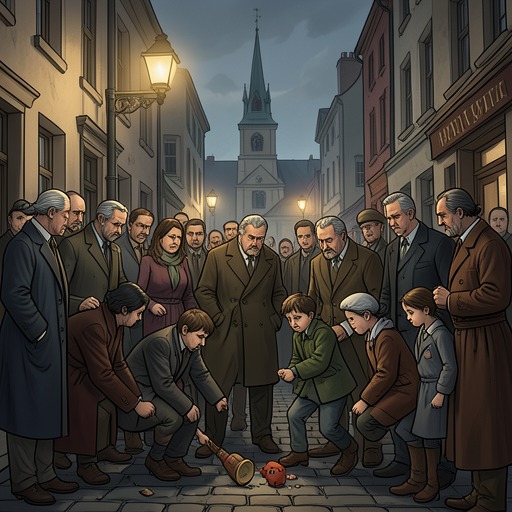
The Gorbals incident unfolded around the Southern Necropolis, an extensive and poorly maintained cemetery containing nearly a quarter of a million graves. The immediate claim was that a vampire with iron teeth had killed two local children and remained at large, although no child murders or disappearances had been reported that year. The absence of confirming facts did not weaken the story. As the rumour intensified on Thursday 23 September, children assembled in the cemetery carrying stakes and knives; some even brought dogs. Police officers attempting to disperse them were overwhelmed by the number of young hunters moving through the graves.
The episode belonged to a wider history in which fear turns unexplained danger into a supernatural target. Earlier vampire panics had attached contagious disease, unfamiliar death and social uncertainty to returning corpses. The Gorbals story similarly gave children a personal enemy against which they could act. A vampire could be hunted, surrounded and killed in imagination even when the actual sources of fear were less visible and less controllable.
From Local Excitement to National News
The Daily Mirror placed the incident on its front page on 25 September 1954 under the headline “AMAZING SCENE AS HUNDREDS OF CHILDREN STORM A CEMETERY,” adding the sub-header “The Toddlers Joined In.” Its report described children clinging to the journalist’s coat and asking whether he had come to shoot the vampire so that they could sleep. The article dismissed the story as a “stupid tale,” yet its dramatic presentation also helped give the event a durable public form.
The press soon redirected responsibility from the children’s immediate surroundings to imported American horror comics. Local mothers reported that children who read such comics were frightened that the vampire would enter through open windows. By Monday 27 September, the Daily Mirror was openly discussing whether horror comics should be banned, reporting that civic and welfare leaders in Glasgow believed the publications had caused the hysteria. On 1 October, the newspaper described a further outbreak in which children attacked a travelling family’s caravan with stones while shouting that its occupants were witches. The reported crowd reached roughly three hundred, turning a cemetery rumour into evidence for a broader theory of comic-book contamination.
Possible Origins of the Vampire
The supposed creature may have emerged from a far more local and physical source than imported comics. The Necropolis backed onto Dixon’s Blazes, an ironworks whose furnaces regularly lit the night sky with red light and smoke. One boy later recalled that the glow and smoke made the gravestones appear to leap and created the impression of figures moving in the distance. This explanation does not erase the legend; it shows how industrial scenery, darkness and collective expectation could supply the visual material from which a vampire story was made.
The competing explanations reveal the politics of interpretation. A supernatural vampire, a comic-book menace and an industrial landscape each locate the cause of fear somewhere different. The first blames the dead, the second blames popular culture, and the third points toward the ordinary conditions of a working urban environment. The Gorbals became important because the most dramatic explanation travelled furthest, while the mundane explanation remained comparatively powerless against the momentum of the press.
Legislation and Moral Panic
On 1 October, Alice Cullen, then the Member of Parliament for the Gorbals constituency, asked Home Secretary Sir David Maxwell Fyfe to introduce legislation banning horror comics in the United Kingdom. The request followed the cemetery disturbance and helped convert public alarm into an institutional question. A confidential government memo later acknowledged that banning an entire genre would be legally difficult because “obscene” under the Obscene Publications Act 1857 generally referred to graphically sexual material. It nevertheless argued that objectionable comics could be as harmful, or more harmful, to children and young persons as publications legally classified as obscene.
The Children and Young Persons (Harmful Publications) Act 1955 was introduced by Home Secretary Gwilym Lloyd George in May and came into force on 6 June. It targeted books, magazines and similar works consisting wholly or mainly of picture stories that portrayed crimes, violence, cruelty, or repulsive and horrible incidents in a form considered likely to corrupt children. The Act was prompted almost entirely by the drama surrounding the Gorbals Vampire incident. Its final standard remained notably vague, but the law is still in force and has produced relatively few prosecutions.
The Gorbals episode also anticipated later arguments about media influence. In the United States, psychiatrist Fredric Wertham claimed that horror comics caused juvenile delinquency, reasoning from the presence of comics among 95 percent of children in reform schools to the conclusion that comics had taught them to become criminals. His testimony before the Senate Subcommittee on Juvenile Delinquency helped produce the Comics Code Authority, whose restrictions included words such as “zombie,” “crime” and “terror,” and required criminal characters to receive punishment. Across these cases, a dramatic incident became a moral diagnosis: the scale of the public response far exceeded the evidence that comics had caused the original behaviour.
Cultural Meaning
The Gorbals is significant as a setting where folklore, class anxiety, childhood imagination, journalism and state censorship converged. Vampire stories have repeatedly served as metaphors for outsiders and intruders, especially groups regarded with fascination and suspicion. The district’s episode therefore belongs not only to supernatural history but also to the history of labelling: a frightening figure was assigned to a cemetery, children were treated as endangered or corrupted, and comics became the object against which adults could organise a campaign.
The incident also demonstrates how gothic culture can function as both threat and refuge. Later accounts of goth identity describe the scene as a supportive community in which difference can be expressed through music, literature, clothing and elaborate makeup rather than hidden. The Gorbals panic represents the opposite process: imagery associated with the gothic was stripped of cultural complexity and recast as a danger to children. In that reversal, the district’s vampire became a symbol of how societies manufacture monsters, then use the monsters to justify control.
The 1954 gathering remains the decisive event attached to The Gorbals. It did not establish that a vampire had killed anyone. It established how quickly a rumour could become a crowd, how newspapers could enlarge that crowd into a national spectacle, and how spectacle could become legislation. The lasting “vampire” of The Gorbals is therefore the mechanism of panic itself: a story that fed on uncertainty until the social response became more consequential than the alleged creature.