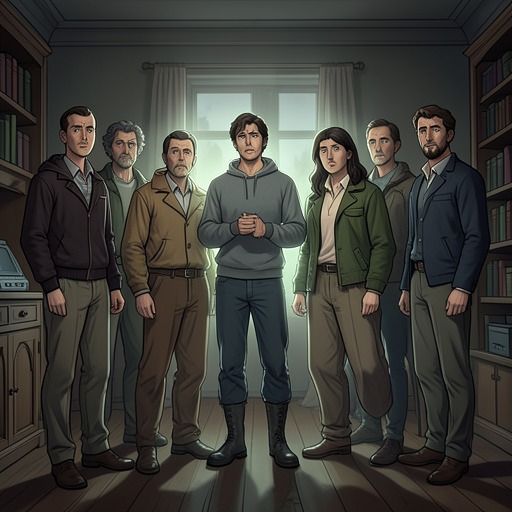
The Radley family
A History of the Vampire in Popular CultureThe Radley family, at the center of Matt Haig’s The Radleys, are vampires trying to pass as an unremarkable middle-class household. Their life in a quiet Yorkshire village turns concealment into a daily performance, but the family’s decisive crisis exposes the cost of treating their nature as something that can simply be denied. In this account, vampirism is less an animal transformation than an addiction, binding the family through both danger and devotion.
Identity and life in hiding
Peter Radley is a family doctor, Helen Radley an artist, and their teenage children appear to belong to the ordinary human world around them. The family’s disguise requires no elaborate supernatural spectacle: it is a heavy layer of beige banality. That contrast makes them a distinctly domestic kind of vampire, not strangers arriving from elsewhere but people attempting to fit into the routines and expectations of a recognizable community.
Their hidden condition is precarious even before it becomes public. The family’s attempt to live safely among humans depends on keeping their vampiric nature concealed, while the desire for blood remains part of the life they are trying to make ordinary. The apparent normality of the household is therefore not proof that the conflict has disappeared; it is the form their struggle takes.
Clara’s crisis and the family’s response
The family’s private arrangements are disrupted when Clara accidentally murders a classmate who sexually assaults her. The event forces her to confront the possibility that she is not entirely normal, and it places the whole household at risk of discovery. A family secret that had seemed containable now has consequences beyond the family itself.
Peter and Helen try to protect Clara from the repercussions and keep the family’s true nature hidden. Their efforts are not simply a return to routine: they must confront uncomfortable truths while searching for stability and safety for their children in a human world that neither fully welcomes nor understands them. Clara’s crisis thus draws the family together around an urgent shared problem, while also exposing the weakness of a life built on concealment.
Blood, addiction, and denial
The Radleys’ defining difference from many traditional vampire figures is that they are presented as addicts rather than animals. They can live without blood in the physical sense, but the book’s comparison to heroin or alcohol dependence stresses that possibility is not the same as ease: abstaining carries a serious mental strain. Blood is consequently not just a supernatural appetite. It is a continuing pressure on the family’s attempt to maintain a safe, human-seeming existence.
Their fear of losing the stability they have made is as powerful as their desire for blood. That tension helps explain why the family tries to avoid confronting what it is, even as Clara’s experience makes such avoidance harder to sustain. Their denial is not a solution to dependence or danger; it becomes part of the cause of their eventual downfall.
Downfall and narrative significance
The family cannot preserve its former arrangement. Its determination to evade its true nature ultimately leaves its members with no option but to piece together a hybrid existence, part human and part vampire. The outcome is neither a simple return to ordinary life nor a triumph of concealment: the family must continue in a changed form after the security it sought has failed.
The story’s bleak risks—betrayal, death, and destruction—coexist with an unexpectedly affirmative account of family attachment. The Radleys do not always like one another, yet remain devoted and entwined. Their arc turns the familiar vampire question of fitting into human society inward: the family’s longing for acceptance cannot make denial sustainable, while acknowledging what they are does not erase their bonds. Their uneasy new existence carries both the cost of evasion and the possibility of living without pretending that the family is something else.