Trstenik
A History of the Vampire in Popular CultureTrstenik is identified as the Serbian village where Arnold Paole, a hadjuk, died in 1726 after falling from a hay wagon and breaking his neck. Its significance lies less in a developed portrait of the settlement than in the chain of supernatural interpretation attached to Paole’s death: illness among villagers, the suspected transmission of vampirism, the opening of a grave, and the cremation of a corpse treated as a dangerous revenant.
Setting and Historical Context
Trstenik stood on the banks of the West Morava River in central Serbia. The account places it within an eastern European region where fear of the undead produced repeated accusations during the early eighteenth century. In what is sometimes called the eighteenth-century vampire craze, entire villages became convinced that vampires were invading their communities, and residents responded by digging up suspected corpses and staking them.
The village’s story belongs to a period when epidemic death was difficult to explain. Tuberculosis and other illnesses could move through households while medical knowledge remained limited, and communities often turned fear into a visible supernatural target. The broader nineteenth-century vampire panic in New England followed a similar pattern, with tuberculosis interpreted as the dead returning to steal the life force of surviving relatives. Trstenik’s earlier case shows the same cultural mechanism in a Serbian setting: unexplained illness became evidence of an undead attack, while the grave became the place where that accusation could supposedly be tested.
Arnold Paole and the First Accusation
Arnold Paole had been a Serbian hadjuk, roughly a member of an irregular peasant infantry. Before his death, he claimed that a vampire had plagued him, probably in the region now known as Kosovo. According to his own account, he escaped the vampire by eating soil from its grave and covering himself with blood. The strange protective ritual did not remove the fear surrounding him; instead, it provided a ready-made explanation when villagers later began to fall ill.
Paole died in Trstenik in 1726 after falling from a hay wagon and breaking his neck. His death might have remained an accident, but the illnesses that followed among villagers transformed it into a suspected supernatural transmission. The community concluded that the Kosovo vampire had infected Paole and that the hadjuk had now become a murderous creature of the night. The logic was circular but powerful: Paole’s earlier testimony established contact with a vampire, his death marked a possible transformation, and subsequent illness appeared to confirm that the transformation had spread.
Exhumation, Staking, and Cremation
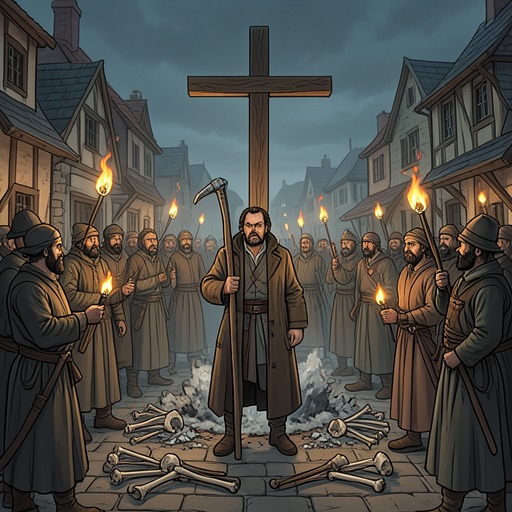
The villagers disinterred Paole’s body. They reported that the corpse showed no signs of decomposition and that the nails on his hands and feet had fallen away and been replaced by apparently fresh growth. When the body was staked, Paole was said to shriek and to bleed from the wound. These observations were read not as ordinary effects of decomposition or the physical processes surrounding a corpse, but as proof that Paole remained active after death.
The response was both investigative and ritualistic. Opening the grave was meant to reveal the truth, yet the examination was governed by the beliefs it supposedly tested. Staking the corpse functioned as an attempt to halt its return, while the reported shriek and bleeding intensified the sense that the body was still responsive. The villagers then cremated Paole’s remains, choosing destruction as the safest protection against further attacks. Trstenik therefore became associated with a complete anti-vampire procedure: identify the suspected source, remove it from the grave, pierce it, and burn what remained.
Place in Vampire Folklore
Trstenik is not presented as a recurring setting with its own sustained community narrative. It is instead a local site through which a wider historical pattern becomes legible. The village anchors a story about how a death, an illness cluster, and a corpse’s altered appearance could be assembled into a coherent vampire case. The physical details attributed to Paole—new nails, lack of decay, a cry, and blood at the stake wound—would later resemble the kinds of signs repeatedly invoked in reports of vampirism.
Its importance also lies in the tension between local conviction and external explanation. In later Serbian cases, officials and medical observers were called to investigate deaths that villagers attributed to vampires, yet their presence did not necessarily dissolve the supernatural interpretation. Trstenik’s episode demonstrates how folklore could turn a vulnerable corpse into both a suspected agent of disease and an object of communal punishment. The village thus survives in the historical imagination not through architecture or description, but through the evidentiary drama staged around Paole’s grave.