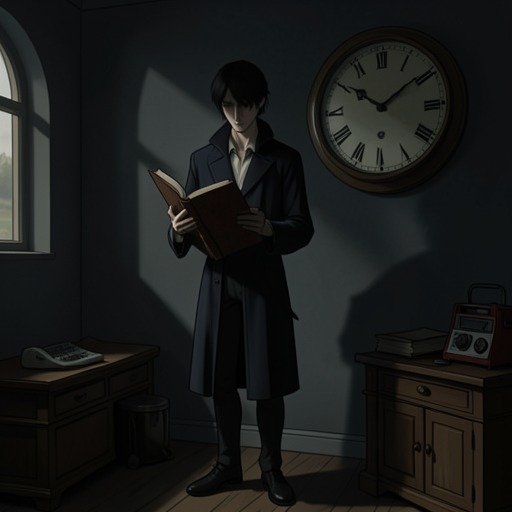
Undead
A History of the Vampire in Popular CultureUndead names a condition rather than a single creature: a person is dead by ordinary standards yet continues to move, act, or endure. The idea reaches from medieval accounts of revenants rising from graves to modern portrayals of immortal bodies trapped in decay. Across these versions, undeath unsettles the boundary between life and death, making the corpse both evidence of death and an instrument of continued action.
Medieval Revenants and the Problem of Death
In the twelfth century, Walter Map recorded stories of beings that would now be called vampires, although the period more generally described them as revenants, or the undead. His De Nugis Curialium gathered folk stories and historical anecdotes whose truth could rarely be verified, so the accounts preserve uncertainty as part of their subject. The undead appear not as a stable species with a single definition, but as ordinary dead people whose return disturbs the living community.
One of Map’s stories concerns a Welshman of evil life who refused to remain dead. He rose from his grave each night to curse the villagers he had left behind, prompting the English knight William Laudun to seek advice from Gilbert Foliot, then Bishop of Hereford. Foliot explained the activity as the work of an evil angel empowered to move the dead body, and advised that the corpse be exhumed, its neck cut through with a spade, and both body and grave sprinkled with holy water before being reburied. The treatment combines physical interruption with religious ritual: the returning body must be disabled materially and purified spiritually.
Map also described a man who, after an unchristian death and firm burial, wandered for more than a month in his shroud, terrifying the local population. Roger, Bishop of Worcester, ordered that a cross be laid on the grave. The measure apparently succeeded; the deceased sank into the soil and remained there. In this account, the boundary between life and death is restored through a Christian sign, while the wandering corpse is treated as a problem requiring communal and clerical intervention rather than as an individual tragedy.
William of Newburgh addressed similar reports in Historia Rerum Anglicarum. He presented himself as unbiased by personal beliefs and recounted supernatural happenings without claiming that they were true, yet he still regarded the possibility of life after death as plausible within the intellectual world of his time. The contrast between Map’s anecdotal curation and Newburgh’s professed neutrality shows how undeath survives through competing modes of narration: rumor, clerical explanation, historical testimony, and cautious suspension of judgment.
From Uncertain Folklore to a Modern Definition
The meaning of vampirism, and therefore the meaning of undeath, has never been clear or fixed. The modern world gradually sharpened the vampire into the familiar figure of a corpse that returns, feeds, and persists beyond death, but earlier stories often left the mechanism unresolved. A revenant might be a cursed dead person, a corpse animated by an evil force, or a living person mistakenly believed to be dead.
That uncertainty is connected to taphophobia, the fear of being buried alive. Before science and medicine established more reliable criteria for death, a person could be presumed dead while deeply unconscious. Reports of revenants may therefore preserve distorted memories of premature burial rather than evidence of supernatural survival. A case reported by the Dundee Courier on 6 December 1877 described a woman buried while in a trance. When the grave was later opened to receive another body, her clothing was torn to pieces and her limbs were broken from attempts to escape the living tomb. Such a case does not confirm undeath, but it explains why stories of the dead returning could appear credible and why the grave became a site of both supernatural fear and medical uncertainty.
The concept also acquired a metaphorical life. In a passage quoted in the book, social parasites are described as the true vampires, living at the expense of kings and people and sucking the blood of society in daylight rather than dwelling in cemeteries. Karl Marx later made the metaphor structural, describing capital as dead labour that lives by sucking living labour. Here, undeath no longer designates a corpse that walks; it describes a dead system that continues to operate by consuming the living. The metaphor depends on the same contradiction as the folklore: what should be inert remains active, and what should be dead derives its persistence from another form of life.
Undeath in Vampire Fiction
In later vampire fiction, undeath becomes more than continued movement after biological death. It can mean an extended existence stripped of ordinary human limits but also stripped of a natural ending. The distinction is especially stark in The Hunger, where Miriam’s promise of eternal life is fulfilled for John, an eighteenth-century cellist, but not in the form he expects. John is allowed to continue existing, yet he does not retain eternal youth.
After two centuries of glamorous undeath, John begins to decay and ages decades within days. He kills and feeds in the desperate hope of stopping the process, but nothing arrests his decline. The story thereby separates immortality from preservation: eternal duration does not guarantee an unchanged body, and supernatural feeding cannot restore the promise that created the relationship.
John seeks help from the leading gerontologist Sarah Roberts, but she rebuffs him. He then begs Miriam to kill him so that he can be released. Miriam ignores the request and places him in one of the coffins in her attic, where her previous lovers are also confined. Their cries for true death continue while Miriam leaves them behind. Undeath is thus transformed into conscious imprisonment: the victims are trapped in decaying shells, fully aware of what is happening, yet denied the death that would end their suffering.
The ending intensifies the reversal. Sarah, discovering that something is seriously wrong, returns to the apartment and is seduced by Miriam, who intends to make her John’s replacement. Sarah eventually turns the expected power relation against Miriam by forcing her to swallow Sarah’s blood. Miriam is then attacked by her own victims as they begin to rise from their tombs. When she falls, she ages through the centuries that had been held outside her body, and the final image places a coffin-sized draped box behind a mesh screen while Sarah looks over the city from her balcony. Miriam’s voice screams from inside. The creator of undeath is finally subjected to the same condition of confinement she imposed on others.
Meaning and Narrative Function
Undead functions as a threshold state in which categories that ordinarily exclude one another are forced together: corpse and person, death and activity, permanence and decay, liberation and captivity. Medieval narratives try to close the threshold through exhumation, severing, holy water, crosses, or renewed burial. Later narratives keep it open, using the returning body to expose fears about premature burial, uncertain knowledge, social exploitation, and the cost of immortality.
The concept’s narrative power lies in its unresolved definition. Medieval chroniclers present reports whose truth is uncertain; modern accounts give the condition increasingly recognizable rules; The Hunger then makes those rules emotionally severe by showing that eternal life may preserve awareness without preserving dignity, youth, or choice. Undeath is therefore not simply life after death. It is an unstable form of existence whose central horror is that death has occurred, yet its finality has not been permitted to take effect.