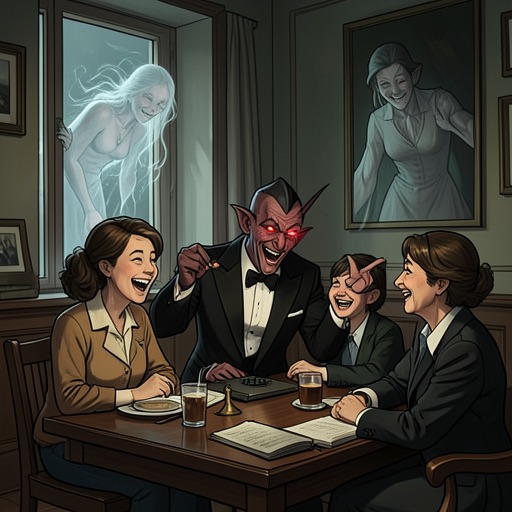
Vladislav
A History of the Vampire in Popular CultureVladislav, also known as “The Poker,” is an 862-year-old Romanian vampire in What We Do in the Shadows. Turned at the age of sixteen, he has remained physically sixteen ever since, a condition he treats with matter-of-fact pride while the film treats it as one more absurd contradiction in his character. He is the group’s most visibly old-school vampire, but his grand manner does not make him emotionally controlled: beneath the ancient title and aristocratic theatricality lies someone capable of behaving like a wounded, self-absorbed teenager.
Identity and Appearance
Vladislav’s nickname invokes the legend of Vlad the Impaler and presents him as a figure rooted in the older, more brutal traditions of vampire lore. His age gives him an imposing historical distance from the other inhabitants of the vampire house, while his sixteen-year-old appearance makes that authority unstable. The explanation for his youthful face is not a disguise or a temporary glamour but the direct consequence of his turning: he was transformed at sixteen and therefore always looks sixteen. The joke depends on the collision between enormous age and arrested adolescence, making his body an emblem of the film’s broader refusal to separate the undead from ordinary human immaturity.
Viago describes Vladislav affectionately as a genuinely good man who is also “a bit of a pervert” with “pretty old ideas about things.” That assessment places him between affection and criticism. Vladislav is not reduced to a purely monstrous villain, yet his morality and social attitudes remain visibly shaped by the distant period in which he lived. His “old school” identity is therefore both a character trait and a historical residue: he carries obsolete assumptions into a world that no longer shares them, then expresses them through the exaggerated confidence of someone who expects his age to command respect.
Temperament and Comic Method
Vladislav’s defining manner is melodrama. His reactions are expansive, self-important, and frequently disproportionate to the immediate problem, but the surrounding domestic setting makes them ridiculous rather than majestic. When he is denied the status of guest of honour at the Unholy Masquerade, he does not respond with dignified indifference. The honour instead goes to Pauline, his former girlfriend and only successful opponent in a fight, and Vladislav retreats into his coffin in a heap of wounded teenage emotion. His response converts an ancient vampire’s social humiliation into the familiar behaviour of a jealous partner or sulking adolescent.
The film’s comedy repeatedly places this dramatic temperament beside mundane practicalities. The Unholy Masquerade is held in the Cathedral of Despair, which turns out to be the headquarters of a local bowling club. The grand title promises occult ceremony and historical grandeur, but the location collapses that promise into ordinary community life. Vladislav’s own performance works in the same way: he reaches toward the language of gothic menace, only for the scene to expose quarrels, embarrassment, or domestic inconvenience beneath it.
Jonny Brugh explained that Vladislav was built from a petulant temperament, boredom, and a desire to slaughter guests, including the discarded line “send their souls to hell.” During the largely improvised basement sequence in which police search the house, Deacon suggests eating them, while Vladislav proposes waiting to see what other “Fire Safety” issues might arise. The moment captures his comic function precisely. He remains a vampire capable of killing, but his immediate attention is diverted into the language of household management. The performers were encouraged to keep the script hidden and play from simple character traits, allowing confused reactions and spontaneous interruptions to shape Vladislav in the moment.
Pauline and the Rivalry with the Beast
Vladislav’s central personal conflict concerns “The Beast,” an arch nemesis whose identity turns the supposedly external threat into a romantic history. The Beast is Pauline, Vladislav’s ex-girlfriend and the only person who has ever defeated him in a fight. Their rivalry is therefore not a simple opposition between hero and enemy. It is a cycle of intimacy, humiliation, anger, reconciliation, and renewed conflict.
The Unholy Masquerade intensifies that cycle. Vladislav expects to be made guest of honour, but Pauline receives the privilege instead. His mortification is both public and personal: the ceremony confirms her superiority at the same time that it wounds his vanity. His retreat into the coffin resembles the reaction of a jealous young lover more than that of a creature who has survived nearly nine centuries. The pair fight, reunite, and fight again, repeating the unstable pattern of couples across ordinary human history. Their immortality does not elevate the relationship beyond familiar emotional habits; it gives those habits centuries in which to recur.
Place in the Vampire Household
Vladislav belongs to a vampire household in which ancient identities are constantly reduced to the scale of shared rooms, arguments, visitors, and wounded feelings. His relationships with Viago and Deacon are marked by genuine companionship. When Petyr is killed by a vampire hunter, Vladislav, Viago, and Deacon are genuinely heartbroken. The loss is connected to Nick, the newest and least wanted member of the vampire family, because Nick’s careless presence alerts the hunter to the household. Vladislav’s grief thus exists alongside the household’s resentment toward its new arrival, showing that the vampires’ bonds are not merely comic accessories but sources of real attachment and pain.
His domestic role also places him within the film’s contrast between supernatural scale and ordinary social behaviour. The vampires are undead, dangerous, and centuries old, yet they argue and fret like anyone else. Vladislav’s ancient Romanian identity, sexual perversity, rivalry with Pauline, and emotional volatility all remain legible through familiar relationship patterns. The result is not a normalization that erases his monstrosity; rather, the film makes monstrosity coexist with pettiness, boredom, affection, and embarrassment.
Narrative Significance
Vladislav demonstrates how modern vampire fiction can preserve traditional imagery while dismantling its authority through comedy. His nickname recalls Vlad the Impaler, his age places him within the long history of the undead, and his “old school” ideas connect him to an earlier model of vampire power. Yet the narrative repeatedly denies him the solemnity that such associations might promise. A cathedral is a bowling-club headquarters, a threat becomes a domestic discussion about fire safety, and a centuries-old rival behaves like an aggrieved teenager.
His character also participates in the book’s wider account of how vampire figures absorb historical fears and social expectations. Earlier vampire panics turned disease, unfamiliar bodies, and social instability into supernatural explanations. Vladislav reverses that process: the supernatural figure is made familiar enough to reveal the ordinary emotions beneath the legend. He is frightening in premise but comic in conduct, an ancient predator whose most recognizable struggles involve recognition, romantic defeat, boredom, and the management of a shared household.
Vladislav’s importance lies in this unstable doubleness. He is at once “The Poker” and the sulking former lover; an 862-year-old Romanian and a permanently sixteen-year-old boy; a violent vampire and a performer whose menace is continually interrupted by domesticity. The film does not resolve these contradictions. It makes them the engine of his comedy and the reason he remains a vivid example of the vampire’s continuing ability to change shape without losing the cultural memory attached to the form.