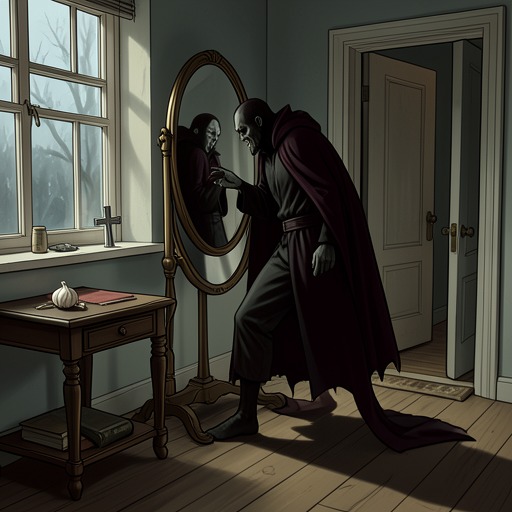
Vrykolakas
A History of the Vampire in Popular CultureVrykolakas is a Greek-derived form of the undead bloodsucker, a creature whose history demonstrates that the modern Vampire is not a single ancient invention but a layered product of regional names, fears, and narrative functions. In Lord Byron’s account, the term belongs to a tradition of terrifying revenants associated especially with Greece and the Levant; later discussion places the same family of creatures within the wider Slavic and Eastern European history from which recognizable vampire fiction emerged.
Names and Cultural Origins
Vrykolakas appears under several related names. Lord Byron records the Greek forms “Vroucolachas” and “Vardoulacha,” while “Broucolokas” is identified as an older Hellenic appellation. The terminology is unstable rather than incidental: the book presents the variations as evidence that communities named and reshaped comparable life-sucking beings according to local language and custom. The name Vrykolakas is therefore best understood as a regional designation within a broad family of revenant traditions, not as a perfectly fixed species with one universally agreed appearance or rulebook.
Byron describes the vampire superstition as still general in the Levant and recounts the terror provoked by a child’s scream, which a family interpreted as the visitation of one of these creatures. He also notes the horror with which Greeks pronounced the word and emphasizes that stories of such “foul feeders” in Hungary and Greece could be presented as extraordinarily well attested. The anecdote shows how Vrykolakas belonged simultaneously to folklore and to claims about witnessed experience: fear was sustained not only by the creature’s imagined appetite but by the insistence that ordinary people had encountered its signs.
A Hybrid Undead Creature
The Vrykolakas is described as a confused or hybrid being, combining characteristics of a Werewolf and a Vampire. Its name is associated with “wolf hair,” suggesting a werewolf connection, yet the creature’s essential behavior is vampiric: it belongs to the tradition of the returning dead and the blood-feeding revenant. This mixture makes Vrykolakas important to the history of the genre because it exposes the permeability of categories that later fiction often treats as separate. The boundary between animal transformation, nocturnal predation, and posthumous return was not originally fixed.
The same cultural vocabulary could therefore support different emphases. In Greece and related traditions, Vrykolakas could name a terrifying revenant with wolf-like associations; in Serbia and Bulgaria, the word “vampir” was commonly used for comparable beings. The names changed, but the underlying narrative function remained recognizable: a dead or undead presence threatened the living, crossed the boundary of the grave, and demanded explanation, containment, or destruction.
The Revenant Tradition
Vrykolakas belongs to the older category later rendered in English as Revenant, literally the undead. Walter Map’s twelfth-century De Nugis Curialium recounts stories of beings that modern readers would call vampires even though the period more commonly described them as revenants. One tale concerns a Welshman who repeatedly rose from his grave at night to curse his former villagers. The Bishop of Hereford advised that the body be exhumed, its neck cut through with a spade, and the corpse and grave sprinkled with holy water before being replaced.
This response clarifies the practical structure shared by Vrykolakas-like legends. The threat was not defeated through abstract classification but through a sequence of recognition, excavation, bodily immobilization, and ritual cleansing. The grave was treated as an active point of danger, while the corpse itself became the material evidence that permitted the community to act. Such stories preserve the logic of a local explanation model: unexplained deaths or nocturnal disturbances were attributed to a returning body, and physical intervention was joined to religious protection.
From Folklore to Modern Vampire Fiction
The Vrykolakas tradition forms part of the cultural background from which nineteenth-century Gothic fiction developed the modern Vampire. Before Gothic literature, vampire-like beings were generally feared and loathed and were often imagined as physically ugly. Their stories were especially common in Eastern Europe, while related life-sucking figures appeared elsewhere, including Lamia in Greek mythology, Astryiah in Sefer Hasidim, the Impundulu of the Eastern Cape, and the Scottish Baobhan Sith. These figures differ in shape, gender, powers, and social setting, yet each turns a fear of predation, death, or unexplained bodily loss into a recognizable supernatural narrative.
Nineteenth-century literature gradually reorganized this dispersed material. Lord Ruthven in John William Polidori’s The Vampyre replaced the ragged and ugly revenant with a handsome upper-class predator, while Varney introduced sharpened, fang-like teeth and made the vampire a more familiar literary figure. Carmilla established the night-roaming, physically and emotionally predatory vampire in an increasingly elegant form, and Dracula gave the creature a fully rounded personality, deliberate plans, and a lasting public identity. Vrykolakas survives in this genealogy less as a single direct model than as evidence of the older, unstable reservoir that modern vampire conventions later homogenized.
Continuing Cultural Significance
Modern portrayals can make vampires heroic, sympathetic, comic, openly integrated into society, or radically unlike traditional revenants. That flexibility is possible partly because the older traditions never possessed one immutable definition. The Vrykolakas, with its Greek names, Slavic parallels, and hybrid werewolf-vampire nature, represents the genre’s deep history of variation before mass-market fiction and film standardized expectations about darkness, seduction, fangs, and nocturnal life.
The creature’s afterlife is also visible in the broader Gothic culture that grew around vampire imagery. Film made the vampire increasingly recognizable, from the threatening and non-erotic Count Orlok in Nosferatu to later elegant and seductive figures, while the goth subculture that emerged from post-punk clubs in Britain in the early 1980s carried undead imagery into music, fashion, and public identity. Vrykolakas thus matters not only as a folkloric name but as a reminder that every apparently settled vampire rule is historically assembled: the modern monster is a composite, built from revenants, demons, hybrid animals, literary aristocrats, cinematic bodies, and successive acts of cultural reinterpretation.