Zoe Van Helsing
A History of the Vampire in Popular CultureZoe Van Helsing is the modern descendant and intellectual successor of Sister Agatha, the nun who confronted Dracula in the 2020 BBC adaptation. Terminally ill and working with Dracula’s blood in a gothic laboratory, Zoe transforms inherited memory into scientific investigation. Her encounter with the Count reveals that the myths governing vampirism can be internalized by their supposed subjects, while her final decision to let Dracula drink her blood gives his centuries of unwanted immortality a shared and merciful end.
Identity and Background
Zoe appears in the present-day portion of the adaptation as a great-great-niece of Sister Agatha. The relationship is not merely genealogical. Blood carries memories, sensations, and emotions across the generations, so Agatha remains active within Zoe rather than existing only as an ancestor remembered from history. As Zoe weakens, the boundary between the two women becomes unstable: the modern scientist can snap back and forth between her own identity and Agatha’s, making descent a form of continued embodiment.
Zoe is terminally ill with cancer, a fact that radically alters the usual power relationship between human investigator and vampire. Her disease is not simply an affliction that makes her vulnerable. It becomes an instrument with which she can threaten Dracula, because the blood of a person with cancer is poisonous to him. The adaptation therefore gives Zoe a body that is simultaneously failing, knowledgeable, and dangerous: the condition that brings her toward death also provides the means to control the immortal creature who has spent centuries evading it.
Investigation and Blood Connection
Zoe drinks Dracula’s blood after taking samples in her laboratory. The act completes the connection begun when Dracula drank Sister Agatha’s blood centuries earlier. Agatha’s earlier blood exchange with the Count had allowed memories and sensations to pass between them; through Zoe, that circuit runs across time, joining the dead nun, her living descendant, and Dracula in one physiological and psychic history.
Zoe’s scientific curiosity gives this inherited bond a distinctive modern form. Sister Agatha had used blood directly and provocatively, biting her lip and spitting her own blood at Dracula when he tried to conceal his identity aboard the Demeter. Zoe instead takes samples and studies the material in a laboratory, yet the result is no less intimate. Investigation becomes ingestion, and medical knowledge becomes a route into the supernatural relationship that Agatha began.
The connection also helps Zoe sustain herself as illness advances. Agatha’s fascination with Dracula keeps her great-great-niece going from inside, even as Zoe’s body deteriorates. This support is protective but not wholly comforting: the stronger Agatha’s presence becomes, the less securely Zoe can separate her own consciousness from that of the ancestor whose conflict has returned through her blood.
Conflict with Dracula
Zoe is fascinated by Dracula, but her fascination does not soften her judgment of him. She understands the power contained in blood and uses knowledge rather than conventional force to confront him. Her presence in the modern story exposes a contradiction in the Count’s apparent invulnerability: the vampire who can survive centuries of history can be reduced to a retching, animalistic heap when he drinks from her cancerous body, with bloody-black vomit issuing from his mouth.
The encounter changes Dracula’s relation to his own mythology. He has spent centuries believing that the cross, invitations, and other barriers define what he is, but the final scenes reveal that most of these restrictions exist only in his mind. His fear of the cross is different because it is real and immutable. Zoe helps uncover the emotional origin of that weakness: Dracula absorbed the religious fears of the uneducated peasants on whom he fed, and he also carries shame over his inability to face mortality and die a true death.
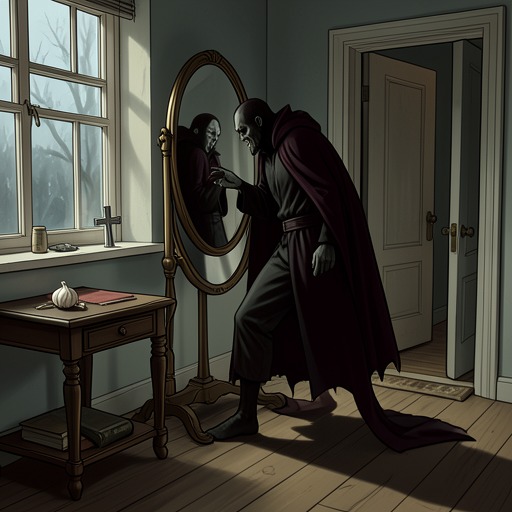
Zoe articulates the interpretation that Dracula is not merely infected by the beliefs of his victims. He is ashamed. He is ashamed that he cannot die, that he must watch everyone around him disappear, including his mortal family, and that he has been forced to continue existing for centuries beyond the life he wanted. His hatred of mirrors expresses this shame: they do not merely expose him to others, but show him an ancient, crumbling, walking corpse. Through Zoe, vampirism becomes less a condition of triumphant power than an imprisonment maintained by self-loathing and social belief.
Final Choice and Ending
The final confrontation takes place with Zoe and Dracula alone in a modern penthouse, where the centuries of antagonism are reduced to the space between two dying bodies and a table. Zoe has discovered Dracula’s true weakness, but she cannot do so without the knowledge and inherited presence of Agatha. The two women together make the Count confront the mortality he has spent his existence avoiding.
Dracula eventually drinks Zoe’s blood. The decision is partly practical and partly compassionate: by taking her blood, he transports Zoe’s spiritual form into a dream state in which she can escape the pain and loneliness of death. Her physical body lies fully clothed on a table, while the death dream joins her with Dracula in an intimate encounter that is both their first and their last. The scene turns the act of feeding into a shared passage toward oblivion rather than an ordinary act of predation.
The ending is not entirely altruistic. Dracula takes himself into the same final release, using Zoe’s poisoned blood to achieve the death he has secretly desired. Zoe’s discovery therefore becomes an act with two consequences: it ends her suffering and gives Dracula the means to end his own. For the first time since his transformation, the Count is not alone in death. His final kindness toward her is inseparable from his own need, but it remains kindness, acknowledging the bond that has linked Dracula, Agatha, and Zoe across the centuries.
Narrative Significance
Zoe Van Helsing completes the adaptation’s movement from inherited legend to modern reinterpretation. The story begins with Dracula acting as though the rules of vampire mythology are objective laws, but Zoe’s investigation demonstrates that belief itself can become a bodily prison. Religious symbols, ancestral memory, cancer, and blood are not separate explanatory systems; they meet in Zoe’s body and make her the point at which folklore, medicine, and psychology become inseparable.
Her role also reverses the traditional arrangement in which the vampire possesses the knowledge and the human victim merely suffers. Zoe is ill, but she is not narratively helpless. She identifies the weakness that Dracula cannot acknowledge, turns her disease into a weapon, and forces the immortal figure to recognize that immortality has become his deepest punishment. The inherited presence of Sister Agatha makes this victory collective: the past does not simply repeat itself, but returns through Zoe in a form capable of completing what Agatha began.
Zoe’s ending rejects a simple triumph over evil. Dracula does not merely get destroyed by an external weapon, and Zoe does not simply survive by defeating him. Their final exchange creates a tragic reciprocity in which the human and the vampire share vulnerability, memory, and release. Zoe’s decisive significance lies in making Dracula face the true enemy beneath the legends: the shame of being unable to die.