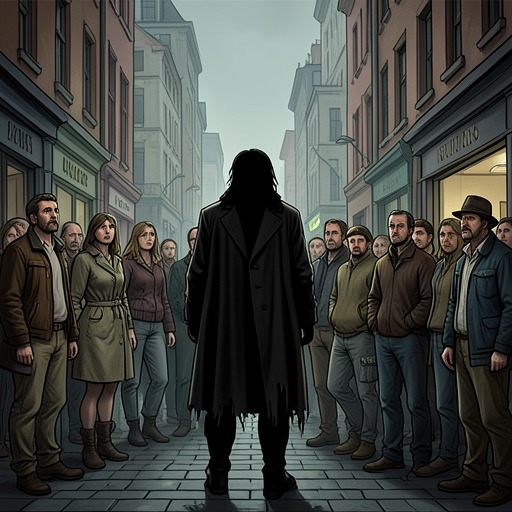
coming out of the coffin
A History of the Vampire in Popular Culture“coming out of the coffin” is a metaphor for vampires making themselves publicly known, and its decisive force lies in turning the traditional image of concealment into a political and cultural act of disclosure. In True Blood, vampires have lived alongside humans for millennia while feeding, killing, and hiding to avoid becoming targets; the phrase therefore marks not merely a change in visibility but a demand to be treated as a group entitled to equality. Its humor depends on replacing the human closet with the vampire’s grave, while its seriousness comes from the history of fear and exclusion that the metaphor carries.
Meaning and Immediate Context
The expression is most directly linked to True Blood, Charlaine Harris’s portrayal of modern vampires living openly in small-town Louisiana and the television adaptation centered on Sookie Stackhouse and Bill Compton. The vampires have emerged from secrecy and seek equality, aided, at least in theory, by Tru Blood, a synthetic blood substitute intended to let humans feel safe in their company. The phrase compresses this entire social situation into a memorable image: vampires are no longer remaining in shallow graves during daylight hours or moving invisibly through human society, but presenting themselves as a public constituency.
The expression is deliberately modeled on language used in civil-rights struggles, especially the language associated with LGBT+ communities. True Blood places “coming out of the coffin” beside the slogan “God Hates Fangs,” making the connection explicit rather than incidental. The vampire metaphor thus shifts from a story about supernatural predation to one about minority rights, public recognition, and the risks of demanding social acceptance from a hostile majority.
Disclosure, Danger, and Equality
The phrase does not make the vampires harmless. True Blood’s vampires have histories of feeding and killing, and the book stresses the unresolved question of whether a substitute diet can break habits formed over eternal lifetimes. Public disclosure consequently creates a political problem rather than solving one. Humans may be reassured by Tru Blood, but the underlying fear remains that those who have spent centuries hunting people cannot simply become safe through a change in public rhetoric or diet.
Sookie Stackhouse embodies the tension between recognition and vulnerability. Although she is presented at the beginning as a mortal telepathic waitress, she refuses to be treated as a walking buffet by the vampires around her. Her telepathy has made her an outsider among humans, but it has also made her suspicious of other people’s motives. She is unaffected by glamour and therefore cannot be easily managed through the supernatural charm that might control other humans. Her relationship with Bill Compton gives the expression an intimate dimension: coming into the open may make contact possible, but it does not remove the unequal power between a human body that can be consumed and a vampire who has learned to pass within human society.
A History of the Outsider
The expression draws strength from the broader history of vampiric otherness. Carmilla presents a central character who is emotionally and physically predatory, sleeps through the day, prowls at night, and pursues women in a nineteenth-century culture in which same-sex relationships were far from socially acceptable. Her openly same-sex desire gave the vampire figure a capacity to horrify and titillate by embodying a forbidden form of intimacy. In that context, concealment is not only a supernatural necessity; it is also a narrative condition imposed on identities treated as socially unacceptable.
The same pattern appears in the discussion of Liverpool’s vampire stories. Vampirism can function as a metaphor for outsiders and intruders who fascinate the public while also provoking suspicion. In a port city such as Liverpool, legends and superstitions arrived with crews from different countries and cultures, while Toxteth’s multicultural population was often associated with those who could not or would not live in more affluent parts of the city. The vampire becomes a convenient bogeyman and scapegoat. “Coming out of the coffin” reverses that process by making the hidden outsider visible and by asking who has the authority to decide whether an unfamiliar group is dangerous.
From Monster to Cultural Identity
The expression also belongs to a long history in which vampire conventions continually change. Varney the Vampire, first published in instalments in 1845, helped establish familiar features such as sharpened, fang-like teeth, while its sympathetic protagonist struggled against his murderous instincts and ultimately killed himself to escape his eternal fate. Carmilla refined the image of the nocturnal, selective, and increasingly elegant predator. Nosferatu’s Count Orlok, by contrast, was threatening in both appearance and manner, without the erotic beauty later associated with vampires. Across these transformations, the vampire has remained available for cultural reclassification: monster, seducer, victim, outsider, or political minority.
Modern portrayals make that flexibility explicit by allowing vampires to be good or bad and by encouraging the fantasy that they may already be present without being recognized. “Coming out of the coffin” names the moment when secrecy itself becomes a public identity. The phrase therefore participates in a movement away from a fixed vampire essence and toward a social model in which vampirism can be performed, negotiated, defended, or used to expose the prejudices of those who fear it.
Gothic Visibility and Self-Presentation
The metaphor resonates beyond fictional vampire politics because gothic culture has also transformed concealment into visible affiliation. The goth subculture emerged from post-punk clubs in northern England in the early 1980s, during political unrest and economic depression, and developed from a musical genre into a culture with its own aesthetics, history, and community. Its persistence is described as a kind of cultural afterlife: a love that does not die. In this setting, coffin imagery and mourning-wear are not signs of literal undeath but recognizable means of declaring an attachment to the gothic world.
Nadia van der Westhuizen describes goth as a safe space in which a person can be completely themselves, a culture that connects people who might otherwise feel different from the heteronormative mainstream. Clothing and elaborate makeup become methods of projecting an internal self outward; the “true” face is associated not with a bare face but with the chosen exterior. “Coming out of the coffin” can therefore be read alongside this practice of visible self-definition. Both expressions transform an identity marked as strange or threatening into something publicly claimed, socially shared, and capable of forming a community.
Cultural Function
The power of “coming out of the coffin” lies in its double register. It is a comic phrase because it treats a grave as the vampire equivalent of a closet, yet it is also an accurate description of the movement from secrecy to collective political speech. It preserves the vampire’s association with blood, death, and danger while borrowing the moral vocabulary of equality and civil rights. In doing so, it asks whether a stigmatized group must first prove its harmlessness before it can claim recognition, and whether public visibility can change the conditions that produced concealment.
The phrase ultimately makes vampirism less a biological condition than a language for contested identity. It gathers together the vampire’s traditional status as a feared outsider, Carmilla’s forbidden sexuality, Liverpool’s suspicion of immigrants and marginal communities, True Blood’s minority-rights allegory, and goth culture’s insistence that external appearance may be an authentic expression of the self. To come out of the coffin is thus to turn the old place of burial into a platform for declaration: the monster is no longer merely emerging to attack, but appearing in public to demand a place among the living.