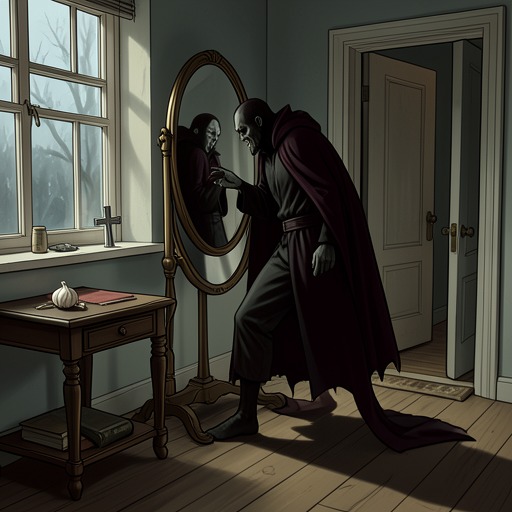
vampire crucifix rule
A History of the Vampire in Popular CultureThe vampire crucifix rule is the convention that a crucifix, or the Christian symbolism represented by it, can repel, frighten, or otherwise protect against a vampire. Its decisive importance lies in its instability. The rule appears to offer a simple defence against supernatural predation, yet the evidence repeatedly makes its effectiveness conditional: the vampire must know the symbol, believe that it has power, and participate in the religious system that gives it meaning. The crucifix therefore functions less as a universal weapon than as a boundary marker between holiness and forbidden life, with its authority shaped by history, fiction, fear, and belief.
Religious Symbolism and the Vampire
The rule draws its force from Christian ideas about life, death, and moral order. The cross becomes a visible sign of divine power confronting a creature associated with blood, the grave, and an existence outside ordinary mortality. In the nineteenth-century English novels The Vampyre and Dracula, both written by middle-class white men in England, Christian symbolism reflects the authors’ social and religious background. The cross is consequently presented not merely as an object but as an instrument of cultural classification: it identifies the vampire as a force aligned with darkness and places the defender within a Christian moral universe.
That symbolism belongs to a wider pattern in which religious ritual is used to control bodies understood as contaminating or dangerous. The Sefer Hasidim account of Astryiah describes an elderly female vampire who drinks blood through her hair, while the related account of an estrie states that a corpse with its mouth open may continue to attack the living. The proposed remedy is material and ritual at once: a spike must be driven through the mouth into the earth, and the mouth should be filled with stones. This is not the crucifix rule itself, but it belongs to the same imaginative system, in which blood, open mouths, graves, and the boundary between the dead and the living require a sanctioned act of containment. The text also gives the estrie’s victim the unusual remedy of eating the creature’s bread and salt, showing that protection against supernatural harm may involve food, burial practice, and bodily incorporation as well as Christian signs.
A Rule Made Conditional by Belief
Modern accounts explicitly question whether a crucifix possesses power independently of the person confronting the vampire. A cross can work as an anti-vampire safeguard only if the attacker knows that it is supposed to inspire fear and believes the myth strongly enough to respond to it. This makes the rule culturally recursive. Human communities teach that vampires fear the cross; vampires in fiction learn or inherit that expectation; later stories then treat their reaction as proof that the rule was always real. The supposed law of the supernatural is thus sustained by repetition.
This conditional structure also explains why vampire traditions continually contradict one another. The broader mythology includes expected tests such as looking for a reflection, using garlic, and displaying a crucifix, but the book stresses that many interpretations play fast and loose with these conventions. A crucifix-resistant vampire can exist without destroying the genre, because the rule is an expectation rather than a fixed natural principle. Each adaptation can preserve, weaken, reverse, or mock it, while audiences continue to recognise the underlying convention.
The BBC Dracula and Internalized Fear
The 2020s BBC adaptation of Dracula gives the rule its most elaborate psychological treatment in the supplied evidence. This version of Count Dracula appears to conform to several familiar conventions: he fears the cross, cannot cross a threshold without an invitation, and behaves as though these barriers are objective laws. Only in the final scenes does the adaptation reveal that most of the barriers exist in Dracula’s mind. He has spent centuries believing the myths later associated with his image, raising the deliberately self-referential question of how those myths could have shaped him when the stories were themselves developed by writers such as Sheridan le Fanu and Bram Stoker.
The cross is the exception. Dracula’s fear of it is real, fixed, and personally intelligible. In his homeland, he fed largely on uneducated peasants who were deeply subject to religious authority and who treated the power of the Cross as absolute. By absorbing the fears and beliefs of the people he killed, Dracula became vulnerable to the religious symbolism that structured their lives. The rule therefore becomes a form of psychological inheritance: the vampire does not merely suffer an external weakness but carries the beliefs of his victims within himself.
The adaptation offers a second interpretation through Zoe Van Helsing. She argues that Dracula’s vulnerability may not be an infection of peasant superstition but shame. His inability to face mortality and die a true death has left him ashamed of the condition he has chosen. Whether the source is absorbed belief or moral self-condemnation, the result is the same: the cross has authority because Dracula recognises it as the sign of what he cannot overcome. His declaration that he cannot wait to eat atheists turns the convention into dark comedy while confirming that religious belief remains central to his fear.
Protection, Ritual, and Authority
The crucifix rule is also presented through scenes in which religious authority competes with sexual desire and predation. In Francis Ford Coppola’s Dracula, Abraham Van Helsing uses religious quotations and communion wafers to repel danger when Mina is drawn into Dracula’s influence and moves toward an attack. The episode makes the cross-related tradition part of a larger arsenal of Christian protection that includes consecrated materials and scriptural language. It also carries a moralizing structure: religious defence intervenes when Mina’s desire threatens to expose her to the consequences of the vampire’s power, while Van Helsing’s authority is reinforced through the ritual objects he controls.
The 2020s adaptation complicates that conventional authority through Sister Agatha Van Helsing. Agatha describes vampirism as a contagion that removes the holy ability to die, and presents herself as an intelligent woman armed with a crucifix. She is not a passive victim awaiting rescue. Instead, she hunts Dracula in pursuit of truth and logic, testing theories about his supposed weaknesses even when she is uncertain that they are correct. Her use of the crucifix is therefore investigative as well as defensive: the object belongs to a religious tradition that she distrusts, but it remains useful as evidence in the examination of Dracula’s self-made mythology.
Historical Doubt and Cultural Persistence
The rule survives despite a long history of scepticism about vampires themselves. Antoine Augustin Calmet, the learned Benedictine monk whose Phantom World discussed apparitions, revenants, and vampires, rejected the return of vampires as impossible and incredible, regardless of how many people claimed to believe in it. His position separates the authority of testimony from the truth of the supernatural event. If the vampire is not real, the crucifix cannot be a literal weapon against it; nevertheless, the rule can remain culturally powerful because it organizes stories, rituals, and expectations.
The same tension appears in accounts of vampire panics. During the eighteenth-century vampire craze, entire villages in eastern Europe reportedly dug up suspected corpses and staked them. In 1731, deaths in a Serbian village were attributed by residents to vampire attacks despite a doctor’s explanation that malnutrition was the likely cause. The later examination of corpses by Johann Flückinger and other witnesses recorded unusual appearances that encouraged supernatural interpretation. In nineteenth-century New England, tuberculosis was likewise understood by some communities as the dead returning to drain the life of surviving relatives. The exhumation and mutilation of Mercy Brown’s body, followed by the failed attempt to give her burned organs to Edwin as a cure, shows how fear converted disease, corpses, and ritual action into a single explanatory system.
The vampire crucifix rule thus belongs to a larger history in which communities transform uncertainty into visible enemies and sanctioned responses. It gives fear a focus and supplies an apparently manageable act: raise the cross, invoke sacred authority, and hold the boundary against the dead. Its persistence in literature, film, television, and public imagination does not depend on consistent supernatural mechanics. The rule endures because it condenses religious history, bodily pollution, moral judgement, and the human desire for protection into one recognisable image: a small sacred sign held between the living and the thing that should not have returned.