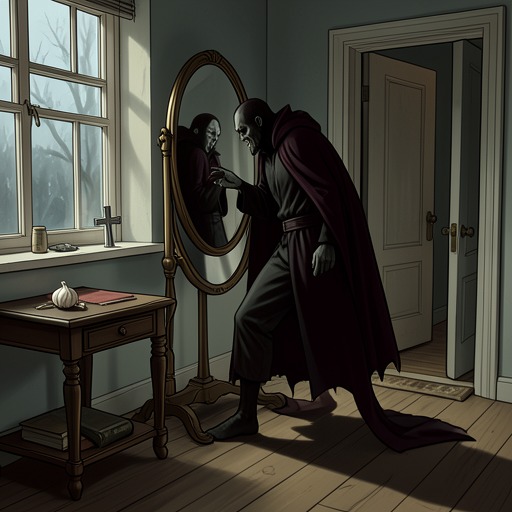
vampire reflection rule
A History of the Vampire in Popular CultureThe vampire reflection rule is the folkloric and fictional expectation that a vampire cannot be seen in a mirror. Its importance lies less in universal consistency than in the way it turns an ordinary household object into an instrument of suspicion: a glance at reflected glass can convert an apparently human figure into a supernatural threat. The rule belongs to the wider package of vampire conventions that modern literature, cinema, television, and popular culture have repeatedly inherited, altered, and sometimes mocked.
Definition and Detection
The rule is presented as a practical test for vampire tendencies. A person may be inspected in a mirror to determine whether a reflection is present, just as garlic and a crucifix are treated as defensive measures against an attack. In this form, the mirror does not merely display appearance; it promises access to an underlying identity that ordinary social behavior might conceal. The test therefore combines folklore with a small ritual of verification, making uncertainty visible through an apparently simple absence.
The convention is part of a broader modern mythology whose elements became increasingly standardized during the nineteenth century. The sharpened, fang-like teeth associated with Varney helped establish a recognizable visual vocabulary, while Carmilla reinforced the image of the vampire as a nocturnal predator who sleeps through the day and selects victims with increasing discrimination and elegance. The reflection rule operates within this same process of consolidation: it is one recognizable sign among several that allow audiences to identify a creature whose outward form may otherwise remain human.
Variations Across Vampire Fiction
The rule is not treated as an inviolable law. Its force depends on the particular interpretation of the vampire, and vampire stories have repeatedly played fast and loose with supposedly fixed conventions. The text explicitly places the reflection test beside garlic and the crucifix while warning that many versions of the legend resist or ignore these expected weaknesses. A vampire who can withstand a crucifix, or who can share a meal seasoned with garlic, demonstrates that the rules are genre conventions rather than a single coherent supernatural system.
The history of vampire representation makes this instability especially clear. In Varney the Vampire, published serially from 1845 and issued as a book in 1847, the vampire was already being reshaped into a sympathetic figure who struggled against his murderous instincts and ultimately killed himself to escape his eternal fate. Carmilla, serialised from late 1871 to March 1872, made the vampire emotionally and physically predatory while also giving the figure an openly same-sex desire that carried particular force in nineteenth-century society. These works did not simply repeat one fixed monster; they expanded the range of what a vampire could signify, and the reflection rule consequently remained available for alteration.
Film, Image, and the Vampire Body
Cinema turned vampire rules into especially powerful visual material. F. W. Murnau's Nosferatu presents Count Orlok as a threatening, rat-like figure without the erotic beauty associated with many later vampires. The film adapts the basic Dracula story while simplifying its plot and using advanced techniques for its time, including stop-motion effects that make Orlok's coffin lid fly back into place and allow him to open a ship's hatch as if by magic. Although the film's central visual emphasis is not specifically the mirror test, its treatment of the vampire body shows how cinema can make supernatural identity depend on what the camera permits viewers to see.
The survival of Nosferatu itself also demonstrates how unstable vampire images can become. Prana-Film was ordered by the courts to destroy every copy after Bram Stoker's family challenged the adaptation, but one copy had already escaped distribution and could not be recovered. All later copies descend from that survivor. The vampire image thus persisted through a form of visual survival that resembles the genre's own fascination with bodies that refuse to disappear, even as each new medium revises the signs by which those bodies are recognized.
Tod Browning's 1931 Dracula established an even more influential public image. Bela Lugosi's performance as the Count, following his success in the Broadway role and secured partly because he accepted a greatly reduced fee, helped make him an emblem of the classic vampire. The adaptation changes details of the novel, including Mina's position as Dr Seward's daughter and Renfield's journey to Castle Dracula in place of Jonathan Harker's, while retaining the general structure of the story. This process of adaptation shows why reflection rules cannot be separated from performance and visual style: audiences learn what counts as vampiric through repeated images, but those images are continually reorganized.
Social Meaning and Contemporary Revision
The reflection rule also participates in a larger cultural pattern in which vampirism marks otherness. Liverpool's many vampire stories are discussed as possible expressions of public suspicion toward immigrants arriving through its busy docks during the nineteenth and twentieth centuries. In that interpretation, the vampire becomes a metaphor for outsiders and intruders: figures who fascinate while also provoking distrust. A mirror test similarly divides the apparently ordinary person from the supposedly hidden stranger, transforming social suspicion into a supernatural diagnosis.
Contemporary representations increasingly permit vampires to be good, bad, visible, hidden, elegant, comic, or socially integrated. In True Blood, vampires come openly out of hiding in small-town Louisiana and seek equality, while the synthetic Tru Blood substitute is intended to make coexistence with humans possible. This modern extension of vampire identity weakens the idea that any single sign can settle the question of what a vampire is. The rule survives as a familiar expectation, but its reliability is undermined by a genre that now treats vampirism as a flexible identity and a vehicle for arguments about stigma, desire, and belonging.
Cultural Afterlife
The persistence of the rule reflects the continuing power of vampire conventions even when audiences know they are artificial. The goth subculture that emerged from post-punk clubs in northern England during the early 1980s turned vampire-associated darkness into music, fashion, and a broader cultural identity. Its imagery carried Victorian mourning-wear, theatrical makeup, and an enduring attraction to the undead into public daylight. For people within the scene, makeup and clothing can function as an outward projection of an internal self rather than as a disguise, reversing the older logic by which a hidden supernatural identity is exposed through the mirror.
The rule therefore remains useful precisely because it is both recognizable and negotiable. It offers a compact image of the vampire as a being that does not fully belong to the visible human world, while the history of Varney, Carmilla, Nosferatu, Dracula, contemporary television, and goth culture demonstrates that the boundaries of that world are repeatedly remade. The missing reflection is not a stable scientific fact within vampire fiction; it is a genre signal whose meaning changes whenever creators and audiences decide what the vampire should represent.