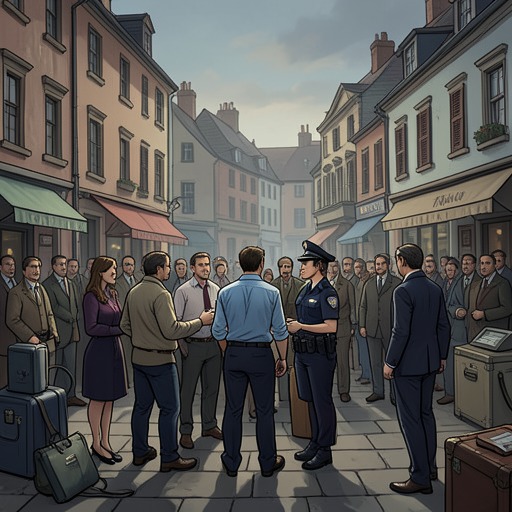
Clara murder case
A Killer’s MindClara’s murder enters the account through its aftermath: a school announcement, a funeral, and Zoe Bentley’s struggle to understand why she feels no grief. Clara was Nora’s older sister and a victim of the Maynard serial killer; her body was left in the Assabet River. For Zoe, the loss is inseparable from a disturbing question about herself: whether her apparent lack of empathy places her on the killer’s side of a moral divide.
The news and Clara’s place in Maynard
Two days before the funeral, the principal entered Zoe’s class and announced that Clara had been killed. The room responded with sobbing, cries, and shocked whispers. Zoe, instead of joining the children around her, watched the principal’s red eyes, struck by the fact that she had never seen him cry before. The announcement makes the death public and immediate, while Zoe’s attention settles on another person’s visible grief rather than on her own response.
Clara was Nora’s big sister. Nora was Zoe’s age and attended most of her classes; when they were six, the girls had been friends, and Zoe had visited Nora’s home three times. Her memories of Clara were hazy, but they included the image of a beautiful ten-year-old whom Nora idolized. This limited but personal connection distinguishes the loss from an impersonal news story: Zoe knew the family, remembered Clara as a child, and understood that Nora had lost her only sister.
The murder is associated with the Maynard serial killer and with the discovery of Clara’s body in the Assabet River. The account does not stage the crime itself. Instead, it gives its consequence through the news received at school and the funeral that follows, keeping attention on how the killing is understood by those left behind.
The funeral and the absence of grief
At the chapel, Zoe tries to summon the reactions she assumes the occasion requires: grief, horror, and fear. What she actually notices is emptiness, along with regret that she had not gone to the bathroom earlier. The bluntly ordinary regret sits beside the gravity of the funeral, emphasizing the gulf between the solemn event and her internal experience.
Zoe’s mother cries beside her, and the chapel is full of people whose sobs echo through the hall. Zoe tries to imagine Nora’s pain and to make herself cry for a girl only four years older than she is, killed brutally and taken from her sister. The effort produces nothing. When it is time to approach the coffin, Zoe makes herself look at Clara’s face. Clara appears asleep rather than visibly marked by violence. That still appearance offers no emotional release: Zoe turns away to search the crowd for someone else who seems not to be crying, but sees tears or near-tears on the adults’ faces.
The scene sets public mourning against private blankness without treating the crowd as a measure that Zoe can simply imitate. The school counselor has told the students that grief takes different forms and that all reactions are normal, yet Zoe doubts that this reassurance includes feeling nothing. The question is not only why she fails to mourn in the expected way; it is whether that failure means something alarming about her character.
Zoe’s fear of resemblance
Before Clara’s death, Zoe had been borrowing books about serial killers and reading about psychopaths. She had also been collecting articles that mentioned the Maynard killer. At the funeral, these interests sharpen her self-scrutiny: she knows that psychopaths are associated with an absence of empathy, recalls the estimate that they make up one percent of the general population, and wonders whether she is one of them. Her inability to cry for Nora’s suffering becomes, in her mind, possible evidence against herself.
That fear culminates in a harsh comparison. Zoe perceives herself as having no tears and no empathy, and concludes that she is like the killer. The comparison is her distressed judgment, not a finding established by the account: the same passage shows her worrying about Nora, trying to feel for her, and fearing what her own response might mean. Her fascination with murder and her numbness at the funeral therefore converge as questions she cannot resolve, rather than proof that she shares the murderer’s nature.
Andrea and the journey home
Andrea walks beside Zoe and takes her hand, her face serious. She has been sleeping in Zoe’s bed every night, and Zoe recognizes that she knows something is wrong. Andrea’s quiet closeness provides a counterpoint to the public rituals of the funeral: she does not need Zoe to explain or display a particular emotion in order to stay with her.
Outside, snow covers the chapel yard, the trees, the grass, and the low wall beside the street. Zoe follows her parents to the car in silence and feels lightheaded, almost elsewhere. On the ride home, Andrea rests her head against Zoe’s arm and repeatedly strokes Zoe’s thumb, as she sometimes does at night. Zoe says nothing, even though the touch tickles. The car journey through the small town is quick, but after they get out, Zoe cannot understand why the world seems to tilt. The account ends this passage not with an answer to her fear, but with the physical disorientation of a child carrying an experience she cannot yet make sense of.
Significance in Zoe’s story
Clara’s murder matters here through the contrast it creates between what the community can express and what Zoe believes she cannot. Her examination of the coffin, her search among the mourners, and her attempt to compare herself with the killer all turn the funeral into an inward test. The evidence does not show Zoe reaching a conclusion about her capacity for empathy. It shows her beginning to treat emotional numbness as a frightening possibility, while Andrea’s hand and presence offer a small, concrete form of companionship amid the unanswered question.