Jackie Teller
A Killer’s MindJackie Teller is the second young woman killed in the 1997 Maynard murders, found in the shallow water of Durant Pond after going out with her dog. Her death transforms a local fear into a personal loss for Zoe Bentley’s family and becomes one of the case’s enduring uncertainties: the police account leaves open whether Jackie was killed by the same person as the other victims, while a later account says authorities either left the case unresolved or blamed Manny Anderson. Jackie is known through these fragments, but their consequences reach well beyond the circumstances of her death.
Identity and Connection to Maynard
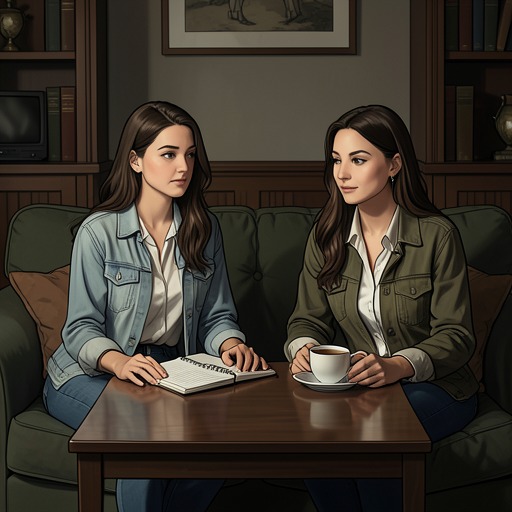
Jackie was the daughter of a woman in Zoe Bentley’s mother’s book club. Zoe’s mother had attended Jackie’s sixteenth birthday two years earlier, and, after Jackie was killed, attended her funeral. That social connection makes the crime more than news from a neighboring street: someone the family knew through ordinary community life has been taken. Jackie’s presence in the story is brief, but the family connection gives her loss a specific place within the town’s network of parents, children, and acquaintances.
The account does not describe Jackie’s character, daily life, or ambitions. Instead, it establishes her through the circumstances in which other people encounter her: her mother’s search, a dog returning without her, a shaken search-party member, and the increasingly guarded routines of the Bentley household. That limited perspective is itself significant. Jackie appears less as a speaking character than as a person whose absence reorganizes the behavior and understanding of those left behind.
Disappearance and Discovery
On the evening she disappeared, Jackie went walking with her dog. When she had not returned an hour later, her mother went out to look for her and then called the police. A few hours after that, the dog came home with its leash still attached, but Jackie did not. A search party found her that same night in the shallow water of Durant Pond. Her hands had been tied behind her back. These details establish the sequence plainly: an ordinary walk became an unexplained absence, and the dog’s return offered no answer about where Jackie had gone.
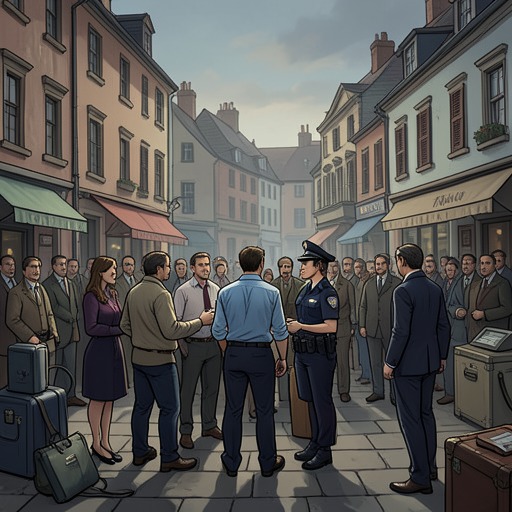
The discovery also made the crime immediate to people beyond Jackie’s household. Roy, the nineteen-year-old brother of Zoe’s friend Heather, was part of the search party. He came home deeply shaken and blurted out what had happened before the adults could keep Heather from hearing it. The information reached Zoe through this distressed disclosure, rather than through a full public account. For her, Jackie’s death was therefore both a reported crime and a frightening event already moving through the lives of people close to her.
By October 23, five days after Jackie had been killed, the household around Zoe had changed. Zoe’s parents spoke in whispers; her mother sometimes fell into long, unresponsive stares and insisted that the girls be driven to and from school. Zoe had to be home by five, before dark. When Andrea ran outside with a ball, their mother chased her back inside in a panic, and Zoe comforted her younger sister. The family expected there would be no trick-or-treating that Halloween. These reactions belong to Jackie’s aftermath rather than to Jackie herself, but they show how the killing turned everyday freedoms into perceived risks.
The Case and Its Uncertainties
Early reporting offered little clarity. Asked whether Jackie had been killed by the same person as the first victim, police said they were still investigating all possibilities. The article Zoe read reported progress without supplying details about suspects or explaining why the women had been killed. With two young women dead and the investigation’s conclusions unavailable to the public, Maynard’s residents began avoiding the streets at night. Jackie’s case thus entered the story not as a solved crime but as part of an expanding danger that people could feel and could not yet explain.
The question of a connection between the victims recurs through physical and investigative evidence. Both bodies had been found in shallow water, a similarity Zoe noticed when she went to Durant Pond and considered whether proximity to water mattered to the killer. She imagined the search party moving along the trail with flashlights and finding Jackie in the water. The scene at the pond was calm when Zoe visited, with leaves on the surface and ducks swimming nearby, but its ordinary appearance could not settle what had happened there. Zoe’s observation raises a question; it does not establish that the killer selected victims or locations because of water.
Later, Jackie’s case remained part of the disputed record of the three Maynard victims. Looking at photocopied files, Zoe explained that some would call Jackie’s death unresolved, while others would say Manny Anderson had killed her; Manny was dead. The shifting description matters: a case can be labeled solved through an accusation without the people around it agreeing that the evidence has resolved it. Zoe’s view of the police’s reasoning was sharply critical. She believed they had found someone who loosely fit and then made the case conform to him, pointing to judgments based on his cartoons, role-playing games, and lack of a girlfriend. The narrative presents her objection as a challenge to the credibility of that reasoning, not as a complete account of every investigative step.
Memory and Narrative Significance
Jackie’s death keeps returning through images and records. Zoe wakes from a nightmare thinking of Jackie and Beth, then distinguishes their fate from hers: they had not woken afterward. At another point, Zoe recalls the case photographs she obtained from the Maynard Police Department. Much later, a yellowed photocopy with grainy crime-scene images brings Jackie’s file into a new investigation, where Tatum Gray asks whether she was one of Rod Glover’s victims. Zoe answers by locating her among the three 1997 Maynard killings and describing the uncertainty over who was held responsible. The file carries the case forward, but it does not make the case less contested.
Jackie also shapes how Zoe learns to reason about violence. At Durant Pond, Zoe asks what might have happened on the path and whether the killer approached Jackie directly or spoke with her first. These are questions, not recovered facts, and the narrative preserves that distinction. The gap between what is known and what can only be imagined becomes part of Jackie’s continuing presence: she prompts Zoe to test theories against circumstances while warning that a plausible explanation is not proof. Her role in the novel is therefore both personal and evidentiary. She is a daughter and a young woman whose death devastates a community, and a case whose unresolved status exposes the cost of premature certainty.