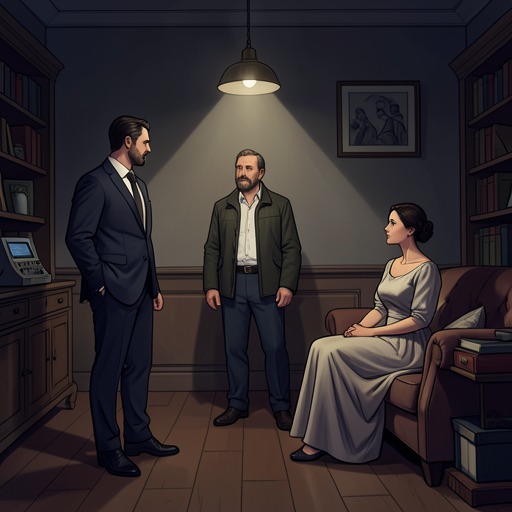
Jeffrey Alston’s need for control
A Killer’s MindJeffrey Alston’s need for control is the organizing principle behind his methods and his fantasies. In the emerging profile, careful preparation and command over his victims are not separate from his longing for companionship: both serve a private world in which uncertainty and the possibility of rejection have been removed. The interpretation shifts the case from a study of technique toward a disturbing account of loneliness turned into possession.
Identity and Development of the Profile
The profile first takes shape as Lieutenant Martinez asks Zoe Bentley to return to her analysis of the killer. She has been distracted by evidence that has made her think she may already know who he is, but she resumes the task by looking at what his behavior indicates. His prolonged practice of preservation techniques on animals suggests a methodical person, she reasons: someone who plans before pursuing a fantasy and then carries out that plan patiently rather than improvising.
That inference becomes more specific when Zoe identifies control as the profile’s central attribute. She reads it across the killer’s choices, from the way he restrains victims and preserves them so that he can pose them, to his selection of vulnerable women and use of a setting where he can dominate the situation. His strangulation method, as she understands it, is designed to limit both physical contact and the victim’s ability to resist or call out. The details matter to her not merely as clues to a technique but as parts of a consistent preference: the killer seeks to determine what happens and to prevent events from escaping his command.
Zoe also proposes a childhood explanation, predicting that the man will prove to have had an abusive parent and an unstable upbringing, with little control over his early life. In this account, adult domination compensates for earlier powerlessness. That remains a profiler’s prediction in the cited analysis, not an independently established fact about Alston’s childhood; the distinction matters because the profile interprets a pattern without turning its proposed cause into confirmed biography.
Control as Method
The killer’s preparation gives control a practical form. His long practice with preservation techniques points to patience and deliberation, while the arrangement of his victims lets him impose a chosen appearance on them. He does not simply act on impulse: the profile describes a sequence in which he develops a fantasy, plans for it, and executes it carefully. Methodical planning is thus both a behavioral signature and a means of reducing the chance that another person can alter his intended outcome.
The same desire governs his management of risk. Zoe’s analysis connects his choice of vulnerable victims and controlled locations with the restraint and killing method she believes he uses. These are distinct parts of one pattern: selection helps place the encounter on his terms, while the method is intended to constrain the victim’s agency. The preservation and posing that follow extend his control beyond the moment of killing, allowing him to dictate how the women appear. The profile’s force comes from this continuity, not from any single technique.
Loneliness and the Relationship Fantasy
A later conversation between Zoe and Tatum Gray recasts the meaning of preservation. Zoe argues that the killer is trying to have a relationship with the women he embalms, not merely to satisfy sexual urges. She acknowledges necrophiliac tendencies but identifies companionship as the larger motive: he wants someone present in his home and cannot manage a successful relationship with a living partner. A ring and an evening dress associated with Susan Warner’s appearance support the impression that the killer imagines the women within romantic scenarios, rather than treating their presentation as an arbitrary flourish.
This interpretation connects loneliness to control without making them interchangeable. The imagined relationship promises company, but it also removes the other person’s independence: the killer can preserve and arrange the women according to his wishes. What he seeks as intimacy is therefore inseparable from his refusal of mutuality. Zoe’s explanation makes the apparent contradiction central to the case: he longs for a relationship while shaping its terms so completely that the other person cannot choose or respond.
Fantasy, Conflict, and Significance
The later account of Alston’s motives brings the two strands together. His fantasies are fueled by control and loneliness, especially in relation to women; he imagines a dead woman whose preserved body will never decay and who will remain with him. That fantasy supplies an explanation for the repeated killings: the imagined companion is not incidental to the crimes but the desired outcome that drives them. The earlier emphasis on planning and technique therefore describes how he tries to realize the fantasy, while the later emphasis on loneliness explains what the fantasy is meant to provide.
Zoe’s confrontation with Alston also turns the profile into a practical understanding of the danger. Recognizing that control governs his fantasies and actions, she has to maneuver herself into the fantasy in order to take control away from him. The narrative thus makes the profile consequential: insight into his pattern shapes how she responds to him, rather than remaining an abstract account of motive. His need for control is both the logic of his crimes and the vulnerability that Zoe attempts to use against him.