Maynard
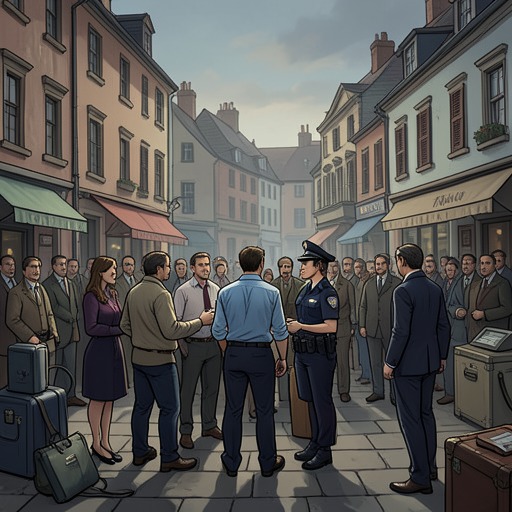
A Killer’s MindMaynard is the Massachusetts town where a series of 1997 murders turns the ordinary circulation of local news into a source of fear, speculation, and error. Its significance lies in the collision between its close-knit social life and an investigation that residents struggle to understand: information travels quickly, yet rumor fills the gaps left by police silence, and familiarity with a suspect can become a substitute for proof.
Setting and social fabric
The story places its Maynard episodes at particular moments in the fall and winter of 1997. On Saturday, September 27, Zoe Bentley overhears her parents speaking in low voices at home. Her mother asks whether the authorities have any suspects, while her father paces nearby. The scene establishes that the investigation has entered family life before Zoe has been given a clear account of what happened. Her parents’ hush is itself a sign of the town’s changed atmosphere: a household described as normally loud has begun to communicate in guarded conversations and strained silences.
Maynard’s small-town character is conveyed less through a general portrait than through the way people are connected. Heather learns about a body from her father and a neighbor, then tells Zoe in private that it was found near White Pond Road Bridge. Later, Zoe learns that Beth Hartley, the victim, was twenty-one and worked as a secretary for a local accountant. Zoe recognizes Beth’s newspaper photograph and wonders whether she might have seen her around town. The possibility of ordinary encounters—on the street or in everyday errands—makes the victim feel close without establishing that the two women knew one another.
The same network of acquaintances brings the next killing into Zoe’s family’s immediate circle. By October 23, Zoe’s mother has learned that Jackie Teller, killed five days earlier, was the daughter of a woman in her book club. She had attended Jackie’s sixteenth birthday two years before and now has gone to her funeral. In Maynard, the murders are not only reports about strangers: connections through parents, neighbors, and social groups repeatedly carry the news into the home.
Murders and the disruption of daily life
The first account Zoe receives of the discovery at White Pond Road Bridge comes secondhand. At school, rumors add details that the investigation has not confirmed in the information available to her. They leave her frightened and helpless, and she goes to the Assabet River, wondering whether that is where the body was found. What she knows there is uncertain: the accounts circulating among students are not the same as verified information. The distinction matters because the town’s fear is fed partly by the crimes and partly by the stories people build around them.
The landscape offers no easy answer to that fear. At the river, Zoe cannot reconcile the ordinary setting with the idea of a body having been found in the water. Her response includes not just fear but agitation and a feeling of excitement. That mixture marks the beginning of her unusually intense attention to the murders; the case is frightening, but it also draws her toward questions she wants to pursue.
The newspaper becomes another imperfect connection between the town and the investigation. After hearing her parents discuss it, Zoe takes a paper to her room and reads a report announcing progress in the Hartley murder. The article supplies little that would resolve her questions about suspects, custody, or motive. Its repeated use of the same photograph of Beth makes the victim visible to the public while leaving the facts of the case indistinct. The gap between a familiar face in print and scarce information sharpens Zoe’s frustration rather than reassuring her.
By December, the effects have reached funerals as well as newspaper pages. On December 14, Zoe stares at an open coffin and finds herself unable to summon the grief or horror she thinks she is expected to feel. The scene places the town’s accumulating losses beside the private, sometimes uncomfortable ways individuals respond to them. Maynard’s changed mood is not presented as a single public reaction; it is experienced through household silences, a mother’s personal connection to a victim, and Zoe’s own confused response.
Local knowledge, rumor, and suspicion
Maynard’s closeness is useful to Zoe when she notices how stories ought to travel. Rod Glover once told her that he had been at Durant Pond and described a fire in which he rescued a secretary. Zoe realizes that she has heard the story from no one else. In a town where even a flat tire might become common knowledge, she reasons, an office fire and a dramatic rescue should have been widely discussed. She recalls other improbable claims Glover has made, including that he had been an extra on Buffy the Vampire Slayer and a CIA informant. Her reasoning turns the town’s reputation for gossip into a test of credibility: a conspicuously absent story becomes suspicious to her.
Yet the community’s dense circulation of information does not guarantee accuracy. When Zoe raises Glover’s name in connection with Clara’s murder, Officer Will Shepherd retrieves papers and tells her that Glover is not the killer: seventy-eight people, including Shepherd, were part of the search party when Clara disappeared, and the search timing corresponds with the time of death. The evidence gives Glover an alibi. Zoe had arrived convinced that her theories fit, but the dry explanation unsettles her. During the ride home, she questions whether she had joined disparate details too confidently and whether an item of clothing or pornography in Glover’s home could have innocent explanations. Maynard’s familiarity with its residents can generate suspicion as readily as it can test a story.
A different kind of local inference shapes the authorities’ attention to Manny Anderson. After Zoe’s father asks for information to calm his daughter, Shepherd privately tells him that Manny is their suspect and warns him not to tell anyone. Manny is a high-school senior whom Zoe recognizes from the town library, where he reads alone. When she later hears that he keeps to himself, draws strange cartoons, plays Dungeons and Dragons, and has never had a girlfriend, she rejects those traits as evidence. The town’s descriptions may make Manny seem unusual to some residents, but they do not establish that he committed the murders. Zoe sees the same leap in the police reasoning that she believes they made in dismissing her: starting with a person who appears to fit and then making the available details confirm the choice.
Investigation and narrative significance
The Maynard case is also shaped by incomplete investigative knowledge. Zoe questions whether the killer’s public murder sites demonstrate a desire for publicity or a game with the authorities. She argues instead that the places may have been selected because they are nearly empty at night and lack security cameras, and that the posing of a body has meaning for the killer. Her challenge to Lieutenant Martinez’s interpretation shows her trying to distinguish an evidence-based account from an assumption about motive. In another discussion, the prospect of staking out areas where prostitutes might be targeted meets an admission that investigators do not know what to look for; the weakness of the proposed profile makes the uncertainty concrete.
Maynard’s episodes also feed Zoe’s understanding of how an offender might change. After the police nearly catch the killer in another part of the story, she reasons that he will adapt, avoid repeating the mistake of leaving a phone with a victim, and perhaps choose someone outside the group the investigators expect him to target. This is her assessment, not proof of the killer’s next move, but it turns the investigation away from relying only on a predicted victim profile and toward tracing mistakes in earlier crimes.
As a setting, Maynard therefore holds two conflicting kinds of knowledge in view. Its residents are close enough to connect victims to book clubs, birthdays, neighbors, and newspaper photographs; the same closeness encourages whispered accounts and judgments about people who seem strange. Zoe’s scrutiny of Glover’s stories demonstrates how local memory can expose a discrepancy, while Manny’s suspicion demonstrates how social difference can be mistaken for evidence. The town is not simply a backdrop to the murders: it is the intimate information network through which grief, fear, investigation, and misjudgment pass.