Strangling Undertaker murders
A Killer’s MindThe Strangling Undertaker murders are a Chicago serial-killing case in which embalming and the deliberate placement of victims turn the bodies into both evidence and public spectacle. The killer’s method grows more controlled over time: early failures give way to increasingly refined preparations, while the investigators struggle to infer his process from scenes left in places used by thousands of people. The case’s central tension is between a pattern that can be read and a perpetrator who learns how to change it.
First Victims and an Emerging Pattern
The case reaches federal attention after Monique Silva, a prostitute from Chicago, is found in Humboldt Park. In the photograph shown to Tatum Gray, she stands on a wooden bridge above a stream, posed as if looking toward the water. Her pallid appearance makes the body seem strangely lifelike. Christine Mancuso explains that Monique had been dead for five to seven days before discovery, although her pimp had reported her missing two weeks earlier. She is the second victim found embalmed and posed, making the repeated treatment of the bodies—not simply their deaths—a defining feature of the investigation.
The first victim, Susan Warner, represents a less accomplished beginning. She was an art student attacked in her home, where the killer remained to embalm her. Her body was found on April 12. The dress he tried to put on her tore; her limbs would not move into the position he wanted; and the final arrangement did not appear lifelike. In Zoe Bentley’s reconstruction, this is not just a difference in presentation but a failure the killer would try to correct. The almost three-month interval before the next known victim becomes meaningful in that light: Zoe interprets it as time spent learning and experimenting with ways to preserve flexibility and produce a more convincing appearance.
Monique’s case suggests a changed method of access. Unlike Susan, the second and third victims were prostitutes, whom Tatum reasons the killer could persuade to accompany him by posing as a client. His analysis distinguishes the initial attack at a victim’s home from the later pattern of bringing women to a safer place. He also argues that the women were bound while alive, making a street or alley attack less plausible than an encounter in a place the killer controlled. These are investigative deductions, not a complete account of what happened in each case, but they help define the sequence the team is trying to reconstruct.
A Public Investigation
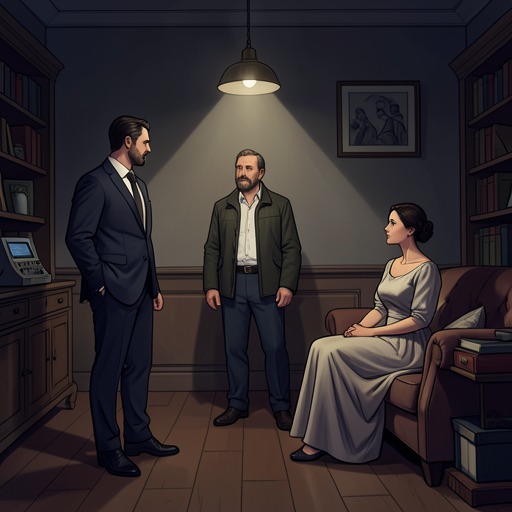
The Chicago Police Department’s Central Investigation Division gives the cases a dedicated situation room: detectives work around a large table, with photographs, timelines, and a Chicago map marked at two locations. The nickname The Strangling Undertaker has already spread through newspaper coverage. A reporter coined it only days earlier, and it quickly caught on. The label condenses the case into a memorable figure, even as the investigators still have to establish what the evidence actually supports.
The bodies’ placement in public areas makes the case difficult to contain. After another woman is found at Ohio Street Beach, spectators gather behind the crime-scene tape, some taking photographs, while television crews report from the scene. Tatum identifies her as the third victim; Lieutenant Martinez confirms that only eleven days have passed since the previous one. The short interval turns the pattern into an immediate warning: the investigators fear another death before they can identify the killer. Public visibility brings pressure on the Chicago Police Department, which has asked for help. The bureau’s Chicago agents are occupied with a large impending arrest of Latin Kings members, leaving the case to be pursued with federal assistance from outside that immediate workload.
The investigative response initially follows the behavioral profile. Martinez says the suspect is thought likely to have worked in a funeral home, so detectives begin checking funeral-home records in the areas where the bodies have been found. Tatum questions whether watching the drop sites would help: they are busy public places, with thousands of people passing through. The exchange captures a practical difficulty at the heart of the case. A public dumping ground offers visibility after the crime, but its ordinary crowds make it hard to identify the person who used it.
The Killer’s Process and Adaptation
Zoe’s reconstruction treats the murders as a process that changes in response to mistakes. Susan’s failed presentation points to a period of learning; Monique’s more controlled pose suggests that the killer has improved. Zoe also revisits the autopsy findings: marks on Monique’s throat and restraints on her wrists and ankles indicate strangulation and a struggle against being bound. The physical evidence helps her reason backward from the bodies to the practical circumstances of the crimes, rather than treating the poses as a fixed signature detached from how the killer obtained control.
Clothing offers another clue to the sequence before the murders. Susan’s wardrobe was available because she was killed at home, but the later victims wore clothes that did not fit the same way across their differing builds. Zoe points out that Krista Barker was taller than Monique and that Lily Ramos was not as thin as either. She reasons that the killer may have taken victims shopping before killing them, presenting the outing as part of a client’s plans to dress them for the evening. Tatum follows the implication to a shopping mall. The hypothesis reframes the clothing as evidence of an earlier stage in the killer’s approach, not merely a detail of how the bodies were presented.
After the police come close to catching him, Zoe anticipates that he will change his routine. She believes he knows the mistake was leaving a phone with a victim, and predicts he will act faster during a later abduction and choose someone other than a prostitute, while still seeking a vulnerable target. Her conclusion is that future victims may no longer provide the most reliable route to him; investigators will need to trace the clues and errors in his earlier crimes. The distinction matters because the killer’s pattern is not static. In Zoe’s account, adaptation is itself part of the pattern, and each improvement can make the next crime harder to anticipate.
Suspicion, Evidence, and Narrative Significance
The book places the Chicago investigation beside a separate Maynard case to show how readily a suspect can be selected to fit a story. In that earlier investigation, Rod Glover is ruled out of Clara’s murder by an alibi: seventy-eight people were with him during the search for Clara, and the timing corresponds with the time of death. The episode supplies a clear evidentiary contrast to suspicion based on impression. It does not establish a connection between Glover and the Chicago murders.
The same Maynard thread shows Zoe objecting when police reasoning turns Manny Anderson’s reserved personality, unusual cartoons, and Dungeons and Dragons games into an argument for guilt. At fourteen, she believes investigators dismiss her analysis as the reaction of a hysterical girl, even as she sees the weakness in their case against Manny. This separate storyline sharpens the Chicago case’s broader concern with how evidence is interpreted: a psychological profile may guide a search, but it cannot substitute for proof, and a vivid public label can outrun what investigators know. The murders are frightening not only because the killer refines his method, but because both the suspect and the explanation of the crimes can change faster than an investigation built on assumptions can keep up.