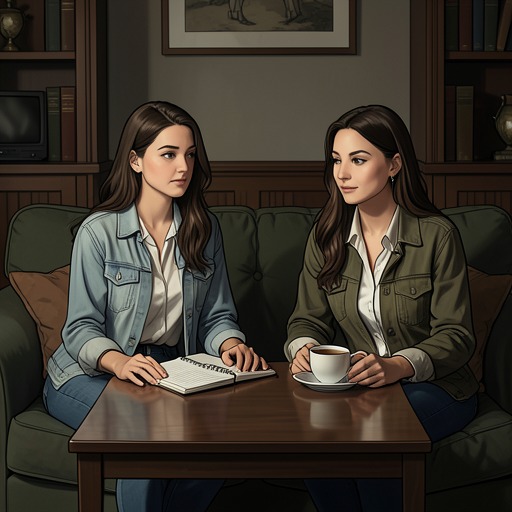
Zoe Bentley
A Killer’s MindZoe Bentley is a psychologist in the FBI’s Behavioral Analysis Unit whose professional judgment is shaped by a personal history of being right about a dangerous man and not being believed. In the 2016 investigation of Chicago’s Strangling Undertaker murders, she challenges an established profile, develops a more specific account of the killer’s behavior, and recognizes a possible connection to Rod Glover, the neighbor she tried to expose as a teenager. Her work is marked by a tension between disciplined analysis and the emotional force of a case that has followed her for years.
Identity and Introduction
Zoe works in the FBI’s Behavioral Analysis Unit and is addressed professionally as Dr. Bentley. Her job requires her to turn information from crime scenes, interviews, and investigative records into a usable behavioral profile. That analytical role is not presented as effortless detachment: she is conscientious about her work, but fatigue and the strain of the investigation affect even its ordinary routines. At the unit, she arrives early intending to finish a weekly report, then falls asleep at her desk before she can begin it. She wakes at 9:12 a.m. with a sore neck and an unfinished document on her screen. The episode gives her professional life a practical texture: the same person expected to interpret a killer’s behavior can be exhausted by paperwork and the accumulated pressure of the case.
That pressure has a recurring personal source. Brown envelopes arriving in the mail bring back nightmares, and Zoe knows to expect them when she goes to sleep. After waking from one, she checks the time: twenty-one minutes past four. The early hour has already cost her the possibility of returning to sleep, and she anticipates needing seven cups of coffee rather than her usual five. Her private response to the envelopes is not separate from the investigation. They make the past intrusive, repeatedly disturbing the rest and concentration on which her present work depends.
The Maynard Case and a Disregarded Warning
The history behind Zoe’s certainty about Glover begins when she is fourteen. She tells a police officer that her neighbor is the Maynard serial killer, and tries to make the accusation credible by laying out the research behind it rather than relying on a vague impression. She describes how Glover appeared to match traits she had studied, raises Durant Pond, and refers to an interview with Son of Sam about returning to a crime scene. She has also looked inside Glover’s home using a key, where she noticed pornography, underwear, and a shoebox. Acknowledging that she had a key seems to her a way of making her conduct sound less like breaking in, even as she recognizes that the distinction may not hold.
The officer’s response reduces her account to a neighbor’s odd habits. He treats wet socks as evidence that Glover is a slob, not a suspect, and tells Zoe that fear has spread through the town. When he finally explains the obstacle to investigating Glover, he cites an alibi: seventy-eight people, including the officer himself, were in the search party for Clara at the time of her death, and Glover was on the list. The officer uses that fact to tell Zoe to stop accusing him. The details she has assembled do not overcome the official conclusion.
The alternative suspect, Manny Anderson, sharpens Zoe’s sense of how an investigation can go wrong. She hears that he is quiet, has few friends, draws strange cartoons, plays Dungeons and Dragons, and has never had a girlfriend. She sees no meaningful evidentiary connection in those traits. To her, the police have found someone who roughly fits their image of a suspect and then made the case fit him. Her anger is compounded by the belief that her own reasoning is discounted because she is a hysterical fourteen-year-old girl. The failure is therefore both investigative and personal: Glover remains beyond scrutiny, while Zoe learns that a plausible warning can be dismissed on grounds that have little to do with its substance.
Profiling the Chicago Killer
When Zoe joins the Chicago investigation, the case has already acquired a media name: the Strangling Undertaker. Lieutenant Martinez shows the task force’s room, where photographs, timelines, and a map organize the evidence. The developing map matters to Zoe because the marked sites do not point to one focused neighborhood. Later, the marks for Ohio Street Beach and Brighton Park make the geographic spread still clearer. The public name, by contrast, encourages a neat explanation: news coverage reports that the killer is probably a white man who works in a funeral home.
Zoe challenges that explanation by examining the victims’ preservation. She argues that the first victim’s decomposing foot and the second victim’s more complete preservation, achieved with a different embalming mixture, suggest a killer learning the process rather than an experienced funeral-home worker. She has spoken with an embalmer, who confirms her assumption that the killer is not an established funeral-home employee, unless he has only recently started. In her view, excluding experienced workers makes more sense than building the suspect pool around the profile’s professional-sounding authority. Ruben Bernstein’s claim that a funeral-home background is likely may sound logical, she argues, but the physical progression of the work points in another direction.
She also resists treating the body-disposal sites as proof that the killer is seeking attention or playing a public game with investigators. He has not written to newspapers or the police. The sites are public, but can be empty at night and lack security cameras; to Zoe, the poses and locations may have private significance instead. She insists that competing interpretations must be tested rather than allowing one to become probable merely because an expert has stated it confidently. In her view, televised serial-killer commentators can mislead the public, encourage hysteria, and damage the conditions for fair trials. Her criticism of Bernstein is thus also a criticism of the authority that comes from a polished profile when the case details do not support it.
Zoe’s working profile remains cautious about what investigators can do with it. She considers prostitutes the highest-risk group and discusses staking out likely areas with Martinez, but admits the practical description of a possible offender is weak: a strong man, not especially intimidating, with a reasonably good-looking car. Martinez observes that this could describe much of the police department. The exchange shows her distinction between identifying vulnerability in a pattern and pretending that a broad description can pinpoint an individual.
Method, Control, and a Changing Offender
Zoe develops her profile from recurrence and change rather than assuming the killer has one fixed signature. She understands that a serial killer may alter methods to fit an evolving fantasy. After the offender nearly gets caught, she reasons that he will need time to regroup and will learn from the mistake of leaving a victim’s phone behind. She expects him to act more quickly next time and possibly choose someone other than a prostitute: still vulnerable, but outside the target group the police expect. Her warning shifts the investigation away from a simple hunt for the next victim and toward evidence left by earlier crimes.
That approach also informs her account of the killer’s preparation. The prolonged practice of preserving animals suggests a methodical person who plans rather than improvises. When Martinez asks for the leading personality trait behind the pattern, Zoe identifies an obsession with control. In her analysis, the victims are restrained; preservation allows the killer to pose them; and he chooses vulnerable people and takes them somewhere he can dominate the situation. The Noose, tightened by twisting from behind, is part of the same pattern: a method designed to limit physical contact, noise, and the victim’s ability to resist. The profile joins seemingly separate choices—practice, location, restraint, and method—under one explanation.
Her own attention to animals emerges through a small but consequential moment at her desk. While shredding the last pages of sparse reports about taxidermied animals, Zoe asks herself what caused the killer to start practicing on them. Preservation makes sense in relation to his apparent desire to keep victims intact, but the initiating influence remains an open question. She considers whether a book or film might have prompted the practice without claiming to know. The question matters because it moves her from describing what the killer does to investigating how the fantasy acquired its form.
Glover, the Envelopes, and the Present Danger
The envelopes eventually force Zoe to consider the connection she has been trying to establish. In July 2016, she keeps three ties in a desk drawer on top of the envelopes and delays giving them to Martinez. She wants to assemble the corresponding evidence first. If she presents the killer as the same man she accused when she was fourteen, she fears that Martinez will think her irrational and remove her from the case, perhaps along with Tatum Gray. She tries instead to frame the question as whether a dangerous man with a history of killing is connected to the new murders. The distinction is important to her: personal history has led her to the possibility, but she knows that possibility must be made persuasive as an investigative claim.
The old envelopes provide a reason to suspect Glover, but Zoe still tests alternative explanations. She wonders whether a reporter could have sent the new ones and compares the handwriting with that on the envelopes she has at home. She is not a document examiner, yet the writing appears similar. More decisively, she cannot see how anyone else would know about the ties and their significance. Her reasoning remains an inference, not a result established by the evidence she has gathered, and her hesitation reflects the danger of letting personal certainty outrun verification.
Glover’s identity becomes immediate when Zoe sees him at close range. Twenty years older and now in his mid-forties, he is heavier than the thin, lanky man preserved in her adolescent memory. His eyes, however, seem unchanged to her. When he blocks her route back toward the road, she runs in the opposite direction, cutting toward the tree line. Afterward, when she can speak to Tatum and Lieutenant Martinez, she identifies him by name. The name makes explicit what the investigation has been circling: the man she had tried to expose in Maynard is present in the danger now confronting her.
Tatum does not accept that recognition as proof that Glover is the Chicago killer. He argues that Glover may have killed two women in 2008, including one whose killing he admitted, while using the envelopes and Zoe’s history to unsettle her after seeing her in the news. Tatum also suggests that she may have reached one of Glover’s old locations, where Pamela Vance had already been killed, because he led or drew her there. In his account, the man killing and embalming women in Chicago could still be someone else. Zoe rejects that interpretation. Their disagreement preserves an important distinction: Glover’s history, his attention to Zoe, and the Chicago murders may intersect, but Tatum and Zoe do not initially agree that they describe one offender.
Change and Narrative Role
Zoe’s experience changes the way she understands both evidence and authority. As a teenager, she tried to make a case from research, observation, and details inside Glover’s home, only to see those details dismissed beside a group alibi. As an adult, she insists that investigators examine what the evidence actually indicates, challenges a prominent consultant’s assumptions, and recognizes that a plausible profile can still be too broad to guide a stakeout. Her confidence does not erase uncertainty: she tests the handwriting on the envelopes, considers another sender, and understands why she must distinguish an evidentiary argument from the story of her own past.
That history also gives her confrontation with Glover a particular psychological shape. Zoe understands that loneliness and control feed his fantasies, including the imagined companionship of a woman whose body will never decay. When she faces him, she identifies herself as a psychologist and presents herself as unarmed. Rather than trying to overpower him physically, she recognizes that she must enter the logic of his fantasy in order to take control away from him. The strategy brings her professional work and personal history into the same moment: the knowledge once used to warn the police becomes a means of responding to the danger they failed to recognize.
Zoe’s narrative role rests on the friction between insight and credibility. Her casework shows how close attention to small differences—the condition of a preserved body, a changed mixture, a missing phone, a set of locations, or the handwriting on an envelope—can challenge an appealing but premature explanation. Her history shows the cost when judgment is discounted before it is tested. She is not simply vindicated by recognizing Glover: the disagreement with Tatum and the uncertainties around the envelopes keep suspicion distinct from proof. Her defining strength is the ability to keep reading the evidence even when the case has become personal, and to turn that personal knowledge into a question the investigation must confront.