Amel
A Man Called OveAmel’s story turns on a contrast between the boundary he first announces in his café and the difficult accommodation he eventually makes at home: he objects to a stray cat in his workplace, yet cannot bring himself to expel his son after learning that Mirsad is gay. The book gives Amel no lengthy explanation of himself. Instead, his feelings emerge through his handling of a broken heater, a bottle of whiskey, and the silence before a father and son begin speaking again.
Identity and Introduction
Amel is behind the counter of a café where the fan heater has stopped working. When the stray cat is on a bar stool, he objects plainly: “Cat out! No animals in café!” The clipped force of his words gives the moment a comic edge, but the scene also establishes him as someone trying to maintain a clear rule in a place he works to keep functioning. The heater overhead is broken; the cat is not welcome; Ove is standing nearby with a possible solution.
Ove studies the heater, the cat, the toolbox Adrian is holding, and Amel before offering a bargain: “If I repair that for you, the cat stays.” Amel briefly loses his composure. When he regains it, he is holding the stepladder instead of standing on it, while Ove climbs up to work. The shift is small and practical, but it changes the terms of the encounter. Amel accepts Ove’s condition, and the cat is allowed to remain while Ove repairs the heater.
When the fan heater splutters back to life, Amel celebrates the repair with an emphatic “You fixed!” He grabs Ove by the shoulders and offers whiskey from his kitchen. It is quarter past two in the afternoon, and Ove declines, uncomfortable both with the offer and with Amel’s physical exuberance. The exchange nevertheless leaves them with a gesture of hospitality on Amel’s side and a working heater on Ove’s. Neither man gives a speech about the other; the bargain and its aftermath do the talking.
Fatherhood and Conflict
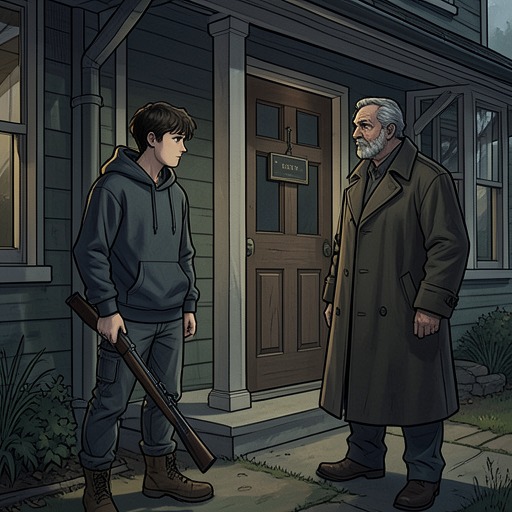
Amel’s more consequential conflict concerns Mirsad. Adrian struggles to explain that Mirsad’s father does not know that Mirsad is gay, and Ove supplies an insulting word before Adrian can settle on one. Later, the narration identifies the stakes more directly: Amel is a man who cannot bring himself to kick a homosexual youth out of his house. The evidence does not spell out every stage of the disclosure or Amel’s private reasoning. It does establish the tension between a father’s difficulty and the fact that he has not expelled his son.
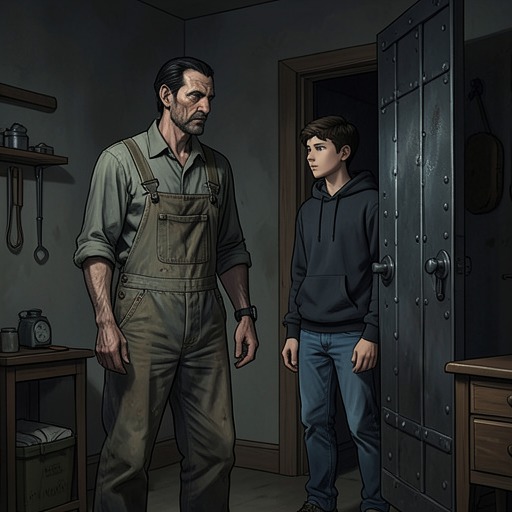
When Ove returns to the café, Amel is again behind the counter, wiping glasses with a white towel. His stocky body has sunk into itself, and his face holds deep sorrow alongside inconsolable anger. The description presents these feelings together rather than reducing him to a single response. He is neither portrayed as having escaped the conflict nor as having resolved it easily. Ove, who has also taken in Mirsad, stands in the middle of the floor; the two men watch each other for about a minute. Their shared connection to Mirsad makes the pause charged, although the scene does not turn it into an argument.
The Return to the Café
Ove eventually sits at the counter, folds his hands, and tells Amel, “I wouldn’t be averse to that whiskey now if it’s still on offer.” It is the same invitation Amel made during the heater repair, but the circumstances have changed. Ove now accepts what he rejected earlier, while Amel must decide how to respond to the man who has returned after the trouble involving his son. He takes a couple of uneven breaths, appears to consider speaking, then says nothing. He finishes wiping the glasses, folds the towel, puts it beside the espresso machine, and goes into the kitchen.
Amel comes back with two glasses and a bottle whose label Ove cannot read, setting them on the counter between them. The action answers Ove’s request without requiring either man to explain his feelings aloud. The narration observes that admitting one is wrong is difficult, particularly after being wrong for a long time. It does not identify a precise confession or claim that Amel delivers one. Instead, the returned offer and the quiet placement of the glasses let the scene register a movement toward acknowledgment without pretending that a gesture erases the history behind it.
Reconciliation and Narrative Role
That evening, Ove eats with Parvaneh and Patrick while Mirsad and Amel talk in Ove’s kitchen. Father and son discuss disappointment, hope, and masculinity in two languages; the narration suggests that courage is perhaps the subject beneath all the others. Their conversation takes place away from the café, after Amel and Ove’s guarded exchange there. The setting matters: Amel is no longer the man behind the counter managing a broken appliance and a disputed rule, but a father speaking with his son.
The book does not report the full conversation or present reconciliation as a sudden, complete transformation. It does show Mirsad greeting Amel as his father and the two sitting down to talk. Ove knows that Sonja would have liked this development and tries not to smile so much that Parvaneh notices. Amel’s movement across these scenes is therefore visible in actions rather than a declared change of belief: he makes room for the cat in the café after Ove repairs the heater, does not cast Mirsad out, and later takes part in a conversation with him. His role brings the story’s questions of courage and masculinity into a family relationship, where a difficult bond is not made easy but is given another chance through the act of staying and talking.