Anita and Rune's House
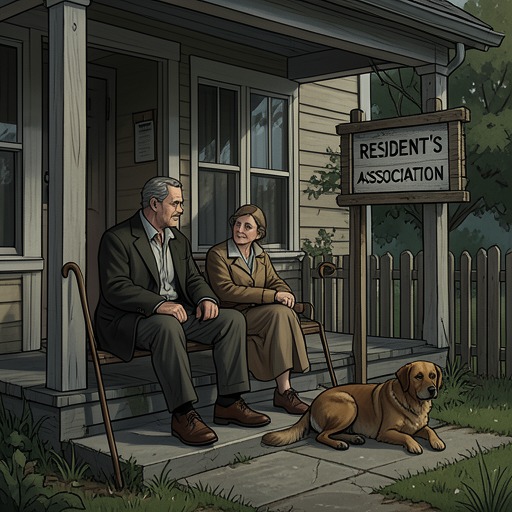
A Man Called OveAnita and Rune's House stands within a row-house block whose changing residents repeatedly test the neighbors’ patience, compassion, and sense of responsibility. It is more than a domestic setting: the house is a refuge in a family crisis and, later, the threshold at which Anita, Ove, and their neighbors confront the authorities’ plan to take Rune away. Its significance lies in the contrast between a home as a place of continuing care and an institution’s attempt to treat that care as insufficient.
Setting and Changing Neighbors
The house belongs to a close-knit residential landscape that Ove and Rune have watched change over nearly four decades. The house between theirs has passed through many kinds of occupants, from families who disturb the neighborhood’s routines to people whose decisions become a source of conflict. Ove and Rune may feud with one another, but they share a durable conviction that the current residents of the intervening house are often troublesome. The recurring changes make the block feel less like a settled backdrop than a place where new household arrangements continually affect everyone living nearby.
One episode gives that turnover a more serious consequence. In the 1990s, a young woman moves into the house with her son, whose father has left. Her new partner is often absent, and Anita and Sonja initially refrain from interfering in what they understand to be the family’s private affairs. When the women hear him shouting, they first tell themselves that families sometimes argue. That restraint changes as signs of harm become harder to ignore: the woman offers an explanation for her bruises, and the neighbors hear her and her son in distress. The house’s walls do not keep the crisis entirely private; what reaches the surrounding homes becomes a call to act.
A Home Protected by Its Neighbors
Ove and Rune respond together despite being in the midst of one of their worst disputes and having gone almost a year without speaking. After a brief look, each goes inside and then returns fully dressed. They confront the man at the door, and Rune joins Ove when the confrontation escalates. The next day, the man leaves and does not return. The young woman and her son stay with Anita and Rune for two weeks, until she feels able to go back to her own home with the boy.
The neighbors’ assistance continues beyond getting the immediate danger to stop. Ove and Rune go into town to the bank; that evening, Sonja and Anita tell the young woman that the money can be treated as either a gift or a loan, without making support conditional on which she chooses. The woman remains in the house with her son, Jimmy. In this episode, safety is made possible through several linked actions: neighbors pay attention, intervene together, provide temporary shelter, and help the family remain in its home. The house is not simply a site where trouble happens; it becomes a place whose continued occupation depends partly on the surrounding community’s willingness to help.
The Threat of Institutional Removal
Years later, the house becomes the focus of a different struggle over who may decide what happens to a resident. When Ove learns that Rune is to be taken from Anita, Parvaneh urgently brings him the news. Ove initially answers with weary resignation, a reaction that surprises both Parvaneh and Anita. But he asks whether the decision is definite and whether there will be further appeals; once assured, he sets off to confront the authorities and asks Anita for the papers they have sent. The planned removal turns the house into the destination of his protest and makes its doorway a boundary he intends to defend.
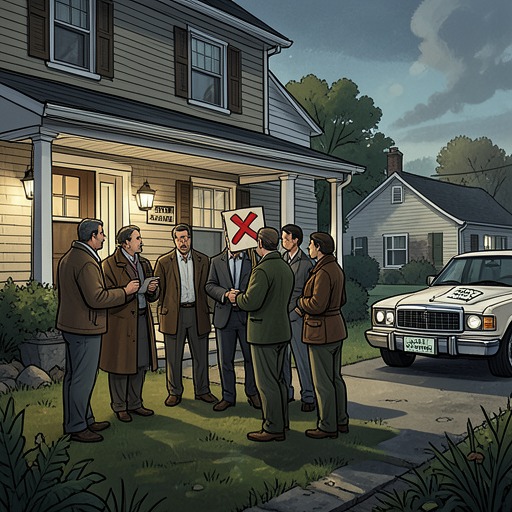
The official arrives with three young men in nurse uniforms and a document, attempting to enter when Anita opens the door. She places herself in his way and insists that she will care for Rune. When he tries to push past her, Ove appears behind her and offers to help. Parvaneh, Patrick, Jimmy, Anders, Adrian, and Mirsad join them in the doorway. The group’s response transforms Anita’s domestic threshold into a shared stand: her claim that love means not handing someone over when care becomes difficult is answered by a household-scale commitment from the neighbors. The scene does not treat the house as a substitute for every form of care; it shows the people around Rune asserting that his existing relationships and home must count in the decision.
Domestic Life and Narrative Significance
The interior remains recognizably lived in amid the confrontation. Rune is in an armchair in the living room, with the television on and coffee nearby, while the man in the white shirt carries official papers. Patrick draws attention to what those papers cannot by themselves disclose: a person’s past may contain things he would rather forget. The domestic details sit alongside the paperwork, setting ordinary household presence against administrative scrutiny. The reader encounters Rune not only as the subject of an official decision but as someone still occupying a familiar room in a home shared with Anita.
The house’s importance therefore comes through repeated acts of neighborly attention rather than through any claim that its walls can solve every problem. Earlier, Ove and Rune cross their feud to protect a woman and child, and Anita and Sonja help that family stay. Later, Ove and the wider circle gather at Anita and Rune’s door when Rune’s place in the home is threatened. Across these episodes, the house links private vulnerability to public action: what happens inside it draws others across the block, and the threshold becomes a practical test of whether care will remain personal or become a shared responsibility.