Awai and father return lost wallet
A Man Called OveThe episode in which Ove and his father return a lost wallet is an early test of the principles that will shape Ove's life. At nine, Ove must choose between keeping a substantial sum, submitting to Tom's theft, and doing what he believes is right. His father protects him from Tom but does not make the decision for him. The wallet is returned, and Ove remembers the encounter not as a lesson delivered in a speech, but as the day he resolved to be as much like his father as possible.
The wallet and the confrontation
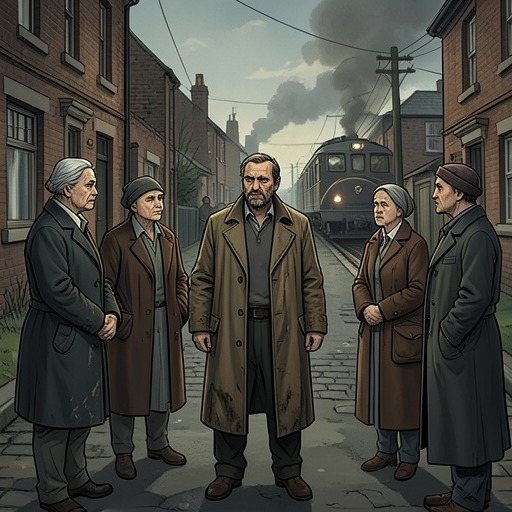
Ove is helping his father at work after school when he is sent to clean out a broken-down railway car with Tom. Tom finds a passenger's briefcase fallen from the luggage rack. Its contents have scattered across the floor, and he eagerly scrabbles to collect them. He treats the find as his by right, telling Ove, "Finders keepers." Ove, who already distrusts Tom's readiness to prey on the defenseless, is unsettled by the expression in his eyes.
As Ove turns to leave, he stumbles over a wallet. Its soft leather feels almost like cotton against his rough fingertips; unlike his father's worn wallet, it has no rubber band holding it together, but a small silver button that clicks open. Inside is more than six thousand kronor, an enormous amount of money in those days. The discovery changes the stakes of the scene: this is not a trivial lost possession but a fortune, and the question of who will claim it becomes immediate.
Tom sees the wallet and tries to wrench it away. Ove resists on instinct. He realizes that he cannot escape the much larger man, sees Tom clench his fist, shuts his eyes, and grips the wallet while waiting for the blow. His refusal is physical before it is explained as a moral position: he will not simply surrender the money to someone who has no greater claim to it than he does.
His father's intervention and Ove's choice
Ove's father steps between them. Tom's angry stare meets his, but his father holds his ground until Tom lowers his fist and backs away. Tom continues to claim the wallet through his version of "Finders keepers." Ove's father does not argue at length or offer a rule that ends the dispute. He points to the wallet and tells Ove, "You decide."
That choice matters because Ove's father has already shown that he sees Tom clearly without reducing him to his worst act. Other railway workers regard Tom as dishonest and malicious, but Ove's father has defended him by pointing to his four children and sick wife, observing that better men could have ended up worse. His compassion does not mean he permits Tom to take the wallet. He stands between the aggressor and his son, while leaving the question of the found money in Ove's hands.
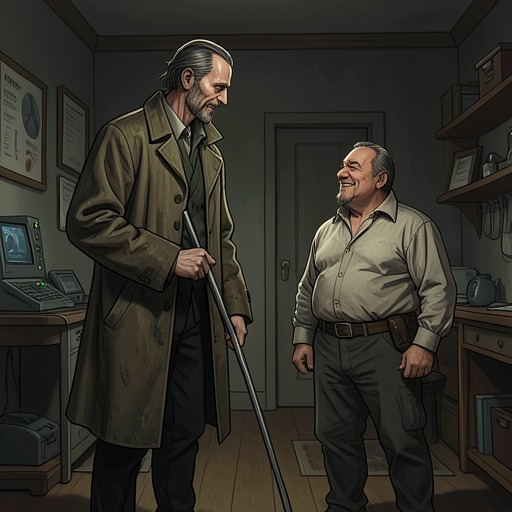
Ove fixes his gaze on the ground under Tom's scrutiny and says, in a low but steady voice, that the wallet should go to the lost property office. His father nods. They walk back for nearly half an hour without speaking, while Tom shouts after them in cold fury. At the office, the woman behind the desk is astonished that they have handed in so much money. Ove's father answers that many people lack decency, takes Ove's hand, and turns back toward work. The money is surrendered without bargaining for a reward or recognition.
A principle formed in silence
On the walk back, Ove asks why his father did not mention the briefcase Tom had taken. His father replies, "We’re not the sort of people who tell tales about what others do." The distinction is central to the episode: Ove's father does not conceal his own son's honest action, but neither does he make reporting another worker the price of doing the right thing. He opposes Tom's claim to the wallet directly, then refuses to turn the encounter into an accusation beyond what is necessary.
Ove understands the difference between himself and Tom, and he believes his father has understood it too. When Ove says he knew he would hand the wallet in and knew Tom would not, his father simply nods. The episode's moral weight comes from this restraint. No lengthy explanation follows; the return of the money, the walk together, and the father's brief answers are enough for Ove to carry the lesson forward.
The narration presents the memory as formative without making the young Ove a boy who consciously theorizes morality. He is not given to dwelling on how a person becomes the person he is. What he does remember is his decision to be as little unlike his father as possible. The scene thus joins a concrete choice to a lasting identity: decency means returning what does not belong to him, while courage includes holding on to that decision even when Tom threatens him.
Later echoes of receiving and giving care
The wallet episode does not make Ove warmly receptive to every gesture, but later encounters show how practical acts of giving and accepting recur in his life. When two young girls bring him a warm container of rice, saffron, and chicken because their mother thinks he is hungry, he accepts the food reluctantly and puts it in the refrigerator. He will not throw food away, a point of principle. The exchange is different from the wallet: no property is being contested, and the gift comes from neighbors rather than a stranger's lost belongings. Still, Ove's response is expressed through what he does with the food, not through an easy display of gratitude.
His relationship with the older man next door develops through similarly concrete gestures. Though they never speak, Ove paints both sides of the man's fence; a homemade apple pie then appears on Ove's doorstep, a food he has not eaten since his mother died. These later acts of giving and response do not alter the facts of the childhood encounter, but they show the quiet, practical form that human connection can take in Ove's world.
The same pattern appears in more intimate moments. Ove hands a little girl back to her mother after keeping her from getting too close to the cat, and later Parvaneh brings a flower from herself, Patrick, and the children to Sonja's grave. Such gestures are not rewards for returning the wallet, nor does the episode directly cause them. They provide a wider frame for its significance: Ove's moral life is repeatedly measured through things held, handed back, repaired, or offered. His father's example begins with a wallet, but what Ove carries away is a way of acting toward other people.