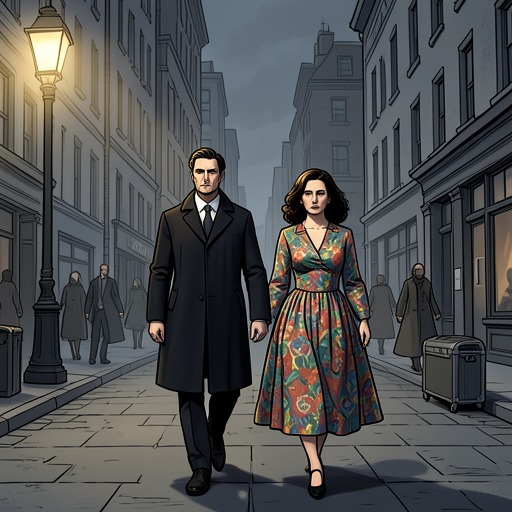
Black and white and color
A Man Called OveBlack and white and color is the novel’s central image for the contrast between Ove’s ordered, practical outlook and Sonja’s expansive, expressive one. More than a shorthand for opposing temperaments, it gives their marriage a shape: Ove’s world is defined by things he can handle and answers he can verify, while Sonja brings the warmth and movement that make that world feel like a life rather than a set of rules.
The Meaning of Black and White
For Ove, black and white suggests more than a preference for plainness. He trusts what can be seen, touched, measured, and made to work. A bookshelf he builds is a legible object; the books Sonja places on it, filled with other people’s feelings, belong to a less tangible realm. Wood and concrete, glass and steel, tools, right angles, instruction manuals, assembly models, and drawings are comprehensible to him because they have material form and can be approached through practical knowledge. The contrast does not make Ove incapable of care. It describes the language in which he can most readily express and understand it.
The image also connects his temperament to his insistence on definite answers. Ove favors straight lines and clear decisions, and mathematics appeals to him because its answers are right or wrong. He distrusts subjects in which a person can argue a case, treating open-ended discussion as a failure to settle what is true. That preference makes black and white both a comfort and a limit: it offers a dependable structure for judging the world, but leaves little room for ambiguity, abstraction, or feelings that cannot be resolved like a problem.
Sonja as Color
The novel sets this inwardly consistent but restricted outlook against Sonja’s vivid difference. Ove’s understanding of himself is captured in the declaration, “He was a man of black and white.” The answering sentence shifts the image from a description of personality to a description of attachment: “And she was color. All the color he had.” The line does not merely say that the couple are opposites. It makes Sonja the means by which color enters the life Ove experiences as his own.
Their difference is visible in their habits. Ove keeps his hands in his pockets and gravitates toward screwdrivers and oil filters; Sonja dances and loves music, books, and unusual words. People regard the pair as night and day, and Ove accepts that he is the night. Sonja, however, can treat the comparison playfully, turning his darkness into a joke about his reluctance to let in the sun. Her brightness is not presented as an argument that he must become someone else. Instead, their shared life holds together through the coexistence of his severity and her openness.
Light, Darkness, and Private Affection
Sonja gives the color metaphor a more intimate expression when Ove questions her persistent optimism. She replies, “You only need one ray of light to chase all the shadows away,” connecting light with the possibility of changing how darkness is experienced. The image does not establish that Ove’s outlook disappears; it shows how Sonja answers it, offering a small, sufficient counterweight rather than demanding that he abandon his nature.
Her teasing insistence that Ove is “dancing on the inside” supplies a related image of a hidden self. She tells him, “You don’t fool me, darling,” and says that she loves him whether he likes it or not. Ove does not understand what she means: dancing seems haphazard and giddy to him, the opposite of straight lines and settled decisions. The affectionate exchange therefore preserves a difference in perception. Sonja reads an inward liveliness in him that he cannot name for himself, while Ove remains wary of the very spontaneity she associates with that hidden movement.
The Metaphor’s Narrative Work
Black and white and color binds the novel’s descriptions of character to its account of intimacy. Ove’s habits are not simply set against Sonja’s as rival ways of living; the repeated image makes their contrast relational. The color belongs to her, but it is also what he says he has through her. His practical competence and her love of books and music remain distinct, yet the metaphor makes their difference part of what they share.
The image also complicates the first impression of Ove as only stern or humorless. Sonja’s claim that he dances inside himself does not turn his directness into an act or prove that he secretly shares her tastes. Rather, it reveals an interpretive gap between how he understands himself and how she sees him. The metaphor leaves that gap intact: he may not recognize the color she brings or the movement she attributes to him, but the language of their relationship gives both a place. Black and white names Ove’s preferred order; color names the presence that makes that order less solitary.