Mirsad
A Man Called OveMirsad’s story turns on a painful disclosure and the community that grows around its consequences. After telling his father that he is gay, he is told that he is sick and no longer welcome in his father’s home. His arrival at Ove’s door initially looks like a threat, but the misunderstanding gives way to a much larger change: Mirsad becomes part of a neighborhood’s chosen family, and later marries Jimmy, with Ove standing beside him as best man.
Identity and Introduction
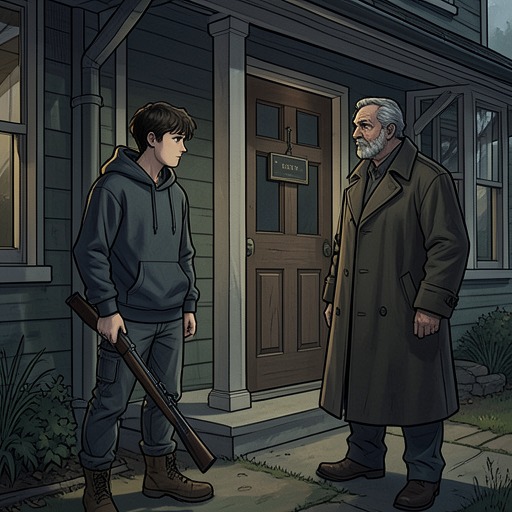
Mirsad first appears with Adrian outside Ove and Sonja’s house on a winter night. Ove is holding an old hunting rifle, and the local news has just warned residents about burglars. Hearing footsteps in the snow, Ove mistakes the two young men for intruders. He kicks open the door in his underwear and socks, and Adrian panics and runs into the toolshed. Mirsad has to make clear that they are not there to burgle the house before Ove can understand what is happening.
The scene’s comic confusion is sharpened by its real danger: Ove is poised to use the rifle, while the visitors have arrived without knowing what he is doing. Mirsad does not respond by fleeing. He straightens, nods to Ove with determination, and tells him that he has come out to his father. Ove’s expression becomes less threatening, though he still does not lower the rifle. The shift is limited but important: Mirsad has moved the encounter from an apparent intrusion to the reason he has come seeking help.
Rejection and the Search for Shelter
Mirsad explains that his father called him sick and said he was not welcome under his roof because of what he regarded as Mirsad’s unacceptable identity. The account makes the consequence immediate: Mirsad has been driven from home after telling the truth about himself. He speaks with visible effort, taking a deep breath and struggling to say the word his father used against him. His disclosure is not presented as an abstract disagreement; it has left him without the security of his family home.
Ove asks him to explain why he is there, but the evidence does not turn Ove’s initial response into a simple scene of instant acceptance. Even after Mirsad has explained himself, Ove keeps the rifle raised. That unresolved gesture preserves the awkwardness and alarm of the encounter. Yet Mirsad has managed to make himself understood, and the two men’s relationship develops beyond this first, hazardous meeting: later he is seen alongside Ove and The Cat, moving through the neighborhood with him.
Solidarity and Family by Choice
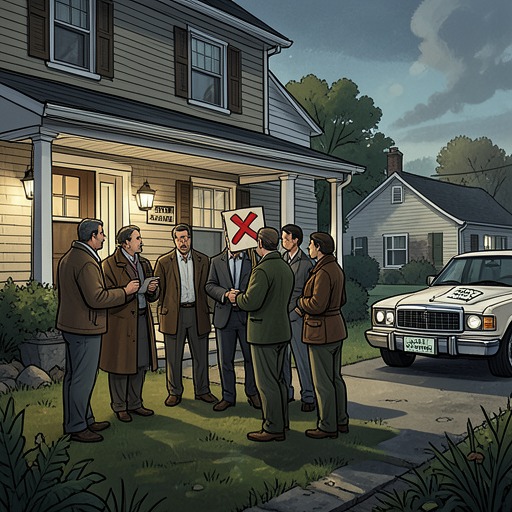
Mirsad’s connection to the wider group becomes visible when The man in the white shirt confronts Ove. Ove says that he will stand firm, and Parvaneh does too; Mirsad joins Patrick, Jimmy, Anders, and Adrian in expressing the same support. They crowd into the doorway together, making their solidarity a physical presence rather than a private assurance. Mirsad’s place in the group is no longer limited to the young man who arrived needing to explain himself. He is among the people prepared to stand with Ove when another person tries to exert authority over him.
The story later places Mirsad beside Ove again after a trip to a car dealership. As they return to their street, Mirsad, Ove, and The Cat separate from Parvaneh, Patrick, Jimmy, and the children. A stocky man has been waiting outside Ove’s house, and when he sees Mirsad he steps forward. Mirsad identifies him as his father. Their brief greeting does not itself explain everything that has changed between them, but it establishes a later encounter between father and son after the rejection that first brought Mirsad to Ove’s door.
Marriage and a New Household
Mirsad marries Jimmy at the Town Hall. Nervous enough to shake in his black suit, he receives a shot of tequila from Parvaneh before going inside. Jimmy is waiting there, and Ove, who has bought a new suit, serves as Mirsad’s best man. The ceremony is followed by a party at Amel’s Café, bringing the neighborhood into the celebration of a relationship Mirsad can now affirm publicly.
Mirsad’s father is also present. He tries three times to make a speech but is too overcome by emotion to manage more than a few halting words. The scene marks a striking contrast with the rejection Mirsad described earlier: the father who had said his son was unwelcome now attends his wedding, even if he cannot easily express what he feels. The account gives no extended explanation of how the relationship was repaired; the father’s presence and overwhelmed attempt to speak carry the change without supplying a fuller reconciliation narrative.
Jimmy names a sandwich after Mirsad’s husband at Amel’s Café, and Jimmy regards it as the most magnificent present he has ever received. The couple continue living together in Jimmy’s mother’s house. The following year they adopt a little girl. Jimmy brings her to Anita and Rune’s House every afternoon at three for coffee, without fail. Their family life is represented through these repeated visits as well as through the wedding: belonging takes the form of a household, a child, and a dependable place in the neighbors’ daily routines.
Narrative Significance
Mirsad’s trajectory links the harm of family rejection to the possibility of making a family elsewhere. His first appearance is organized around mistaken identity: Ove sees possible burglars, while Mirsad has come because he has lost his welcome at home. Later scenes widen that private crisis into collective belonging, first through the neighbors’ united support and then through Mirsad’s marriage and adoption of a daughter with Jimmy.
The change in his relationship with his father is conveyed with restraint. The father’s earlier condemnation and later presence at the wedding stand in tension, while his failed attempts to speak suggest an emotion the scene does not fully translate into explanation. Mirsad’s story ultimately gives more space to what is built after rejection: commitment to Jimmy, Ove’s role as best man, and the small, repeated family ritual of bringing their daughter to visit Anita and Rune. His life in the neighborhood becomes evidence that shelter and kinship can be made through acts of welcome and continued participation.