Ove
A Man Called OveOve is a fifty-nine-year-old widower whose rigid habits and abrasive manner conceal a life increasingly organized around absence. He inspects his house, maintains its routines, and makes careful plans to end his life; yet his attention keeps being pulled toward people who need help. The tension between his wish to disappear and his enduring sense of responsibility defines both his late-life crisis and the legacy he leaves behind.
Identity and Background
Ove is a practical, exacting man who drives Ove’s Saab and judges people quickly, often treating strangers as if they have already given him reason for suspicion. In a shop selling computer equipment, he examines a small white box and mistakes its product for an O-Pad. The scene establishes his wary encounter with unfamiliar technology and the comic contrast between his certainty and a changing world.
His habits are not merely preferences: they give his days order and make him feel responsible for the things around him. After Sonja dies, he continues inspecting the house twice a day, checking the radiators as though she might have altered the heating in his absence. The ritual preserves a small, practical connection to their shared life, even as its repetition makes the permanence of her absence more apparent.
Bereavement and the Plan to Die
Six months after Sonja’s death, Ove believes he has waited long enough. He had returned to work on the Monday after her funeral, treating that return as what a person was supposed to do; the managers did not tell him until months later that they were ending his employment. Their description of the decision as early retirement feels to him like a reduction of a working life of more than three decades to nothing. His chronic heart trouble makes the loss sharper: his doctor advises him to avoid getting worked up, but Ove experiences that instruction as detached from the life he has been given.
His plans to die are methodical. He pays the undertakers, arranges a place beside Sonja in the churchyard, settles his bills, cancels the newspaper, and leaves lawyers a letter with clear instructions. Important receipts, the house deeds, and the service history for Ove’s Saab are assembled in an envelope in his jacket. This preparation reflects the same orderly temperament that governs his daily inspections, but now turned toward making sure no one else will have to clear up after him.
Grief nonetheless breaks through the procedural care. Looking at an old photograph of himself and Sonja in Spain, he remembers her folding an index finger into his palm while they held hands. What he misses most is not an abstract idea of marriage but that particular gesture and the reassurance it gave him. At Sonja’s grave, he brushes snow from the stone and replaces the flowers, then feels ashamed that he has not followed her as he once expected to. His terse explanation to the gravestone—that events have been chaotic—cannot conceal how thoroughly other lives have kept intervening.
Responsibility as an Interruption
Ove repeatedly comes close to acting on his intention and then finds himself responsible for someone else. When Parvaneh is pregnant and needs to get to hospital, he thinks about what Sonja would expect of him. He removes a tube from the Saab’s exhaust and drives Parvaneh there and back, telling himself that doing so will also save him from Sonja’s imagined disapproval. The explanation is characteristically grudging; the action is unmistakably care.
A later crisis involving Parvaneh’s children brings the same conflict into his garage. Ove concedes that he cannot leave the girls to freeze because their father has fallen while trying to open a window. He puts the tube away, locks Ove’s Saab, checks the garage door three times, and goes to fetch his tools. Even as he postpones his plan, he treats the postponement as temporary. His practical response is not a sudden declaration that life has become easy; it is the immediate recognition that other people cannot simply be abandoned.
At the railway platform, Ove is again preparing to die when a man in a gray suit loses consciousness and falls onto the tracks. The interruption arrives at the precise moment Ove is watching the approaching train and calculating his own timing. In the passage, the contrast is stark: his attention is fixed on his planned death until another person’s sudden danger demands it. The scene places the crisis of his isolation beside the instinct to respond to an emergency.
Habits, Neighbors, and Renewed Purpose
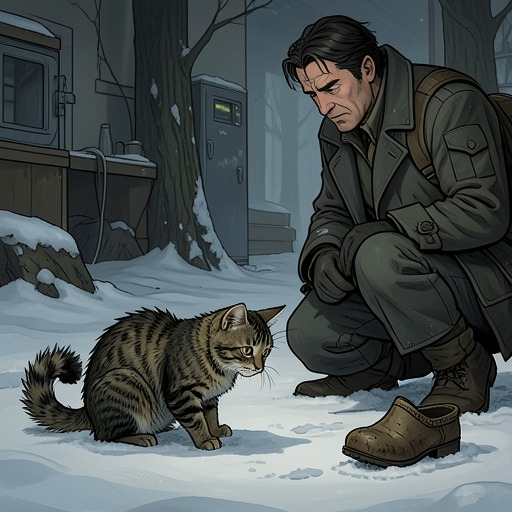
The Cat becomes another presence that alters Ove’s choices. One evening, sitting in the garage with the engine running and exhaust gathering inside, he considers allowing both himself and the cat to die. He looks at The Cat and turns off the engine. The next morning they resume a shared routine: coffee for Ove, tuna for The Cat, and the inspection round. When Ove finishes shoveling the snow outside his own house, he crosses the road and clears it in front of the other homes too. His attention has begun to extend beyond his own property, one ordinary task at a time.
His concern for his neighbors also becomes more forceful when he understands that Rune may be placed in a care home. Jimmy’s explanation that Sonja had thought Ove already had enough troubles prompts Ove to grasp the seriousness of the situation. He moves through the trash room and bicycle shed in mounting anger, slamming a door as the prospect of Rune’s removal sinks in. The response is not detached argument: Ove’s anger registers the depth of his concern for Rune and for the neighbors he has continued to watch over.
Ove then emerges from Anita and Rune’s house carrying documents he has gathered online. Lena points out that media scrutiny could delay the officials’ process for months or even years, and the man in the white shirt is persuaded to leave. Ove’s familiarity with paperwork and his determination to gather records become tools in a collective effort. The man who once prepared documents to ensure that no one would have to manage his death now uses them to defend someone else’s home and future.
Death and Legacy
Almost four years after Parvaneh and Patrick’s trailer struck Ove’s mailbox, Parvaneh notices that the snow outside his house has not been cleared. She uses the spare key Ove gave her and finds him lying peacefully in bed. The Cat rests beside him, its head in his hand. Parvaneh stays with him until the ambulance crew arrives, then whispers a message to Sonja and thanks her for the loan. She finds an envelope addressed to her on the bedside table, a final act of preparation that makes practical provision inseparable from affection.
The envelope contains the records of Ove’s life, from the house plans and Saab service booklet to bank and insurance documents, as well as instructions about his affairs. Adrian is to receive Ove’s Saab. Parvaneh is given the keys and responsibility for the rest, including the care of The Cat, which is to be fed tuna twice a day. Ove leaves instructions for her children and Jimmy’s daughter to receive money when they turn eighteen, and asks that Patrick not manage the inheritance. He also leaves a request that the new neighbors keep their cars out of the residential area. Even in death, his arrangements preserve his familiar insistence on order while directing his resources toward the people who have entered his life.
The novel presents Ove’s bereavement without making his recovery a simple cure. Sonja’s death leaves him feeling that the one person who understood him has been taken away, and he continues to describe himself through routines and responsibilities rather than through open declarations. Yet those responsibilities gradually include Parvaneh’s family, The Cat, and Rune and Anita. His final arrangements reveal how far that circle has widened: Ove’s life ends, but the care he has organized for others continues in their hands.