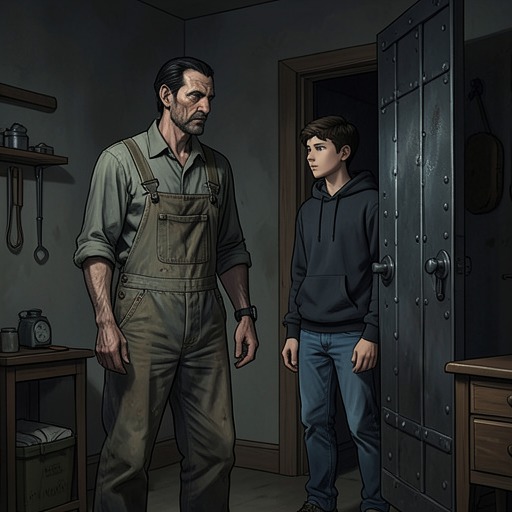
Ove and Mirsad’s relationship
A Man Called OveOve and Mirsad’s relationship grows from a tense encounter into a practical bond of shelter and shared domestic life. Mirsad arrives at Ove’s home after coming out to his father and being told he is no longer welcome there. Ove’s first response is defensive, but the sight of Sonja’s photograph makes room for a different decision: Mirsad can stay. Later, in Ove’s kitchen, Mirsad and his father begin to speak again, while Ove quietly recognizes the courage involved.
A Hostile Welcome
The first meeting takes place in circumstances that make welcome seem unlikely. Ove is standing outside in his underwear, holding a rifle, when Adrian and Mirsad arrive. Mirsad explains that he has told his father he is gay. His father’s hostility is not merely a matter of disapproval: Mirsad says his father had threatened to take his own life if one of his children were gay, and has now called Mirsad sick and barred him from the family home.
Mirsad has no other relatives in town. He had hoped to stay with Adrian, but that arrangement is unavailable, so the two have come to Ove’s house. When Ove raises the rifle at Adrian, Mirsad steps between them and turns its barrel away. His apology is quiet, and the effort of explaining himself is described as a struggle with pride. As he prepares to leave, he calls the plan foolish. The moment exposes both his precarious position and his reluctance to ask for help; he does not assume that Ove owes him a place to stay.
The Decision to Make Room
Ove lowers the weapon, then notices the photograph of Sonja on the wall: she is wearing a red dress, in a picture taken during their trip to Spain while she was pregnant. Ove had repeatedly asked her to remove it, but she had insisted that it mattered as a memory. The photograph interrupts the confrontation. Remembering Sonja’s attachment to it, Ove lets Mirsad remain in the house.
The change is small in outward form but decisive in consequence. Ove had intended that this would be the day he died; instead, Mirsad spends the night and joins the cat in the house. The narration connects Ove’s choice to what Sonja would probably have wanted, while also leaving his customary gruffness intact. He does not turn the exchange into a declaration of sympathy. His response is to open the home to someone who has nowhere else to go.
That home already carries the traces of care and loss. After Sonja’s accident, Ove rebuilt the kitchen himself, lowering the stove and counter to suit her needs; the room retains the marks of her repeated passage through it and the objects she left behind. The kitchen is therefore not a neutral stopover when Mirsad enters Ove’s life. It is a space shaped by Ove’s practical devotion to Sonja, now made available to a younger man in need of refuge.
A Shared Household
The morning after Mirsad’s arrival, Ove comes downstairs and notices that the house smells of toasted bread. He approaches the kitchen cautiously, as though he has caught someone doing something they should not, and asks whether Mirsad has been making toast. Mirsad nods anxiously. The exchange shows the new arrangement beginning through an ordinary act of using the kitchen, rather than through a formal discussion of what living together will mean.
Mirsad’s presence also changes the atmosphere of a house in which Sonja’s absence has been palpable. The narration notes that it has not smelled that way since she died. The detail does not suggest that Mirsad replaces Sonja; instead, it marks the return of everyday activity to a home organized around grief and solitude. Ove’s acceptance takes the form most natural to him: allowing another person to occupy the space and carry on with an ordinary morning.
A Father and Son Reconcile
Mirsad’s relationship with Ove’s household eventually intersects with the possibility of repairing his relationship with his own father. One evening Ove eats dinner with Parvaneh and Patrick, while Mirsad and his father talk in Ove’s kitchen. Their conversation addresses disappointments, hopes, and masculinity, and takes place in two languages. The narration identifies courage as its central subject. The scene presents reconciliation not as something Ove can accomplish for them, but as a difficult conversation the father and son undertake themselves in the safety of his home.
Ove understands that Sonja would have approved of the evening. He tries not to smile so broadly that Parvaneh will notice, a restrained reaction that contrasts with the open significance of what is happening nearby. His role is chiefly to have made the meeting possible: the home he once opened to Mirsad now provides a setting in which father and son can address their disappointments and hopes. The evidence does not detail the whole course of their reconciliation, but this conversation marks a meaningful beginning.
Significance of the Relationship
Mirsad’s place in Ove’s life is defined by a concrete act of acceptance after rejection elsewhere. Their bond begins under the sign of misunderstanding and threat, yet turns when Ove hears why Mirsad has come and remembers Sonja. The contrast matters: Mirsad is treated as unwelcome by his father, while Ove—who has no close prior relationship with him—makes room in his home.
The relationship also belongs to Ove’s wider return to connection through practical acts. He does not offer an abstract account of tolerance; he lowers the rifle, steps back into the house, and lets Mirsad stay. Later, his kitchen becomes the place where Mirsad and his father can speak. Ove’s care is visible in these arrangements rather than in declarations, and the consequence is that a moment intended as an ending becomes part of a household shared with the cat and a young man who needed shelter.