Ove and Rune join forces to save the woods
A Man Called OveOve and Rune join forces to save the woods in a campaign that begins as neighborhood resistance and becomes one of the most revealing episodes in their early friendship. The Local Council and Administrative Authorities planned to clear the forest behind their houses for further construction. Ove and Rune answered with eighteen months of organized opposition, and when the plan was abandoned, they found themselves almost disappointed that the struggle had ended. The episode shows them united not only by the ground they shared, but by their appetite for defending a principle against an opponent who could keep them fighting.
Background and Alliance
Ove recalled that he and Rune had not initially disliked one another, though their friendship was the reserved kind associated with men like them. Both couples had moved into the area at the same time. Sonja and Anita became close friends, and the men’s bond grew in the orbit of that household friendship as well as through their common life in the neighborhood.
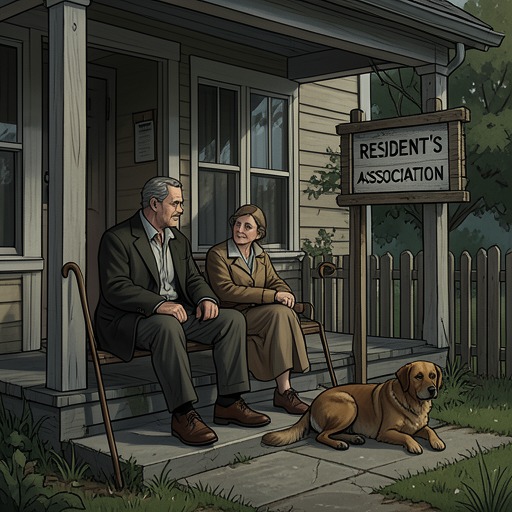
The two men helped establish the Residents’ Association, with Ove as chairman and Rune as assistant chairman. Their opposition to the proposed development was therefore not a private disagreement with officials: they acted as organizers for a community. The forest stood behind both their houses, and the plan to replace it with more houses put a shared, nearby place at stake. The Local Council and Administrative Authorities maintained that the construction plans had existed for years before Ove and Rune moved in. That chronology did not persuade the two men to accept them. In the contest as they understood it, the existence of an earlier plan did not settle whether it deserved to be carried out.
The Campaign
Rune gave their resistance its combative register when he roared down the telephone line, “It’s war, you bastards!” The phrase was more than bluster: what followed was a sustained campaign of appeals and writs, petitions, and letters to newspapers. The account gives the resistance a duration as well as a list of methods. For a year and a half, the men kept pressing the issue through formal challenges and public argument rather than treating the construction plan as an inevitable administrative decision.
Their partnership joined Ove’s chairmanship to Rune’s willingness to declare open conflict. Neither man accepted the authorities’ account of the development’s history as a reason to stand aside. Their repeated acts of opposition made persistence itself central to the episode: the aim was to make the planned clearing difficult to carry out, and the men continued until the Local Council and Administrative Authorities gave up and began building somewhere else. The forest was spared from this particular construction plan, though the evidence describes the outcome as relocation of the building work, not an end to development in the area.
Victory and Its Paradox
After the authorities abandoned the plan, Ove and Rune each drank a glass of whiskey on Rune’s patio. Their wives noticed that the men did not seem especially pleased. The campaign had succeeded, but success removed the contest that had occupied them for eighteen months. Rune wondered, “Is no one prepared to fight for their principles anymore?” Ove answered, “Not a damn one,” and they toasted “unworthy enemies.”
That exchange makes the victory deliberately double-edged. The men had resisted the plan successfully, yet they also valued the prolonged opposition as an absorbing undertaking. Their disappointment does not undo the result or mean that the forest mattered little; instead, it reveals how much the fight itself had come to matter to them. They could celebrate having prevailed and regret that the other side had stopped giving them a reason to continue. In their toast, even the defeated opponents retained a place in the shared ritual of the campaign.
Place in Their Friendship
The episode belongs to a period before the rupture in the Residents’ Association and before Rune bought a BMW. Ove’s recollection sets the woods campaign against the later antagonism between the men: once allies in a dispute that demanded eighteen months of coordination, they would eventually become unable to have a reasonable conversation. Ove’s later irritation at Rune’s car choice—he repeatedly treated the purchase as proof that the two could no longer talk sensibly—makes the earlier cooperation especially striking. Their differences had not always made alliance impossible.
The remembered campaign also clarifies why their later conflict carries the force of a lost partnership. Ove and Rune had once shared leadership, a common opponent, and the satisfaction of continuing to resist after the other side might have expected them to yield. Their agreement was not founded on gentleness or effortless harmony; it took shape through dispute, work, and a mutual respect for fighting over what they considered right. Saving the woods thus stands as a concrete achievement and as a measure of what their friendship could once sustain.