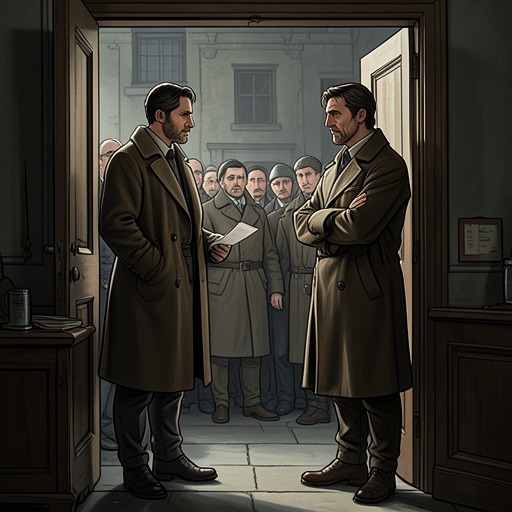
Ove begins helping Rune and Anita
A Man Called OveOve begins helping Rune and Anita when a request to repair their radiators draws him into a crisis he would rather avoid. His help starts not with a declaration of concern but with a wrench, a blunt question, and an unceremonious step across Anita’s threshold. The scene turns his familiar resistance to other people into a small, consequential act of care.
The request and Ove’s resistance
Anita approaches Ove because the radiators in her house are not producing heat. She asks carefully, smiling at him and at Parvaneh and Patrick, while Ove checks his dented wristwatch and complains that nobody on the street seems to have a job to go to. Anita apologetically explains that she is retired. Her cautious manner and his impatience set the terms of the encounter: she is asking for help, but Ove treats the request as an interruption before he treats it as a practical problem.
He begins with diagnosis rather than sympathy. When Anita suggests that the radiators may be the cause, he asks whether she has bled them. She has not, and asks whether that might explain the lack of heat. Ove rolls his eyes. Parvaneh immediately tells him to stop being rude; he insists that he is not rude, then grudgingly falls silent. The exchange makes his manner part of the obstacle Anita must get past, even as his attention is already fixed on the repair itself.
Parvaneh helps keep the request alive. She places an encouraging hand on Anita’s arm and assures her that Ove can help. Anita brightens and thanks him, but Ove asks whether her husband cannot handle that kind of work himself. His refusal is not simply about the heating: he invokes Anita’s role in organizing a coup in the Residents’ Association, speaking quietly and punctuating the complaint with discreet coughs. The old grievance surfaces precisely when a neighbor is asking him to act as one.
Rune’s illness changes the stakes
Ove’s resentment sharpens when he asks what Rune knows about heating systems. Anita concedes that Ove may be right about the practical matter, then adds that Rune is very sick and that it no longer matters. Her lower lip trembles, but she regains her composure, straightens her neck with dignity, and explains that the authorities have said they will take Rune from her and put him in a home. Ove hears enough to understand that the radiator request sits beside a much larger threat to their household.
His response is to back across his own threshold, hands in his pockets. He does not offer comfort or promise to intervene; he withdraws. That retreat matters because the scene has placed a concrete task beside Anita’s fear of losing Rune to institutional care, while Ove’s familiar habits—suspicion, grievance, and brusque dismissal—seem to keep him safely outside both. His earlier complaint that Anita helped organize a coup in the Residents’ Association exposes the personal history complicating what might otherwise look like a straightforward favor.
A return with tools
The return comes after Ove’s attempted suicide is interrupted. He disposes of the snapped rope, folds the plastic sheeting, puts away his drill and drill bits, and returns the equipment to the shed. The orderly cleanup is practical, but his thoughts turn to Sonja: she used to nag him to tidy the place, and now he fears that tidying would leave empty gaps. He hates those gaps. Rather than stay with the emptiness, he picks up an adjustable wrench and a little plastic watering can, locks the shed, and tugs the door handle three times.
Ove then walks along the path between the houses, turns by the last mailbox, and rings Anita’s doorbell. Through the open door he sees Rune sitting in his wheelchair, staring vacantly out of the window; Ove thinks this is what Rune has done for the last few years. He does not explain why he has come or apologize for backing away. Instead, he mutters, “Where have you got the radiators, then?” Anita starts to thank him, but he steps into the hall before she can finish and without taking off his shoes. His only explanation is that the day is already ruined anyway.
Practical help as a change in conduct
The repair is a modest action, but its timing gives it weight. Ove has just put away the materials of a failed attempt to die; he next carries tools to a neighbor’s house. The text does not present this as a speech about choosing life or as a resolution of his grief. It shows him redirecting his attention toward a task and toward people whose need he had just tried to avoid. His change is legible in what he does, not in a softened manner: he remains abrupt, enters without ceremony, and starts by asking about the radiators.
The scene also alters the meaning of Ove’s self-description. Earlier, when Parvaneh asks with genuine curiosity whether he is always so unfriendly, he looks insulted and says he is not. At Anita’s door he behaves exactly as though courtesy were an unnecessary complication, yet he has returned with equipment and crossed the threshold. His practical competence offers a form of assistance that his speech cannot comfortably express.
Anita’s request therefore becomes the opening of Ove’s renewed involvement with Rune and Anita. The need for heat gives him an immediate, specific way to help; Rune’s illness and the threatened move to a home reveal the larger stakes surrounding the household. Ove does not settle the conflict over Rune’s future in this scene, and the evidence does not establish what he does with the watering can. What it establishes is the first turn: after withdrawing from Anita’s plea, he comes back, asks where the work is, and begins.