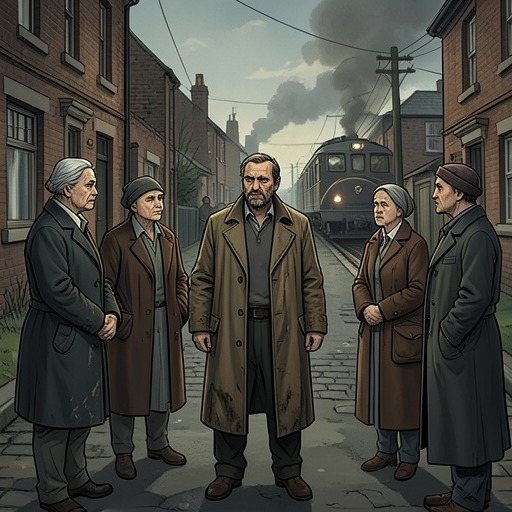
Ove knocks Tom down to recover his father’s watch
A Man Called OveOve knocks Tom down to recover his father’s watch in a turning point shaped by accumulated loss and public humiliation. The confrontation begins after Ove has left the site where his parental home once stood and is working as a night cleaner. When Tom mocks him, then takes The Old Watch His Father Left Him from the changing room, Ove abandons his usual restraint, retrieves the watch, and hits him once. The encounter restores Ove’s possession of a family keepsake, but it also marks a change in how he intends to meet those who exploit or deceive him.
Causes and Background
The confrontation comes after a chain of setbacks. Ove has signed a document and left the plot where his parental home once stood. He rents a small room in town, spends his days staring at the wall, and works nights cleaning train compartments. The loss of the house is therefore not merely a change of address: it has left him without the home he had been rebuilding and with little to occupy his days beyond work.
At the head office, workers are told to collect new work clothes rather than use their usual changing rooms. In the corridor Ove encounters Tom for the first time since Ove was blamed for a theft from a railway carriage. Tom responds with a taunt that casts Ove as the thief, and one of Tom’s younger colleagues elbows Ove as he tries to pass. Tom then repeats the accusation loudly enough for it to echo through the corridors. The exchange makes the old accusation a public insult again, delivered in front of men who appear to take Tom’s side.
In the changing room, Ove removes his dirty work clothes and unclips The Old Watch His Father Left Him, placing it on a bench before showering. Tom appears in the doorway and mocks the fire that destroyed Ove’s home, invoking Ove’s father as part of the insult. The younger colleagues laugh. Ove does not answer them; he closes his eyes and remains under the hot water for more than twenty minutes, the longest shower he has ever taken. When he emerges, the watch is gone. The object’s disappearance gives the hostility a concrete focus: this time, something his father left him has been taken from him as well.
What Happens
Ove searches the bench, the floor, and the lockers, but cannot find the watch. The narration links the change in him not to a single cause alone but to several pressures gathering together: Tom’s earlier accusation, the fire, a dishonest insurance agent, and other accumulated grievances. It presents the change as a threshold rather than a carefully planned decision. Ove leaves the changing room without dressing and goes to the foremen’s changing room, where Tom is standing before a mirror trimming his beard.
Ove grips Tom by the shoulder and demands the watch. Tom starts to deny having it, but Ove interrupts him and insists. He tears Tom’s jacket away and finds the watch in its inside pocket. The recovery settles the immediate question of where it went: Tom had taken it and kept it on his person. Ove then hits him once. Tom collapses, and Ove turns and walks away. The account keeps the physical act brief; its emphasis falls on the abruptness of Ove’s decision and on the fact that the watch is back in his possession.
The scene reverses the position Tom had imposed on Ove. Tom had publicly labelled him a thief and used a circle of younger colleagues to reinforce the humiliation. Now the stolen object exposes Tom’s own wrongdoing, while Ove refuses to let Tom finish his denial or control the encounter. Retrieving the watch is both the literal objective of the confrontation and its measure: Ove leaves with what was taken, rather than accepting another insult without response.
Consequences and Aftermath
Tom is taken to the hospital. When asked repeatedly what happened, he says only that he slipped. The other men who were present likewise claim not to remember the incident. Their silence prevents the confrontation from becoming a formal account of Ove’s actions; it also leaves Tom’s theft and Ove’s blow without testimony from the people who saw them. The narrative does not explain each man’s reason for saying nothing, but their shared lack of recollection stands in sharp contrast to the public taunting that preceded the fight.
Ove never sees Tom again. He decides that he will not let anyone trick him again, making the event an explicit boundary in his life rather than an isolated quarrel. That resolve is shaped by the encounter’s particular circumstances: the watch was taken after his home had burned, after he had been blamed for a different theft, and after Tom had ridiculed both his misfortune and his father. The return of the watch cannot restore the lost house or undo those insults, but Ove leaves having acted against the latest wrong instead of enduring it in silence.
He keeps his night-cleaning job but gives up the construction work. With no house left to build, he no longer has the same reason to remain at the construction site; by then, he has also learned enough about construction that the workers in hard hats have nothing more to teach him. As a farewell gift, they give him a toolbox fitted with new tools and a note about helping him build something lasting. That gift offers a quiet counterpoint to the changing-room scene: after the fire and the violence, Ove’s practical skill remains recognized by others, even as he leaves the work through which he had developed it.
Significance of the Watch and the Encounter
The Old Watch His Father Left Him is more than the property at the center of a theft. Ove removes it before showering and places it carefully on the bench; when it disappears, he searches systematically before acting. The watch’s clear connection to his father gives the theft a personal weight beyond the value of an ordinary possession. Ove’s demand is directed at Tom, but recovering the watch also means refusing to let a keepsake be absorbed into the same sequence of losses that has already taken his home.
The encounter also dramatizes a change in Ove’s response to humiliation. Earlier in the corridor, he tries to pass Tom without answering, even when he is mocked and elbowed. After discovering the watch missing, he does not make another attempt to retreat or wait for someone else to intervene. He confronts the person responsible, secures the evidence in Tom’s jacket, and leaves immediately after striking him. The shift is not presented as a general transformation into an open or easygoing man; it is a decision, made under pressure, about what he will no longer allow.
In the broader portrait of Ove, this episode clarifies the force beneath his reserve. He is capable of enduring insults without replying, but the narrative distinguishes that silence from indifference. The recovery of the watch makes the difference visible: once the loss touches both a concrete possession and the memory of his father, Ove acts. The episode thus ties his stubbornness to loyalty and to a strict response to perceived injustice, while showing the cost and abruptness of the moment when restraint ends.