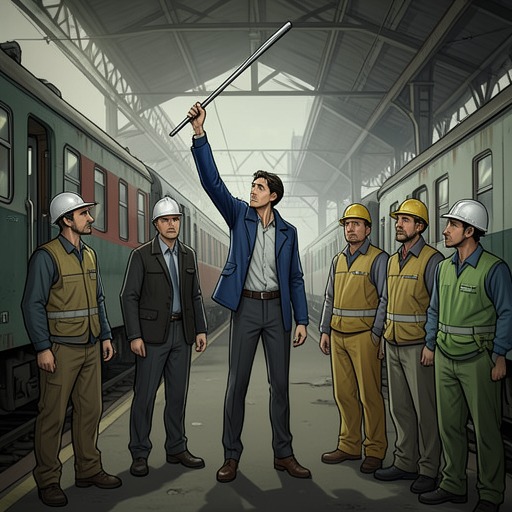
Ove refuses to report Tom for stealing
A Man Called OveOve refuses to report Tom for stealing after witnessing him take money from a railway carriage. Rather than exchange an accusation for his own exoneration, Ove stays silent about who took it and accepts the consequences. The choice costs him the work he values, but the director eventually understands what Ove’s silence means, offers him another railway job, and sets in motion the encounter with Sonja that will shape the rest of his life.
Background and the accusation
Almost two years after his father’s funeral, Ove has just turned eighteen. He has kept his head down at work and rarely spoken, believing there is little purpose in challenging a man twice his size. He goes to work every day and does his job as his father had done; his colleagues have learned to appreciate that steadiness. One older workmate sums up Ove’s reserve by observing that people who do not talk much do not dish out much nonsense either. Ove’s silence is therefore already part of how he moves through the world, but the accusation against him gives it a much higher cost.
Tom is caught stealing money from the cash box in one of the carriages. Ove is the only person who actually saw him take it, and the two of them were the only people in the carriage when the money went missing. Summoned with Tom to the director’s office, Ove is told that no one believes he stole the money; all he needs to do, the director says, is name the person who did. The pressure is framed as a formality, but it asks Ove to become an informant in exchange for clearing himself.
Silence and its cost
Before Ove is called into the office, he waits on a wooden chair in the corridor. Tom emerges first, fists clenched so tightly that the skin on his lower arms has gone white, and tries to meet Ove’s eye. Ove keeps looking at the floor. Inside, he also refuses the chair offered to him. When asked whether he took the money, he answers no; when asked who did, he says nothing. The director orders him to answer, and Ove finally looks up, straight-backed, to state his rule: “I’m not the sort that tells tales about what other people do.”
The silence lasts for minutes. The director warns that if Ove will not identify the thief, and witnesses say Ove took the money, the office will have to conclude that Ove is guilty. Tom has already blamed him. Two younger men from Tom’s shift then claim that they saw Ove take the money with their own eyes. Had Ove accused Tom, the case would have become one man’s word against another’s; because Ove will not tell, Tom’s accusation is set against Ove’s silence. The next morning, the foreman tells Ove to empty his locker and report to the director’s office. As Ove leaves the changing rooms with his work clothes, Tom jeers and calls him a thief.
The director’s decision
Ove walks to the office for what he believes is his last time, carrying the clothes he has taken from his locker. He has liked the work: proper tasks, proper tools, a real job. He imagines that, once the police have completed whatever process follows, he will have to travel far to find similar work, because a criminal record will take distance before it loses its force. He has nothing keeping him there, he thinks, but he has at least avoided becoming the sort of man who tells tales. He hopes his father will be more forgiving when they are reunited, despite Ove’s having lost his job.
After making Ove wait nearly forty minutes, the director tells him that Tom took the money. It is a confirmation, not a question, and Ove does not answer. The director recognizes the family resemblance in Ove’s refusal, saying that the men in his family are not the kind who tell. Ove then gives the principle that makes sense of his conduct: “Men are what they are because of what they do. Not what they say.” He does not know where the words come from, but feels they have to be said. The director writes on a paper and pushes it across the desk for Ove to sign. The scene turns on the difference between Ove’s refusal to accuse and his willingness to be judged by his actions: he will not supply a convenient statement, even when silence leaves him exposed.
A changed job and a consequential encounter
When Ove asks about the police, the director says he thinks the witness testimonies have been lost in the confusion and tells him he is free to go. The reprieve comes without fanfare. As Ove reaches the front door, the woman who first admitted him catches up and presses a paper into his hands: the director wants him to report the next morning to become a night cleaner on the long-distance train. She also relays the director’s assurance that he did not take the wallet when he was nine, just as he did not take the money now, and that it would be a pity to put a decent man’s son out on the street for having principles.
The consequence is not simply that Ove keeps a place in railway work. He becomes a night cleaner instead, and the altered shift brings him off work one morning just as he sees Sonja. The details of that first sight remain vivid: her red shoes, gold brooch, burnished brown hair, and laughter. The narration connects the reassignment directly to the encounter: without the events in the director’s office, Ove would never have left his shift at that moment and seen her. Sonja’s belief that all roads lead to what a person was predestined to do belongs to her understanding of events; for Ove, the outcome is not an abstract purpose but a person.
Significance
The episode establishes a distinction between telling the truth and telling on someone. Ove does not deny what happened, confess to the theft, or offer an alternative account; he refuses to name Tom, even when others use that refusal to make him appear guilty. His conduct puts his livelihood at risk, while the director’s eventual intervention shows that the same silence can be read not as proof of guilt but as evidence of a principle.
The episode also gives Ove’s idea of character an immediate practical test. His brief statement about actions and words follows the more consequential act of enduring accusation without abandoning his rule. The result is an unexpected reversal: a dismissal feared as the end of his working life becomes a transfer to a different railway job, and that job leads to his first sight of Sonja. The story thus makes the cost of Ove’s principle inseparable from its unforeseen consequence.