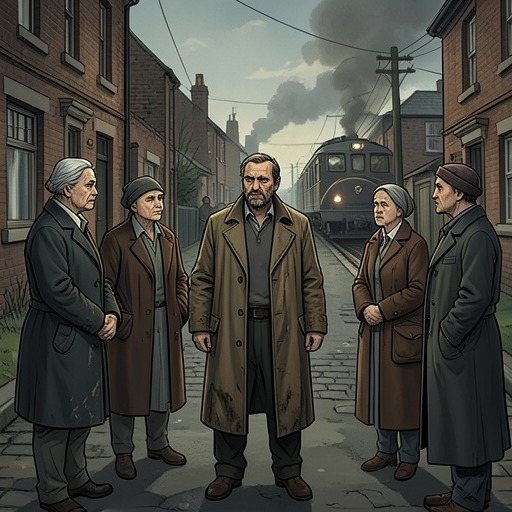
Ove suffers a heart attack while chasing burglars and is rescued
A Man Called OveOve suffers a heart attack while chasing burglars and is rescued after intervening to protect a neighbor’s home. The episode turns one of his familiar patrols into a medical crisis, but its consequences extend beyond his survival: Parvaneh’s fierce concern makes their bond unmistakable, and Ove’s return to the residential area restores him to the daily life he had repeatedly tried to leave behind.
Background and the Night Patrol
Ove encounters the burglars during an evening round with The Cat. The party at Parvaneh and Patrick’s home has ended, and Ove is checking the residential area’s familiar points of order: signposts, garage doors, guest parking and the trash room. He then notices movement near the shed beside the home of a family he believes is away in Thailand. The figures are not party guests. They are working at a window covered with insulation tape, a precaution Ove recognizes from his railway experience, where broken train windows had to be removed without cutting anyone’s fingers.
The scene brings together two sides of Ove’s vigilance. He treats the rules and shared spaces of the neighborhood as responsibilities that must be inspected, but he also knows practical details that matter in an emergency. The sound of the hammer and the taped glass tell him that a break-in is underway. He calls out, receives no reassuring answer, and then bellows at the figures and runs toward them. He has not brought a tool from his shed; seeing one burglar carry a long, narrow object, he decides to confront the person before that object can be used.
The Collapse and Its Immediate Stakes
Ove’s charge ends abruptly. At first he mistakes the pain in his chest for a blow from behind, then recognizes that it is coming from within. He loses his breath and falls into the snow. The burglars run away, leaving him on the ground as Parvaneh approaches. His attention remains fixed on the neighborhood even as he loses consciousness: his last concern is that she promise not to let the ambulance drive between the houses, where motor-vehicle traffic is prohibited.
That final thought gives the crisis its characteristic Ove contradiction. He has just risked himself by running straight at suspected burglars, yet even at the point of collapse he is preoccupied with enforcement of the residential-area rule. The rule is not merely a complaint about disorder; it is part of the place’s shared routine and of the way Ove understands his duty to it. In this moment, however, his insistence on the rule stands beside a more immediate need for help. The burglars’ escape means the attack is not a fight in which Ove defeats them: the decisive change is that his attempt to stop them becomes a medical emergency, and the neighbors must act for him.
At the Hospital
Parvaneh refuses to leave Ove when hospital staff will not let her accompany his stretcher into the operating room. Patrick, Jimmy, Anders, Adrian, Mirsad and four nurses have to restrain her as she tries to get through. When a doctor tells her to sit down and take care because she is pregnant, she overturns a waiting-room bench. A later warning that they should prepare for the worst leaves her in shock. Her behavior is not calm or carefully measured, but its direction is clear: she will not accept being kept at a distance from Ove or being asked to treat his possible death as an abstraction.
At half past three in the morning, a nurse finally brings her to Ove’s room. Parvaneh is exhausted and in tears, but she gathers herself long enough to assure the nurse she is all right. At the bedside she begins thumping Ove’s arm and tells him, in effect, that he is not to die on her. His fingers move weakly; she takes his hand in both of hers and rests her forehead against his palm. The gesture reverses the earlier struggle to reach him: now she is beside him, holding on while he is unable to answer properly.
The doctor explains the immediate finding bluntly: Ove’s heart is too big. Parvaneh first assumes the statement must be a joke, then laughs when she realizes the doctor means it literally. The laughter punctures the hospital’s fearful uncertainty without removing it. The doctor says medication can keep the condition under control but cannot predict whether Ove has months or years. Parvaneh dismisses the prospect of his dying as unlikely, an assertion born of their attachment rather than medical certainty.
Return and Longer-Term Consequences
Four days later Ove limps home through the snow, supported by Parvaneh and Patrick. His return is marked by ordinary signs of welcome: lit windows, The Cat waiting outside the door, and drawings from Parvaneh’s daughters spread across the kitchen table. Parvaneh puts Ove’s spare keys back in the basket beside the telephone. The house is again a place he can enter as part of a network of neighbors, not simply a refuge from them.
Even after the hospital, the neighborhood rule remains active in their exchanges. Parvaneh has recently tried to back Ove’s Saab down between the houses, and he would not allow it; her angry response makes plain that she knows his objection well. The episode thus returns him to the very habits that had framed the night of the attack, while placing those habits inside a relationship that has grown close enough to survive argument. The narrative does not present the attack as curing Ove’s grief or resolving his desire to die. Earlier, at Sonja’s grave, he had faced his failure to follow her as he had planned. His survival instead leaves him with more time in which other people can rely on him and he can remain involved in their lives.
The later chronology confirms that the heart attack is not immediately fatal: almost four years after Parvaneh and Patrick’s trailer accident, Parvaneh notices one November morning that Ove has not cleared the snow outside his house. She finds him dead in bed, with The Cat beside him. The account does not identify the heart attack as the cause of his eventual death. Rather, the long interval makes the rescue’s consequence clear without turning it into a permanent reprieve: Ove survives this crisis, returns to the life around him, and dies later at home. The episode’s emotional center is therefore not a miraculous recovery but the fact that, when Ove falls, the people he has drawn into his life refuse to leave him alone.