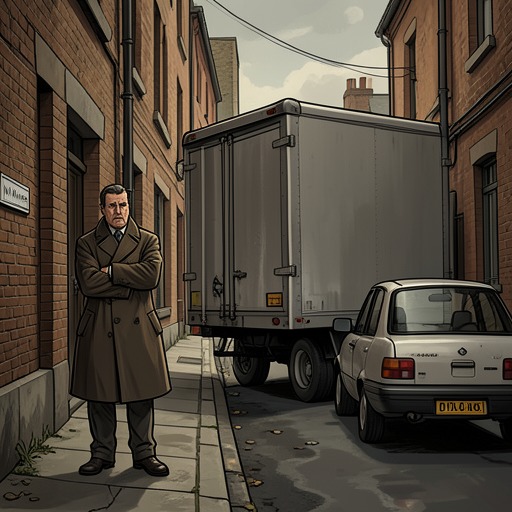
Ove teaches Parvaneh to drive
A Man Called OveOve teaches Parvaneh to drive when Patrick’s expected months in casts leave her needing a license to transport their daughters. What begins as an awkward request becomes a lesson in Ove’s practical competence and in the encouragement he can offer beneath his gruff manner: after an alarming first start and an interruption by an SUV driver, Parvaneh gets back behind the wheel and learns to drive that afternoon.
The request and its circumstances
Parvaneh asks Ove for help passing her driving test. She explains that Patrick will be in casts for months and that she needs to be able to give their two girls lifts. She is also pregnant with their third child. The request catches Ove off guard: he looks so confused that, for a moment, he forgets to become upset. His surprise registers how little he expects Parvaneh to need something from him, but he agrees to help.
The lesson grows out of an immediate family need rather than an abstract wish to learn. Patrick’s reduced ability to get around makes a driver’s license important to the household, while Parvaneh’s request places Ove in the role of instructor. Her eagerness and his reluctance create a mismatch from the outset: she needs to learn, and he approaches the task as a serious responsibility.
A lesson in Ove’s Saab
Ove’s ideas about cars shape the lesson. He treats a car as more than a mere means of transport, and believes that people’s carelessness behind the wheel helps explain the poor state of the roads. Watching Parvaneh prepare to drive, he is concerned by her unfamiliar handling of the vehicle. She first tries to bring a bottle of carbonated juice into the Saab, then reaches for the radio to find a more entertaining station. Ove has spread newspaper on the floor in front of her seat; he picks it up, rolls it, and taps it against his hand as he tries to contain his nerves.
Parvaneh has to adjust the driver’s seat around her pregnant belly, first moving it back to get into the car and then forward to reach the steering wheel. Once she is settled, she asks where to begin. Ove tells her to press the clutch. When she does not know which pedal that is, he identifies the clutch on the far left, the brake in the middle, and the accelerator on the right. He then explains the order of operations: ease the clutch to its engagement point, apply a little gas, release the clutch, and move off. His instruction is precise, grounded in the mechanics of the car rather than softened into general reassurance.
The first start and its setback
Parvaneh follows the instructions, but the Saab lurches forward, pauses, and then surges toward the guest parking area. It nearly hits another car. Ove grabs the hand brake; Parvaneh releases the steering wheel and covers her eyes, panicking until the car stops abruptly. The near collision turns the basic lesson into a test of nerve for both of them. Ove has to reach the brake in time, while Parvaneh must face how quickly an unfamiliar car can move beyond her control.
With the Saab stopped close to the car ahead, Parvaneh asks what to do. Ove tells her to reverse. The episode makes visible the difference between knowing the steps and being able to carry them out under pressure. His technical directions have not yet made the car feel manageable, and Parvaneh’s first attempt has ended in alarm rather than confidence. The lesson might have stopped there, but the story instead places her next attempt after Ove shows her what he thinks she is capable of.
Ove’s confidence in Parvaneh
An encounter with an SUV driver interrupts the lesson. Ove returns to the Saab, and Parvaneh watches him with her mouth open. He addresses her calmly and recalls what she has already managed: raising two children, preparing for a third, coming from far away, learning a new language, gaining an education, and holding together a family he regards as conspicuously incompetent. He does not treat these achievements as a substitute for driving instruction. Instead, he uses them to challenge the fear that has taken hold of her after the near collision.
Ove reduces the task to its workable parts: a car has an accelerator, a brake, and a clutch, and Parvaneh can learn how they work. He tells her she is not a complete twit. The reassurance is unmistakably characteristic of him—an insult-shaped compliment—but its effect is tender. Parvaneh pushes a ringlet of hair away from her face, takes hold of the steering wheel again with both hands, and prepares to try once more. Ove nods, buckles his own seat belt, and settles in beside her. His confidence is not a promise that nothing will go wrong; it is a decision to stay with her while she learns.
The outcome and its significance
Ove gives the instruction again, beginning with the clutch, and Parvaneh continues. That afternoon, she learns to drive. The result follows not from a sudden change in the machinery, but from a change in the lesson’s human terms: after her frightened first attempt, Ove recognizes that she needs to be reminded of her own abilities as well as told what to do with the pedals.
The scene brings together two forms of help that recur in Ove’s relationships with his neighbors. He offers concrete knowledge, explaining the controls and how to operate them, and he commits himself practically by getting back into the car and buckling up for another attempt. For Parvaneh, the lesson addresses a pressing family need created by Patrick’s casts. For Ove, it provides another occasion to turn competence into care, even when that care arrives in his brusque, distinctly Ove-like language.