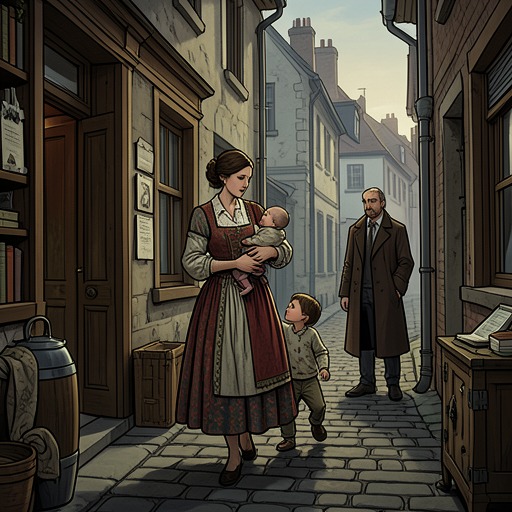
Ove's New Neighbors Move In and the Trailer Accident Occurs
A Man Called OveOve's New Neighbors Move In and the Trailer Accident Occurs is the comic, collision-filled first encounter between Ove and his new neighbors, Parvaneh and Patrick. A badly maneuvered trailer violates the rules of the residential area and damages Ove’s property, but the incident also begins a relationship that outlasts Ove’s anger: nearly four years later, Parvaneh remembers the trailer against his mailbox as a marker of how long they have been neighbors.
Background and Setting
Ove’s response to the arrival is shaped by his attachment to his home and his insistence that the neighborhood’s rules be followed. The house is not simply a place he occupies. When the council had sought to acquire his parental home and demolish it, he had chosen instead to repair the dilapidated building himself. Its condition, its history, and his own labor in maintaining it help explain why a trailer scraping the exterior wall and rolling into his flowerbed is not, to him, a minor inconvenience.
The newcomers arrive in a small Japanese car towing a trailer, attempting to maneuver it into position beside the houses. Patrick, a lanky blond man, is at the wheel; Parvaneh, who is pregnant, stands outside directing him with increasingly emphatic gestures. The mismatch between the cramped car, the trailer, and Patrick’s uncertain handling makes their move-in a public spectacle. Ove first watches from behind the green floral curtains that his wife, Sonja, has long urged him to replace. Then, as the trailer wheel enters his flowerbed, he calls out through the window and rushes outside.
The Maneuver and the Damage
Ove confronts Parvaneh with a demand to know what they are doing. She answers with equal exasperation, making clear that she too is frustrated by the maneuver. Patrick tries to explain that backing the trailer is harder than it looks and proposes moving the car to try again. Ove does not share his optimism. The Residents’ Association has a sign prohibiting motor vehicles in the area, Ove points out, and the rule is part of the order he expects newcomers to respect.
Patrick pulls forward a few yards, but fails to straighten the trailer before reversing. This time it strikes Ove’s mailbox and buckles its green sheet metal. He acknowledges the mistake and says he did not see the mailbox in the rearview mirror; he also admits that he cannot work out which way to turn the wheel when reversing. Ove responds by ordering him out of the car and taking over. The damage makes the situation more than an argument about driving: the newcomers’ difficulty has now reached Ove’s property, and he treats the responsibility for correcting it as his own.
Ove Takes the Wheel
Before reversing, Ove insults Patrick’s inability to maneuver the trailer, comparing his performance unfavorably to that of a person with severe physical limitations. He then gets into the car. The vehicle’s automatic transmission and hybrid system become further evidence, in Ove’s mind, of a modern world that relies on technology in place of practical competence. Patrick begins to explain how the battery and engine work, but Ove does not engage. He closes the window, checks both wing mirrors, and backs the trailer neatly into the space between his own house and his new neighbor’s.
Ove’s control of the maneuver contrasts with Patrick’s confused attempts. Patrick has struggled to understand which way to turn, while Ove performs the task without relying on reverse radar, parking sensors, or cameras. For Ove, the episode confirms his conviction that handling a trailer should require the basic ability to reverse rather than an array of electronic aids. The scene’s humor rests on the difference between his harsh judgment and his practical usefulness: he berates the man he is helping, completes the maneuver, and hands Patrick back the keys.
Patrick thanks him despite the insults. Parvaneh, still standing with her arms crossed, thanks him too, now with a wry smile that suggests she is trying not to laugh. Ove notices her large brown eyes, and her response softens his dislike of her slightly. It is a small change, not a reconciliation or a sudden transformation. The encounter remains prickly, but gratitude and shared amusement break through the hostility. Ove then reiterates that the Residents’ Association does not permit driving in the area and returns to his house.
Significance and Aftermath
The incident establishes a pattern that will define Ove’s dealings with his neighbors: he is severe about rules, quick to criticize, and unwilling to leave a practical problem unsolved. His help does not arrive in the form of reassurance. It takes the shape of getting into the car and doing the task himself. Patrick’s cheerful thanks and Parvaneh’s restrained laughter disclose another side of the encounter: Ove’s manner can be abrasive without making his actions useless, and the newcomers do not answer his assistance with resentment alone.
The damaged mailbox remains a concrete measure of the relationship’s duration. Almost four years to the day after Parvaneh and Patrick backed the trailer into it, Parvaneh wakes on a snowy November morning and notices that the snow outside Ove’s house has not been cleared. She crosses the road in her dressing gown and slippers, uses the spare key he has given her, and finds that Ove has died. The move-in mishap is thus recalled not just as an early quarrel, but as the date from which a long period of neighborly closeness can be counted. Ove’s first response to the new arrivals is to police the boundary of his home; by the end, Parvaneh has a key to it and is the person who recognizes that something is wrong.