Ove’s Saab
A Man Called OveOve’s Saab is more than a vehicle: it gives practical shape to Ove’s habits of planning and care, while also becoming the setting for conflict, companionship, and a decisive retreat from suicide. He treats a car as something deserving loyalty and attention, not merely as transport. Yet the Saab repeatedly carries him beyond his private routines—to help neighbors, visit Sonja, and teach Parvaneh—until, in the garage, its running engine becomes part of a plan he cannot carry through.
A vehicle governed by routine
Ove’s attachment to the Saab is bound up with his distrust of casualness. He plans journeys in detail, studying maps, estimating travel times, avoiding traffic, and choosing shortcuts. To him, a car is not just a way to get from one point to another: care for the vehicle and care in driving belong together. His complaints about people who regard cars as mere transport sit alongside his belief that careless drivers help make the roads worse. The Saab is the object through which this practical code is most visible.
That code appears in small, exacting habits. When Ove parks beside the bicycle shed on returning to his garage, he leaves the engine running and points out that cars are not allowed in the residential area. Even while giving someone a lift, he does not suspend the neighborhood rule. After driving to the Churchyard, he locks the Saab, makes a circuit around it, and checks each door before going up the snowy slope with flowers for Sonja. The car’s security and the journey’s purpose are treated as parts of the same orderly undertaking.
The Saab also exposes how Ove’s routines can be disrupted. On a morning when he intends to leave without interruption, he studies the train timetable, shuts down his house, and walks to the station rather than taking the car. He does so because he expects that the people who have repeatedly interrupted his plans might again draw him into helping them. The walk is a deliberate departure from his usual preference for planned travel: this time, not taking the Saab is part of his attempt to keep his own purpose intact.
Passenger seat, contested territory
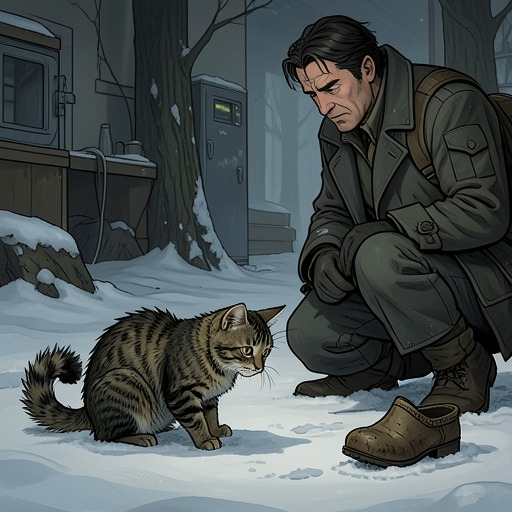
The cat’s arrival turns the Saab into a shared space that Ove tries to regulate. He takes the animal along on errands rather than leave it alone in the house, but insists that it sit on newspaper on the passenger seat. The cat rejects the entertainment supplements Ove first provides, kicking them onto the floor, and settles on the upholstery. Ove lifts it by the scruff and substitutes cultural supplements and book reviews; when it finally remains on the paper, he considers the small contest won.
The victory lasts only until the Saab moves. The cat tears the newspaper and puts its paws through the rip, directly challenging Ove’s arrangement. Ove brakes sharply, and the cat is jolted forward. For the rest of the ride it pointedly ignores him, then licks the steering wheel, seat belt, and inside of the car door while he is in the florist’s. Ove answers with a warning gesture; the cat bites his finger, and he refuses to speak to it for the remainder of the journey. At the Churchyard he uses the crumpled newspaper to usher it out before taking the flowers from the trunk. The scene makes the car a miniature arena for Ove’s need for order and the cat’s persistent refusal to be treated as part of his luggage.
The arrangement nevertheless becomes habitual. On another journey, the cat rides in the back with Parvaneh’s three-year-old, and Ove adjusts the newspapers on the seats. His irritation at being drawn into another hospital visit does not keep him from taking the passengers there. The Saab’s interior, with its newspaper protection and regular upkeep, registers Ove’s effort to retain control; its repeated use for other people shows how often that control gives way to practical help.
Help, instruction, and the road
The Saab serves as a means of assistance as well as a private possession. Ove drives neighbors to the hospital, and Parvaneh offers to pay a parking fine associated with one of these episodes. He rejects the offer by asking whether the car is hers. The exchange reflects his insistence on responsibility for his own vehicle, even when another person is willing to take on the cost.
It also becomes the setting for teaching Parvaneh to drive. Ove is already protective of the car and attentive to the details of driving; he watches her move the seat around her pregnant belly so that she can reach the wheel. The lesson begins amid distractions: Parvaneh tries to bring a bottle of carbonated juice into the Saab and to change the radio station. Ove retrieves the newspaper from the floor and taps it against his hand as she studies the controls. He explains the pedals and the sequence for releasing the clutch and accelerating. When Parvaneh starts the car, it lurches toward the guest parking and nearly reaches another car before Ove pulls the hand brake. The Saab makes the risk of the lesson immediate, but Ove stays beside her and tells her how to reverse.
The garage and the choice to stop
The Saab’s most consequential role comes when Ove backs it into his garage, leaves the engine running, and watches exhaust fumes begin to fill the space. A plastic tube hangs on the wall. Ove imagines remaining there until the fumes end his life and the cat’s; his grief for Sonja makes continued existence feel unbearable to him. The car that ordinarily carries him through carefully organized errands has become an instrument of a plan to die.
The cat is with him in the passenger seat, and its presence changes the outcome. Ove looks at it and turns off the engine. He does not proceed with the plan. The Saab therefore stands at the hinge between an intention and an action abandoned: its mechanical function makes the danger possible, while the passenger beside Ove gives him a reason to stop. The next morning the two are up before six, sharing the ordinary routines of coffee, food, inspection, and snow clearing. The car remains part of Ove’s everyday world, but the engine has been switched off.
Across these episodes, Ove’s Saab links his principles to what he actually does. It is carefully monitored, kept in order, and made to serve the rules of the neighborhood; it also carries people whose needs repeatedly interrupt his plans. The cat’s occupation of the passenger seat unsettles his control of the vehicle, while the garage scene makes the same machine the setting for a choice to continue living. Its significance lies in this contrast: the Saab is at once Ove’s instrument of routine, a vehicle for care, and the place where routine yields to attachment.