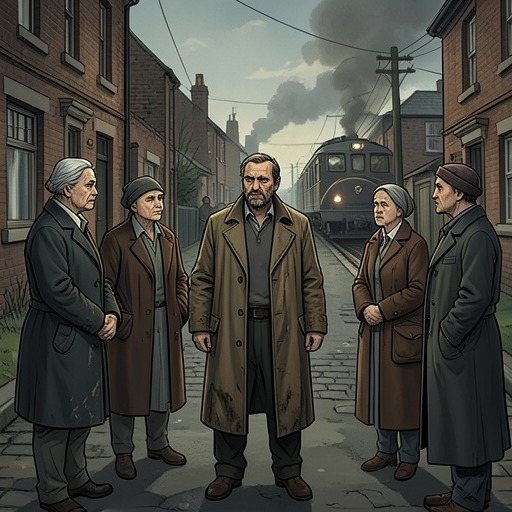
Ove's Father's Saab 92
A Man Called OveOve's Father's Saab 92 is more than an old car passed from one owner to another: it brings Ove into the world of engines alongside his father, and helps shape the choice of car that defines him as an adult. Given to Ove's father by a railway director, the damaged vehicle becomes a family possession, a mechanical classroom, and the first link in Ove's lifelong loyalty to Saab.
Identity and Condition
The car is an extremely old, worn Saab 92, the first motorcar Saab manufactured. By the time it reaches Ove's father, production of that model has ended and the substantially upgraded Saab 93 has taken its place. Its age and obsolescence do not make it disposable to him: he recognizes it at once, including its front-wheel drive and side-mounted engine, whose sound is compared to a coffee percolator.
The vehicle is not offered in working order. It has been in an accident, its bottle-green body badly dented, and the machinery under the hood is in poor condition. Ove's father inspects it with a small screwdriver from his overalls and concludes that time, care, and proper tools could bring it back into working order. That practical judgment is central to the car's story: its value emerges not from its appearance or newness, but from what skilled attention can make possible.
The Gift and Its Repair
The director's offer follows an earlier demonstration of Ove's father's ability. When the director's daughter's wedding car broke down, Ove's father arrived by bicycle with a toolbox so heavy that two men had to lift it from the bicycle. He repaired the car and declined an invitation to the wedding reception, asking instead for bread and meat to take home to his son. The director had seen both the usefulness of his skill and the modesty with which he carried it.
When Ove's father asks whose Saab 92 it is, the director gives him the key and says it belonged to a relative. The gift turns a damaged vehicle into a recognition of the mechanic who can repair it. Ove's father remains in the courtyard trying to catch his breath after the director returns to the office. That evening, he explains the car to his wide-eyed eight-year-old son and shows him the machine now parked in their garden. The scene joins a public gesture of trust to a private moment of astonishment: the car has been entrusted to the father, but its arrival immediately becomes part of the boy's life as well.
A Car as Classroom and Family Ritual
Ove's father spends half the night sitting in the driver's seat with Ove on his lap, explaining how the mechanical parts connect. He can account for every screw and tube, and Ove sees him as exceptionally proud. The lesson is intimate and concrete: the boy learns the car not as a finished product but as a system of parts whose workings can be understood. The Saab gives father and son something to examine together, and the father's knowledge becomes something he can pass on through demonstration.
The instruction continues on Saturdays when Ove's father has time off. He opens the hood and teaches Ove the names of the parts and what each one does. On Sundays they attend church because Ove's mother had insisted on it; afterward, they take a long drive in the countryside in the Saab. The drives become Ove's favorite part of the week. The car thus belongs not only to repair and instruction but to a recurring pattern of shared time: the hood raised in the yard, then the road opening out beyond it. The account of their Sundays also makes clear that they spend more time missing Ove's mother than thinking about God, so the drive is a family ritual shaped by her absence as well as by the car's presence.
Sale and Continuing Legacy
A week after his eighteenth birthday, Ove passes his driving test and walks fifteen miles in response to an advertisement to buy his first car, a blue Saab 93. He pays for it by selling the old Saab 92. The newer model is only marginally newer, and is itself run-down, but the exchange marks Ove's move from learning beside his father to owning a car in his own right. The Saab 92 leaves his possession; the preference it helped create does not.
At eight, after his father shows him the gifted car and its workings, Ove decides that he will never drive anything but a Saab. Years later, he chooses another battered Saab rather than a markedly newer or more polished alternative. The first car's legacy is therefore not simply a remembered childhood object. It establishes a continuity between the father's mechanical expertise, the lessons shared in the yard and on the road, and Ove's adult sense of what kind of car is worth having. Its importance rests on that passage of knowledge and preference, even as the original vehicle is sold to make the next one possible.
Narrative Significance
The Saab 92's story turns on successive changes in its status: obsolete model, damaged machine, gift, working family car, teaching aid, and finally the means of financing Ove's first independent purchase. At each stage, it is joined to practical action. The director recognizes Ove's father's competence by giving him a car that needs repair; the father makes it useful and teaches his son to understand it; Ove later sells it to acquire a car of his own.
The object also makes the bond between father and son visible without requiring either to explain it abstractly. Their time together is measured in opened hoods, named parts, and countryside drives. The Saab's importance is consequently both material and relational: it must be repaired and driven, but in the process it carries the father's knowledge into Ove's adult life. Even after the car itself is gone, that inheritance remains legible in the blue Saab 93 Ove chooses at eighteen and in the loyalty to Saab that began with the gift in the garden.