Patrick's Borrowed Trailer
A Man Called OvePatrick's Borrowed Trailer is first connected with Patrick and Parvaneh's move into the neighborhood and later becomes the physical means by which Ove obstructs officials attempting to leave Anita and Rune's House. Its importance lies in this change of use: when Ove demands that Patrick borrow it again, the trailer gives his anger a practical task, interrupts his plan to die, and puts a council car at the mercy of a roadblock made from an everyday object.
Identity and First Appearance
The trailer enters the story through Ove's direct question to Patrick: “That trailer you had when you moved in. Where did you get it?” Patrick explains that he borrowed it from a man at work. The exchange establishes that it is not Patrick's property, but an item temporarily available through an ordinary workplace connection. Its first association is with the practical business of moving into the neighborhood; the later account dates the incident involving it to the day Patrick and Parvaneh backed a trailer into Ove's mailbox.
That mailbox collision gives the trailer an earlier place in the history between the neighbors, while the later scene shows Ove recalling it as a resource that can be put to another use. Almost four years after the move-in accident, Parvaneh recognizes the date by its proximity to that incident. The book thus gives the trailer two sharply different functions: it first figures in an accidental collision with Ove's property, then in a deliberate obstruction carried out on Ove's behalf.
Borrowed Again at a Turning Point
When Ove reaches Patrick's door, Patrick is standing on crutches, with casts covering much of his body. His cheerful greeting and attempt to wave with a crutch send him stumbling against the wall. Ove does not linger over Patrick's condition or explain his own urgency; he asks where the trailer came from. Patrick begins to answer, “I borrowed it off a guy at work—” and Ove cuts directly to the necessary next step: “Call him. You need to borrow it again.”
The urgency has a life-or-death consequence. The narration explains that Ove does not die that day because anger at a sufficiently absorbing problem detains him. The trailer is therefore bound to an interruption rather than simply to the practical errand Ove assigns Patrick. It supplies a concrete objective at the instant Ove's attention is at risk of returning to his suicide plan: find the trailer, arrange another loan, and use it to solve the immediate problem he has seized upon.
The Roadblock
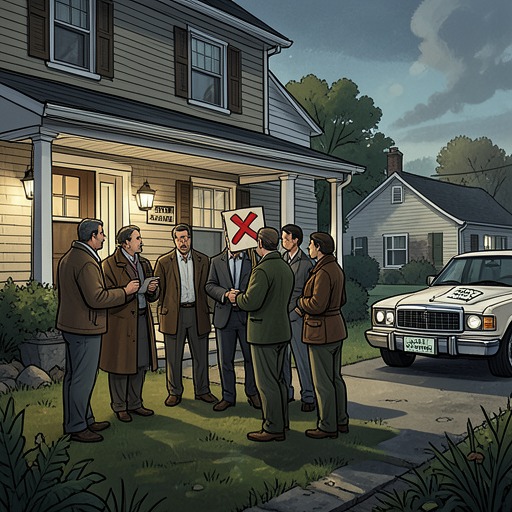
While the man and woman in white shirts are inside Anita and Rune's House, someone parks the trailer so that it blocks the entire road behind their small white car, which bears the Local Council and Administrative Authorities logo. When the pair emerge nearly an hour later, the car is boxed into the cul-de-sac. The narration dryly observes that one could almost think this had been done on purpose; in context, the carefully placed trailer makes the suggestion unmistakable without needing to spell out the maneuver as an explanation.
The obstruction matters because it changes what the officials can do. The trailer does not damage the car or confront its occupants physically; it denies them a clear route out. Its size and placement turn a borrowed piece of equipment into a barrier across the whole road, making an administrative vehicle's mobility depend on the neighbors' actions. One of the white-shirted men immediately approaches Ove and asks, “Have you done this?” The question follows directly from the scene's conspicuous arrangement, though the available passage does not give Ove's answer.
Material Use and Narrative Significance
The trailer's role depends on its physical presence rather than on any explanation of its symbolic meaning. Borrowing it requires Patrick to contact his coworker; using it requires someone to position it across the road; and once parked there, it changes the situation for everyone trying to pass. These ordinary practical conditions make the object consequential. It is not merely remembered as part of a past mishap: it becomes the means by which Ove turns resolve into an effective obstruction.
Its return also links the present action to the neighborhood's longer chronology. Nearly four years after the trailer was backed into Ove's mailbox, Parvaneh wakes one icy November morning, notices that the snow has not been cleared outside Ove's house, and goes to check on him. The timing recalls the move-in accident as a measure of the years that have passed; the passage does not suggest that the trailer itself is present on that later morning. Across those references, it remains a modest object with outsized narrative force: first a marker of an awkward arrival, then the instrument of a deliberate blockade, and finally a point of reference in the time leading to Ove's death.