Railway workshop
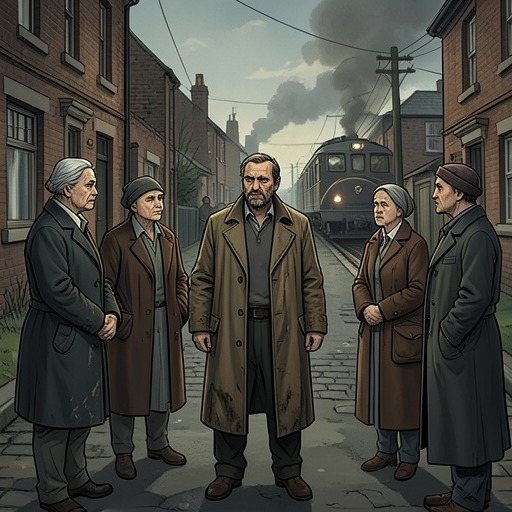
A Man Called OveThe railway yard is more than a workplace in Ove’s life: it is where his father’s example becomes a daily practice, where Ove earns the respect of older railway workers, and where disputes over honesty and loyalty take lasting form. Across its tracks, carriages, and workrooms, the yard connects practical competence with a firm distinction between doing what is right and merely talking about it.
A family connection to railway work
Ove’s father works for the railways, and the workplace is part of the boy’s life from childhood. After Ove’s mother has died, his father takes him to the railway yard after school so he will not be alone at home. The work is dirty and badly paid, but his father regards honest labor as worthwhile. For Ove, this early exposure gives the yard a connection both to employment and to the example of the parent he admires.
That example is visible in how his father handles both work and strength. At a gathering with railway colleagues, Ove sees his slender father defeat much larger men at arm wrestling; afterward, his father cautions him against confusing size with strength. His father does not use violence in the family, either. The yard’s working community therefore enters Ove’s childhood alongside lessons about restraint, fairness, and what a person’s actions reveal.
Learning the work and earning respect
Ove’s own working life develops in the same setting. He works hard, rarely complains, and does not join colleagues for beer after a shift. Some of the older workers find him quiet and odd, but they come to rely on him: when asked to help or cover a shift, he does so without fuss. Their acceptance is practical rather than sentimental, built through repeated evidence that he can be counted on.
One breakdown makes that competence unmistakable. When a truck used on the railway track fails more than ten miles outside town during a severe downpour, Ove repairs it with a screwdriver and half a roll of gauze tape. Afterward, the older track workers consider him all right. The episode condenses his method: he says little, studies the problem, and uses what is available to get the job done. The yard gives that method a community able to recognize its value.
Carriages, lost property, and a test of honesty
The railway carriages also bring Ove into conflict with Tom. When Ove is nine, his father sends him to help Tom clean out a broken-down carriage. Tom finds a passenger’s briefcase and gathers its scattered contents, treating the discovery as something he can keep. Ove, leaving the carriage, notices a wallet on the floor. It is made of soft leather, closes with a small silver button, and contains more than six thousand kronor—a fortune at the time.
The wallet’s value sharpens the choice without changing Ove’s response. Where Tom claims what he has found, Ove does not take the money as his own. The scene establishes the contrast that will recur between them: Tom treats opportunity as permission, while Ove’s sense of right and wrong does not depend on whether anyone is watching. The carriage is not merely a site of railway labor; it is where Ove’s principles are tested in concrete form.
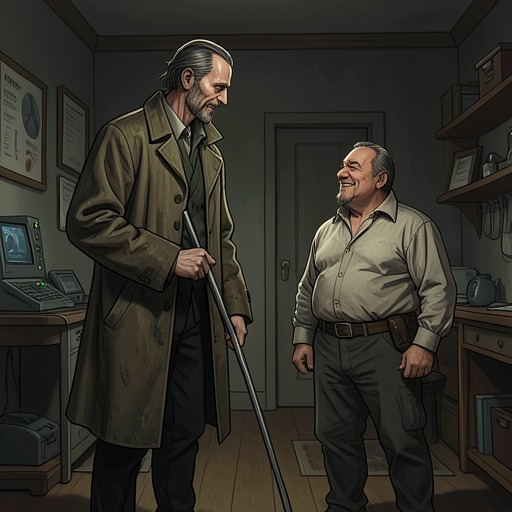
Years later, the yard’s director’s office becomes the setting for another test. Almost two years after his father’s funeral, when Ove has just turned eighteen, Tom is suspected of taking money from a carriage cash box. Ove is the only person who saw him take it, and the two had been alone in the carriage when the money disappeared. The director’s representative recognizes that Ove is not the guilty party, but Tom and Ove are nevertheless called in. Ove waits outside the office, looking at the floor, before being brought in. His silence in this encounter belongs to a longer pattern: he does not readily turn workmates into accusations, even when their conduct puts him in a difficult position.
A workplace marked by conflict and memory
The yard remains a setting for Ove’s unresolved conflict with Tom. In a later confrontation at work, Ove discovers that his father’s watch has gone missing and goes to the foremen’s changing room, where Tom is standing before a mirror. Ove demands the watch back. The episode brings an object inherited from his father into the workplace where their history began: Tom’s earlier conduct in the carriage and the later dispute over the watch meet in the same working relationship.
The yard’s significance rests on this double inheritance. It is where Ove learns a trade and earns trust by repairing what has broken; it is also where he repeatedly has to decide how far loyalty to a fellow worker can coexist with his own standards. The father’s example is present in the work itself—instead of grand declarations, Ove demonstrates reliability by turning up, helping, and solving practical problems. The railway workplace gives that character its daily form, while its carriages and changing rooms provide the settings for the conflicts that test it.